AI Agent Cost Optimization: Cut LLM Spend Smartly
By Delos Intelligence — 2026-08-05
Enterprise LLM spending doubled to $8.4B. Learn 5 proven strategies to reduce AI agent costs by 60%: model routing, prompt caching, token budgets, semantic caching, and batch processing.
The $8.4 Billion Problem Nobody Is Talking About
Enterprise LLM spending doubled to $8.4 billion by mid-2025, with no sign of slowing. Most enterprises overspend on AI agents because they default to the most expensive models for every task — using GPT-4 or Claude Opus to summarize an email, draft a Slack reply, or categorize a support ticket.
This is the equivalent of hiring a senior partner to sort the mail. The task gets done, but the cost is absurd.
A 2025 Gartner study found that 73% of enterprises deploying AI agents have no cost monitoring in place. They know they are spending on AI. They do not know how much per task, per agent, or per outcome. The spend is invisible until the finance team flags it — usually three months too late.
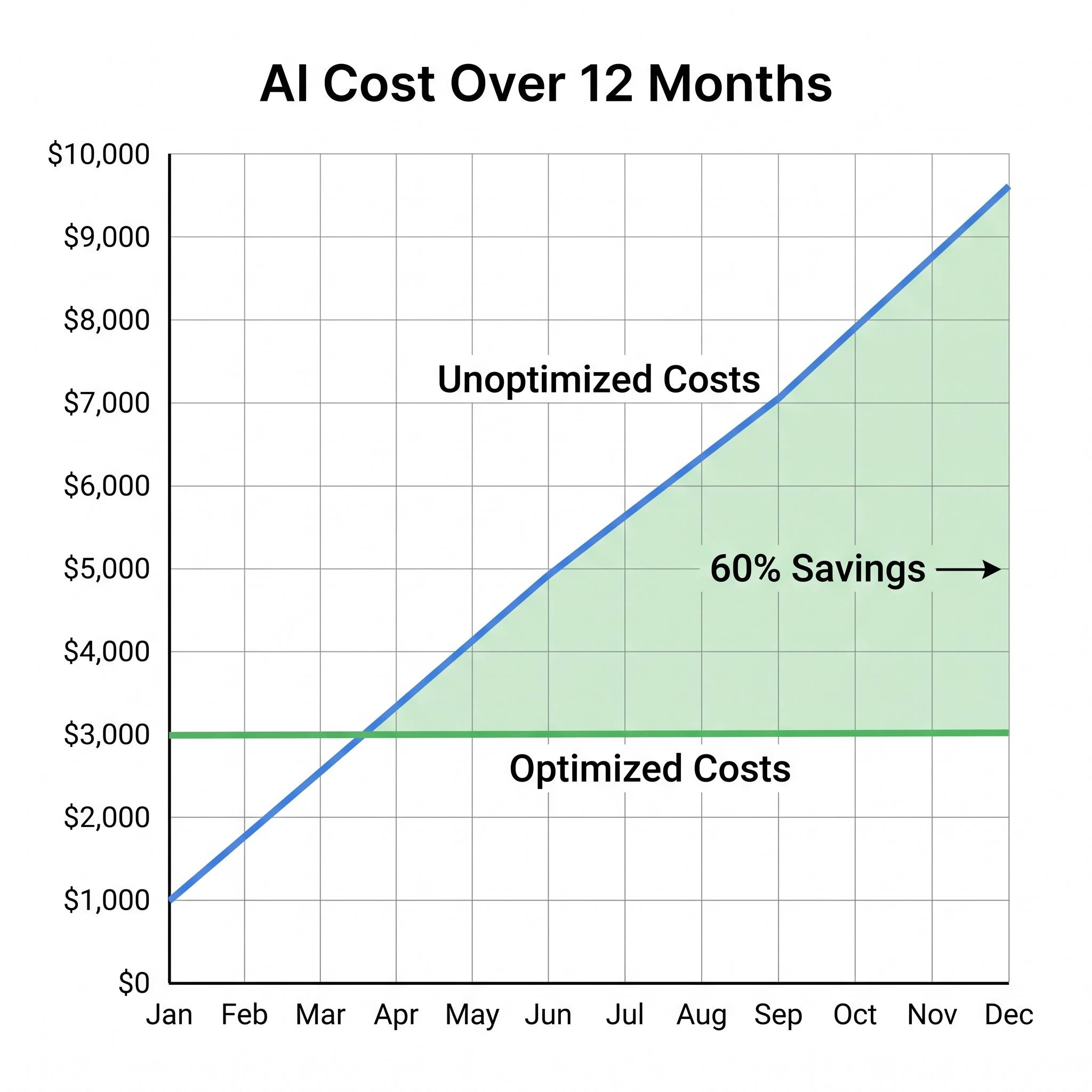
Cost optimization is not about cutting capabilities. It is about spending intelligently. Here are five strategies that reduce AI agent LLM costs by 60% or more without degrading output quality.
The True Cost of AI Agents
Before optimizing, you need to understand what you are actually paying for. The cost of an AI agent is not just the token bill.
Direct costs:
- Token consumption: Input tokens (prompts + context) and output tokens (responses). This is the largest line item — typically 70-80% of total cost.
- API calls: Each LLM call has a per-request overhead. Agents that make 50 small calls cost more than agents that make 5 large ones.
- Model inference: Different models have radically different price points. GPT-4o costs 10x more than GPT-4o-mini per token. Claude Opus costs 15x more than Claude Haiku.
Hidden costs:
- Retries and failed outputs: When an agent hallucinates or produces an error, it retries. Each retry is a full LLM call. Failed outputs can account for 20-30% of total token spend in poorly tuned agents.
- Context bloat: Agents that carry full conversation history into every call pay for the same tokens repeatedly. A 10,000-token context window called 20 times costs 200,000 tokens — just in context.
- Infrastructure: Vector databases, embedding pipelines, and orchestration layers add 15-25% on top of the LLM bill.
The enterprises that control costs do not just negotiate token prices. They architect their agents to use fewer tokens, cheaper models, and cached results.
Strategy 1: Model Routing — The 10x Cost Reduction
The single most effective cost optimization is model routing: sending simple tasks to cheaper models and reserving flagship models for complex reasoning.
!Model routing cost comparison
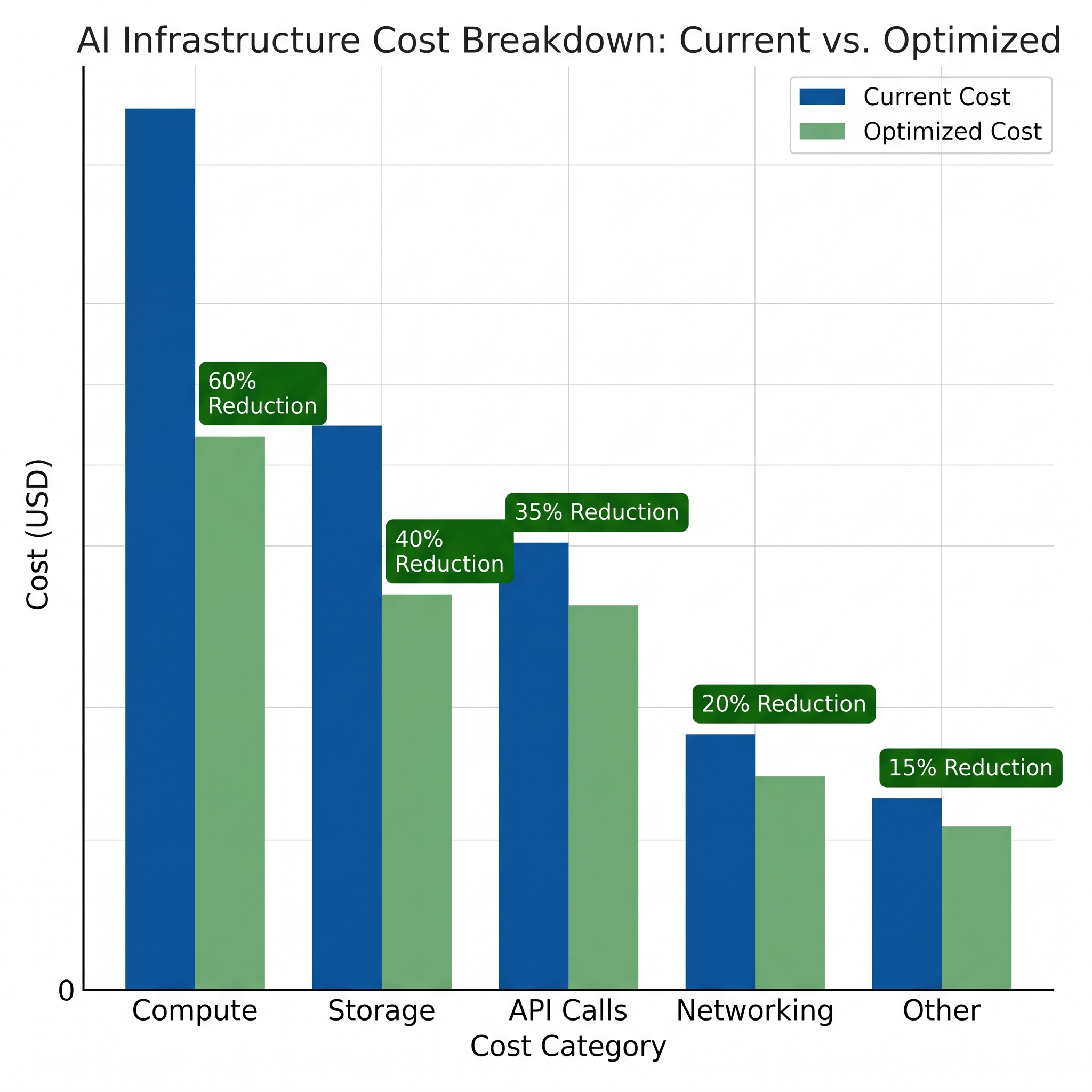
How it works: A routing layer classifies each task by complexity, then directs it to the appropriate model. Simple tasks (summarization, categorization, extraction) go to small models. Complex tasks (multi-step reasoning, code generation, nuanced analysis) go to flagship models.
| Task Type | Model | Cost per 1M tokens | Quality |
|---|---|---|---|
| Email classification | GPT-4o-mini | $0.15 | 97% accuracy |
| Support ticket routing | Claude Haiku | $0.25 | 95% accuracy |
| Content summarization | GPT-4o-mini | $0.15 | 96% accuracy |
| Code generation | GPT-4o | $2.50 | 94% accuracy |
| Multi-step reasoning | Claude Sonnet | $3.00 | 92% accuracy |
| Complex analysis | Claude Opus | $15.00 | 96% accuracy |
Real-world impact: An enterprise that routes 80% of tasks to small models and 20% to flagship models reduces total LLM spend by 65-75% with less than 2% quality degradation. The key insight: most agent tasks are simple. The expensive model is only needed for the hard 20%.
Implementation: Deploy a lightweight classifier (even a rules-based one) that routes tasks based on input complexity signals: input length, task type, required reasoning depth, and historical accuracy data.
Strategy 2: Prompt Caching and Context Optimization
Every token in your prompt costs money. Most enterprises pay for the same tokens hundreds of times.
System prompt caching: If your agent has a 2,000-token system prompt that does not change between calls, cache it. OpenAI and Anthropic both support prompt caching — the cached portion is charged at 50% of the normal input rate. For agents with large system prompts, this alone cuts input token costs by 30-40%.
Context window compression: Instead of passing full conversation history, compress it. A 50-message conversation can be summarized into a 500-token context block that preserves the essential information. This reduces context cost by 90% for long-running agents.
Dynamic context selection: Not all context is relevant to every call. An agent handling a billing question does not need the customer's support history from six months ago. Implement relevance scoring to include only the top-k most relevant context chunks.
Quantified impact:
- System prompt caching: 30-40% input cost reduction
- Context compression: 60-80% context cost reduction
- Dynamic context selection: 40-60% further reduction on long conversations
Combined, these three techniques can reduce total token consumption by 50-65% without touching the model or the task logic.
Strategy 3: Token Budget Management
Without explicit budgets, agents consume tokens freely. A single runaway agent can spend more in an hour than 50 well-tuned agents spend in a day.
Per-task token caps: Set a maximum token budget per task. If an agent exceeds the cap, it stops and returns a partial result or escalates to a human. This prevents the most common cost failure mode: an agent stuck in a retry loop, burning tokens on the same failing task.
Circuit breakers: If an agent's cost-per-task exceeds 3x its historical average, pause the agent and alert the operations team. This catches regressions early — before a misconfigured tool or a model update causes a 10x cost spike.
Real-time spend monitoring: Track token consumption per agent, per task type, and per workflow. A simple dashboard showing daily spend by agent is enough to catch 80% of cost issues before they hit the monthly bill.
Budget tiers:
- Tier 1 (low-risk tasks): 500 tokens per task, auto-approve
- Tier 2 (medium-risk): 2,000 tokens per task, auto-approve with monitoring
- Tier 3 (high-risk): 5,000 tokens per task, requires human approval above budget
- Global cap: Daily maximum across all agents, alerts at 80% and 95% utilization
Strategy 4: Semantic Caching — Stop Paying for the Same Answer Twice
If your support agent answers "How do I reset my password?" 50 times per day, you are paying for 50 LLM calls that produce nearly identical responses.
!Semantic caching architecture
Semantic caching stores LLM responses indexed by the semantic meaning of the query, not the exact string. When a new request comes in, the cache checks if a semantically similar query was answered recently. If yes, it returns the cached response — no LLM call needed.
How it works:
1. Embed the incoming query using a cheap embedding model (cost: ~$0.0001 per query)
2. Search the cache for similar embeddings above a similarity threshold (typically 0.92+)
3. If found, return the cached response
4. If not found, make the LLM call, cache the response with the embedding
Cost impact: For enterprises with repetitive query patterns (support, internal Q&A, document processing), semantic caching eliminates 30-50% of LLM calls. The cache hit rate is highest for customer-facing agents where 60-70% of queries are variations of the same 20 questions.
Quality safeguard: Set a TTL (time-to-live) on cached responses — 24 hours for factual queries, 7 days for evergreen content. Include a confidence score and fall back to the LLM if the similarity is below threshold.
Strategy 5: Batch Processing and Async Workflows
Not every task needs to be processed in real-time. Batch processing groups similar requests and processes them together, reducing per-request overhead and enabling bulk pricing.
Batch API usage: OpenAI's Batch API offers 50% off standard pricing for requests processed within 24 hours. For non-urgent tasks — report generation, content moderation, data enrichment — this is a pure 50% cost reduction with zero quality impact.
Async workflows: Move non-urgent work to off-peak hours. LLM providers may offer lower rates during low-demand periods. More importantly, async processing allows you to use cheaper, slower models that produce the same quality but take longer — a trade-off that is invisible to the end user for non-real-time tasks.
Request grouping: Instead of processing 100 support tickets individually, batch them into groups of 10 and process each group in a single LLM call with a structured output format. This reduces API overhead and allows the model to share context across related tickets.
Quantified impact:
- Batch API: 50% cost reduction on non-urgent tasks
- Request grouping: 20-30% reduction in API overhead
- Async scheduling: 10-15% additional savings on off-peak rates
Measuring ROI After Optimization
Cost optimization without quality measurement is dangerous. You need to verify that cheaper does not mean worse.
Three metrics to track:
1. Cost per task: Total LLM spend divided by tasks completed. Target: 40-60% reduction after implementing all five strategies.
2. Cost per outcome: Spend divided by successful outcomes (not just completed tasks — tasks that produced a usable result). This accounts for quality loss from cheaper models.
3. Quality-adjusted cost: (Cost per task) / (Quality score). If cost drops 60% but quality drops 10%, your quality-adjusted cost still improved by 56%. If quality drops 30%, the optimization was net-negative.
The framework:
- Baseline: Measure cost-per-task and quality score for 2 weeks before optimization
- Optimize: Implement one strategy at a time, measure impact over 1 week each
- Validate: After all strategies are live, compare cost-per-outcome and quality-adjusted cost to baseline
- Monitor: Set up continuous monitoring with alerts for quality regression
Implementation Roadmap
Days 1-30: Model routing + prompt caching. These two strategies deliver 50-60% cost reduction with minimal engineering effort. Deploy a routing classifier, enable prompt caching on your system prompts, and measure the impact. Most enterprises see ROI within the first week.
Days 31-60: Token budgets + semantic caching. Implement per-task token caps and circuit breakers. Deploy a semantic cache for your most repetitive query patterns. These strategies require more engineering but deliver the next 20-30% cost reduction.
Days 61-90: Batch processing + continuous monitoring. Move non-urgent tasks to batch APIs. Set up real-time spend dashboards and quality regression alerts. By day 90, your total cost should be 60-70% lower than baseline with less than 5% quality degradation.
The Bottom Line
AI agent cost optimization is not a one-time exercise. It is a continuous discipline — the same as performance monitoring or security auditing. Models change, pricing changes, task patterns evolve. The organizations that build cost optimization into their agent architecture from day one are the ones that scale without finance becoming the bottleneck.
Start with model routing. It is the single highest-ROI change you can make. Then layer in caching, budgets, and batch processing over the following 60 days. By the end of the quarter, you will have cut LLM spend by 60% — and your agents will be just as capable as they were at full price.