AI-Powered Asset Management: How Enterprises Track and Optimize Physical Assets in Real Time
By Delos Intelligence — 2026-08-06
AI-powered asset management helps enterprises cut maintenance costs by 40%, boost utilization from 58% to 89%, and save $2.3M annually through predictive maintenance and real-time IoT monitoring.
The Problem with Manual Asset Management
Enterprise assets, servers, manufacturing equipment, vehicles, medical devices, HVAC systems, represent millions in capital expenditure. Yet most enterprises track them on spreadsheets, rely on scheduled maintenance calendars that ignore actual equipment health, and discover failures only after they cause downtime.
The numbers are stark. The average enterprise has asset utilization rates of just 58%, meaning 42% of capital assets sit idle or underperform at any given time. Unplanned equipment failures cost an average of $260,000 per hour in manufacturing. And manual asset audits, typically conducted quarterly, leave months-long blind spots between inspections.
AI-powered asset management closes these gaps by providing real-time visibility, predictive maintenance, and utilization optimization across the entire asset portfolio.
How AI Transforms Enterprise Asset Management
Real-Time Asset Visibility
AI asset management platforms connect to physical assets via IoT sensors that track location, performance metrics, utilization rates, environmental conditions, and operational status continuously. Unlike barcode scanning or RFID systems that require human interaction, IoT-connected assets report their status automatically every few seconds.
The result is a live digital twin of every physical asset in the enterprise. A facilities manager can see, in real time, that HVAC unit 7B in Building C is running at 94% capacity in a room that is currently empty, and immediately redirect the cooling elsewhere. A logistics director can see that 23 vehicles in the fleet have not moved in 48 hours and are due for redeployment.
Predictive Maintenance
The highest-value application of AI in asset management is predictive maintenance. Instead of scheduled maintenance (do it every 90 days regardless of equipment health) or reactive maintenance (fix it after it breaks), AI-powered predictive maintenance analyzes sensor data to identify early signs of equipment degradation before failures occur.
Machine learning models trained on thousands of equipment failure patterns can detect subtle anomalies: a motor vibrating at an unusual frequency, a bearing temperature rising 2 degrees above its normal range, a pump drawing slightly more current than usual. Each of these signals, individually insignificant, predicts a failure 7 to 21 days away when interpreted by the AI.
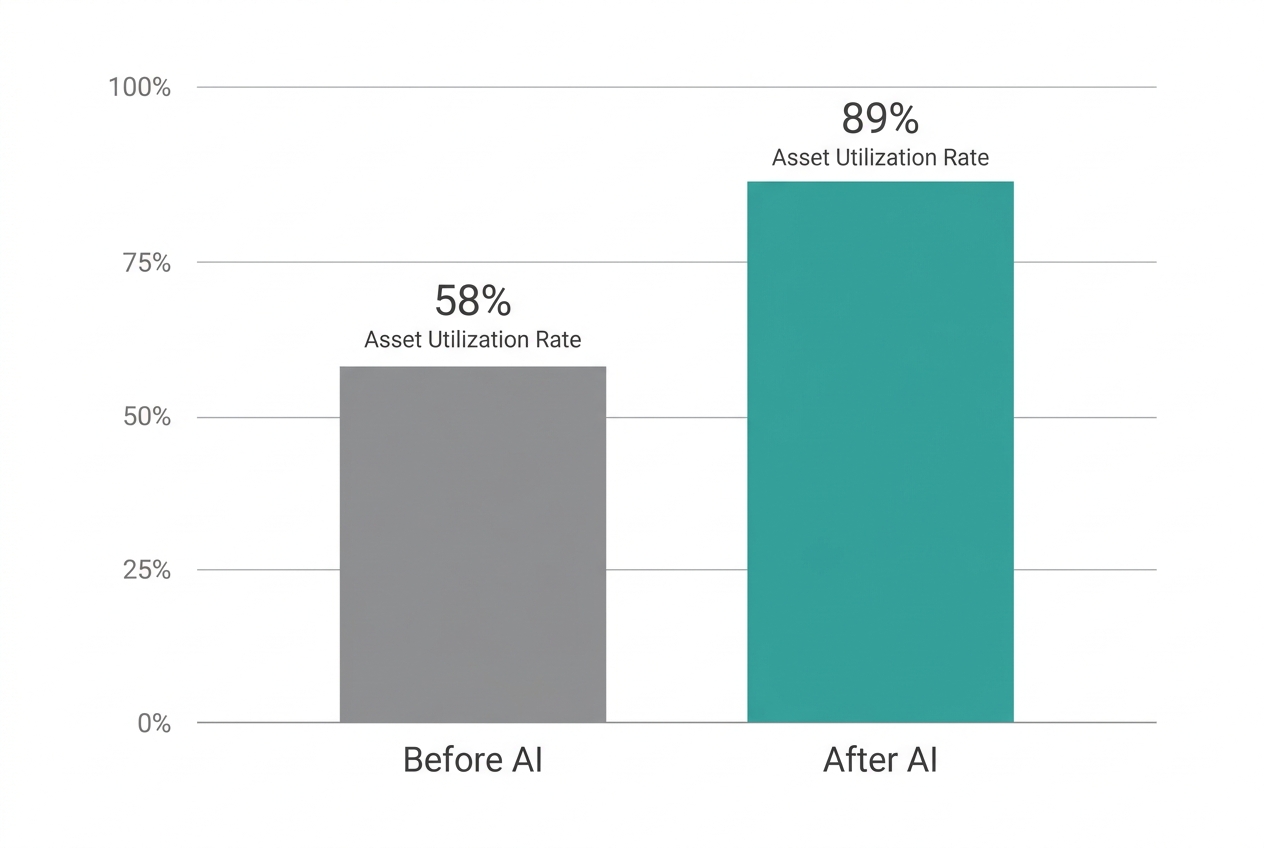
!Asset Utilization Rate Improvement: Before and After AI
Enterprises implementing predictive maintenance report a 45% reduction in unplanned downtime and a 30% reduction in maintenance costs. Maintenance teams shift from reactive firefighting to planned interventions, scheduled during off-peak hours for minimal disruption.
Utilization Optimization
Beyond maintenance, AI analyzes asset utilization patterns to identify underused assets, optimization opportunities, and consolidation potential. A company with 200 company vehicles might discover, through AI analysis, that 40 vehicles are used less than 4 hours per day and could be replaced by a smaller fleet with dynamic scheduling.
For manufacturing equipment, AI identifies underutilized capacity windows that can be filled with additional production runs. For real estate, it identifies offices that are consistently empty and could be decommissioned or repurposed.
The impact on utilization rates is dramatic. Enterprises using AI asset optimization report average utilization rate improvements from 58% to 89%, a 53% increase in productive asset time.
The Financial Case: ROI of AI Asset Management
For a mid-size enterprise with $50M in physical assets:
- Downtime reduction: Cutting unplanned downtime by 45% saves an average of $1.1M annually in production losses and emergency maintenance costs
- Maintenance optimization: Shifting from scheduled to predictive maintenance reduces maintenance spend by 30%, saving approximately $600K per year
- Utilization improvement: Increasing utilization from 58% to 89% generates $800K in additional productive value from existing assets, reducing capital expenditure needs
- Asset lifecycle extension: Better maintenance and monitoring extends average asset lifecycle by 20%, deferring $300K in annual replacement costs
Total annual savings for a mid-size enterprise: $2.3M to $2.8M, against an AI platform investment of $150K to $300K per year. ROI payback in under 3 months.
Implementation Roadmap
Phase 1 (Weeks 1-4): Asset Inventory and IoT Deployment
Conduct a complete asset inventory. Identify the 20% of assets that represent 80% of value and risk. Deploy IoT sensors on these high-priority assets first. Focus on assets where downtime is most costly.
Phase 2 (Weeks 5-8): Data Integration and Baseline Modeling
Integrate sensor data with ERP, CMMS (computerized maintenance management system), and procurement data. Establish baseline performance metrics for each asset category. Begin training predictive models on historical maintenance and failure data.
Phase 3 (Weeks 9-12): Predictive Maintenance Pilot
Run predictive maintenance alerts in parallel with the existing maintenance schedule for 4 weeks. Compare AI-predicted maintenance needs against actual equipment condition. Validate model accuracy and adjust thresholds.
Phase 4 (Months 4-6): Full Deployment
Expand IoT connectivity to the full asset portfolio. Activate utilization optimization recommendations. Integrate AI asset management with procurement workflows for automated reorder triggers and lifecycle planning.
What to Look for in an AI Asset Management Platform
The critical capabilities to evaluate: real-time sensor integration (supporting multiple IoT protocols), predictive analytics accuracy (ask for validation data from comparable deployments), ERP and CMMS integration (it must connect to your existing systems), and explainability (when the AI flags a maintenance need, it should explain why).
Avoid platforms that provide only dashboards without actionable recommendations. The value of AI asset management is not better visibility into the past. It is better decisions about the future.
This article was written with AI assistance.