AI Clinical Trial Matching: Accelerate Patient Recruitment by 60%
By Delos Intelligence — 2026-08-19
80% of clinical trials miss enrollment timelines. AI-powered patient matching identifies 3x more eligible candidates, cuts screen failure by 40%, and saves $1.2M per trial.
The Patient Recruitment Crisis in Clinical Trials
Clinical trials are the backbone of modern medicine — and they are failing at the first hurdle. Patient recruitment accounts for 30-40% of total trial duration, and 80% of trials fail to meet enrollment timelines. The consequence: drug development delays of 1-5 years per trial, costing biopharma companies an average of $8 million per day for late-stage trials.
The core problem is matching. The average Phase III trial has 20-30 eligibility criteria. Identifying patients who meet all of them requires searching across fragmented EHR systems, genomic databases, lab results, and medical histories — a process that, done manually, takes weeks per patient and misses 60-70% of eligible candidates.
AI-powered clinical trial matching changes this equation entirely.
How AI Clinical Trial Matching Works
AI matching systems use natural language processing (NLP), machine learning, and structured data extraction to automate the patient-to-trial matching process at scale.
Step 1: Protocol Parsing
The AI ingests the trial's inclusion/exclusion criteria — typically written in dense clinical language — and converts them into structured, queryable logic. A criterion like "ECOG performance status 0-1, confirmed HER2-positive breast cancer with prior anthracycline-based therapy" becomes a multi-variable query that can be executed against patient records.
Modern NLP models achieve 94-97% accuracy in parsing complex eligibility criteria, including negations ("no prior EGFR inhibitor treatment"), time-bound conditions ("diagnosis within the past 24 months"), and lab value thresholds.
Step 2: Patient Record Analysis
The system continuously analyzes EHR data — diagnoses, lab results, medications, genomic markers, imaging reports — to build a structured patient profile that can be matched against trial criteria.
This includes:
- Structured data extraction from coded fields (ICD-10 diagnoses, LOINC lab codes, RxNorm medications)
- Unstructured text mining from clinical notes, discharge summaries, and radiology reports
- Genomic data integration from NGS panels and molecular pathology reports
- Longitudinal tracking that updates patient eligibility status as new data arrives
Step 3: Real-Time Matching and Ranking
Patients are scored against each trial's criteria, with the AI ranking candidates by eligibility confidence and clinical fit. Recruiters see a ranked list with the evidence trail — which data points support or contradict each eligibility criterion — enabling rapid human review.
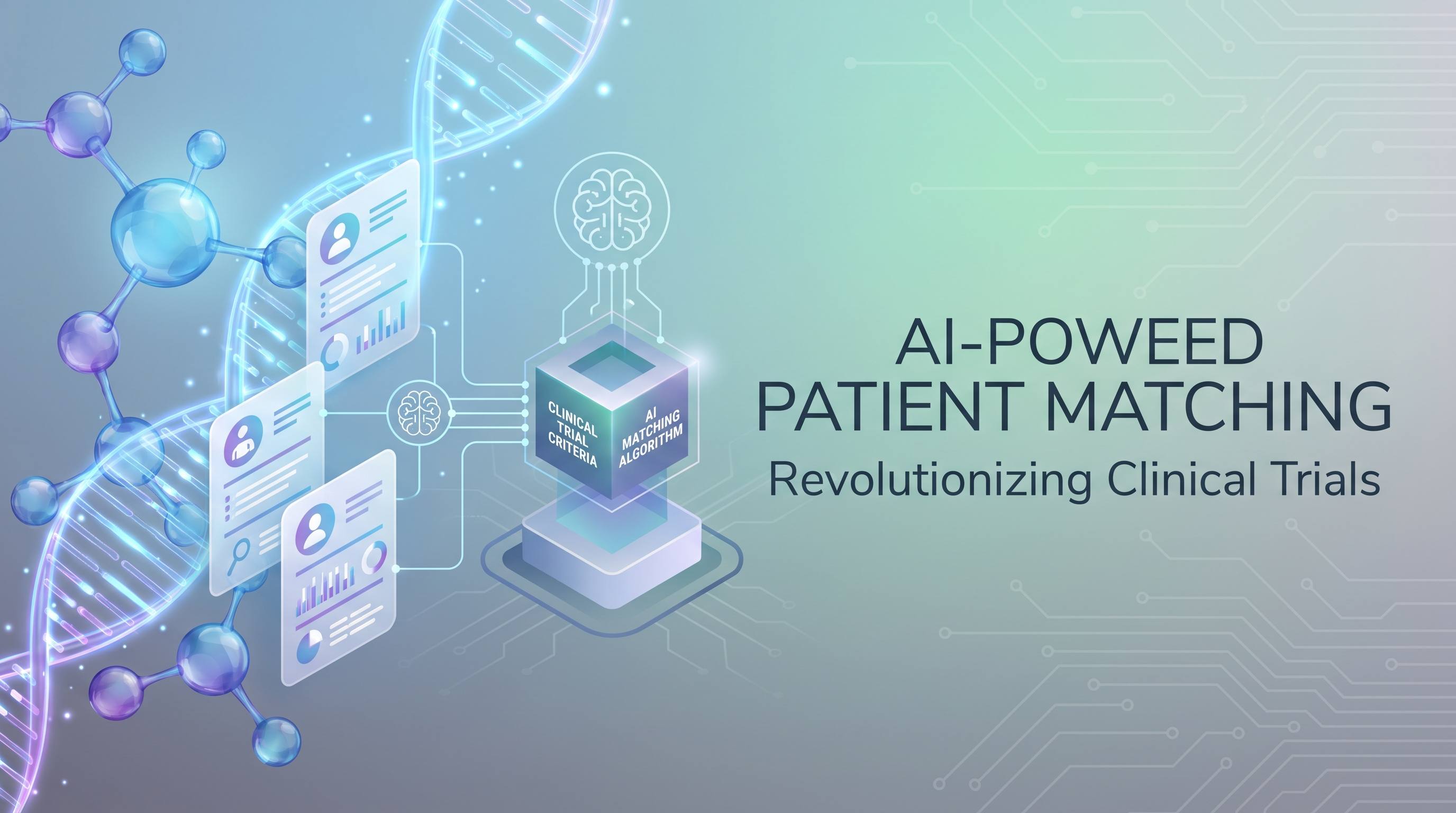
!AI Clinical Trial Matching Workflow
The Numbers: What AI Matching Delivers
The evidence base for AI-powered trial matching has matured significantly in 2025-2026:
- 60% faster patient recruitment compared to manual site-based screening (FDA Digital Health Center of Excellence, 2025)
- 3x more eligible patients identified per site due to comprehensive EHR screening vs. opportunistic recruitment
- 40% reduction in screen failure rates from better pre-screening accuracy
- $1.2M average savings per trial from reduced recruitment delays (Tufts CSDD, 2026)
- 2.4x improvement in diversity metrics as AI surfaces eligible patients regardless of whether they self-present
Sites using AI matching at major academic medical centers have reported screening 10x more patients in the same time period, with screen failure rates dropping from 45% to 18%.
The Five Components of an Enterprise AI Matching Platform
1. EHR Integration Layer
Production-grade AI matching requires deep integration with the site's EHR system — Epic, Cerner, Meditech, or others. This means certified FHIR API connections that pull real-time patient data, not monthly exports.
The integration must handle:
- Real-time data feeds for newly eligible patients
- Historical record analysis for retrospective screening
- Multi-site deployments with different EHR instances
- Data normalization across coding systems (ICD-9/10, SNOMED, LOINC)
2. NLP Engine for Unstructured Data
40-60% of clinically relevant information lives in unstructured clinical notes. A matching system that only reads coded fields misses the majority of the signal.
Enterprise NLP engines must handle:
- Clinical abbreviations and shorthand ("s/p CABG," "DM2 w/ CKD stage 3")
- Negation detection ("no history of MI," "denies chest pain")
- Temporal expressions ("started metformin 6 months ago," "three prior lines of therapy")
- Contextual understanding ("family history of BRCA1 mutation" vs. personal history)
3. Protocol Intelligence Engine
The protocol parser must handle the full range of trial eligibility language, including:
- Derived criteria that require calculation (eGFR < 60 mL/min/1.73m²)
- Biomarker criteria requiring genomic data (KRAS wild-type, PD-L1 ≥ 50%)
- Historical treatment criteria (no prior platinum-based therapy)
- Relative timeframes (within 6 months of diagnosis)
4. Coordinator Workflow Interface
The matching output must integrate into the coordinator's workflow, not create a parallel system. This means:
- Pre-built integrations with CTMS platforms (Medidata, Veeva, Oracle)
- Ranked patient lists with one-click access to supporting evidence
- Automated pre-screening forms that pull AI-identified data into IRB-approved questionnaires
- Audit trails for regulatory compliance
5. Compliance and Privacy Architecture
Clinical trial matching operates under FDA, EMA, HIPAA, and GDPR constraints. The platform must:
- Maintain patient de-identification for multi-site analytics
- Provide audit trails for all data access and matching decisions
- Support IRB-specific data access protocols
- Enable patient consent workflows integrated into the matching process
Implementation Roadmap
Phase 1: Single-Site Pilot (Months 1-3)
Connect to one EHR instance, configure matching for 2-3 active trials, and measure screen failure rate vs. historical baseline. Most sites see measurable improvement within 60 days.
Phase 2: Protocol Library Expansion (Months 3-6)
Expand to all active trials at the site. Build the protocol parsing library and validate matching accuracy through parallel manual screening for 30 days.
Phase 3: Multi-Site Deployment (Months 6-12)
Roll out to additional sites in the network. Implement centralized analytics to identify which sites have the highest concentration of eligible patients for each trial.
Phase 4: Proactive Recruitment (Months 9-12)
Flip from reactive (screen patients for active trials) to proactive (alert sites when a patient becomes eligible as their condition evolves). This requires longitudinal EHR monitoring with automated alerts.
ROI Calculation
For a mid-size biopharma running 8 trials simultaneously with an average Phase II/III cost of $15M:
| Benefit | Annual Value |
|---|---|
| Recruitment timeline reduction (90 days average) | $720K per trial |
| Screen failure reduction (40%) | $180K per trial |
| Staff time savings (40 hours/month per coordinator) | $48K per coordinator |
| Total annual value (8 trials, 4 coordinators) | $6.1M+ |
Platform cost: $200K-$500K annually. Payback period: 2-4 months.
The Bottom Line
AI-powered clinical trial matching is not a future technology — it is a present competitive advantage. The biopharmas that implement it now are recruiting faster, failing less at screening, and building the data infrastructure that will accelerate every trial they run for the next decade.
The technology is proven, the ROI is clear, and the regulatory framework is supportive. The barrier is implementation will and integration investment, not capability.