AI Code Review: How Enterprises Catch 40% More Bugs Before Production (And Why 58% Still Rely on Manual Reviews)
By Delos Intelligence — 2026-07-18
Production bugs cost $1.7M on average. AI code review catches 40% more bugs, cuts review time by 70%, and costs $0.50-2 per PR. Learn the 6-step rollout plan.
The $1.7 Million Bug
The average cost of a production bug is $1.7 million — when you factor in remediation, lost revenue, reputational damage, and customer churn. IBM's research shows that bugs caught in code review cost 10x less to fix than bugs caught in testing, and 100x less than bugs caught in production.
Yet 58% of enterprise engineering teams still rely on manual-only code review. You know, the process where an overworked senior developer scans a 500-line pull request at 6 PM on a Friday, misses a subtle SQL injection vulnerability, and approves it because it "looks fine."
AI code review catches what humans miss, every time, in seconds.
How AI Code Review Works
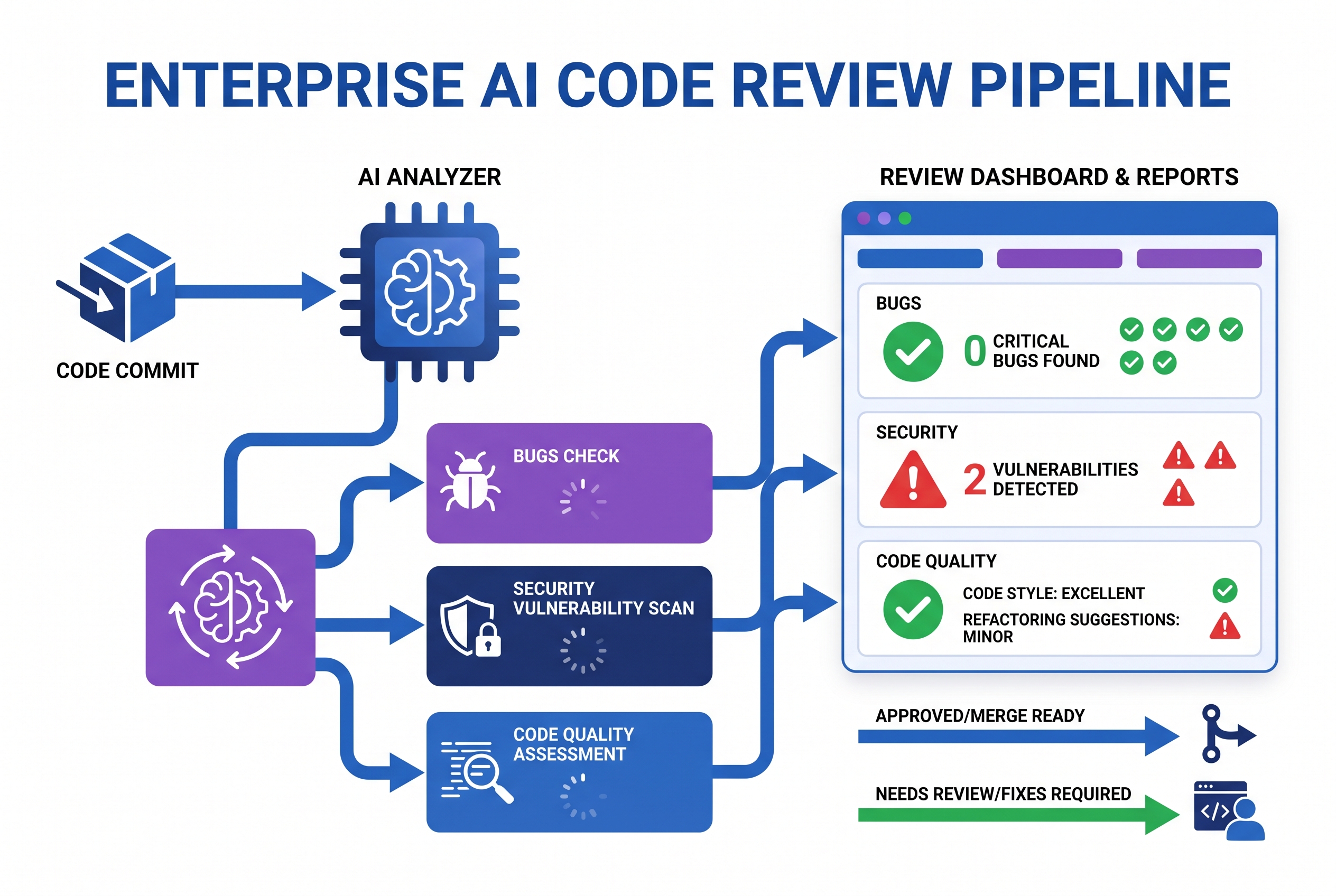
Layer 1: Static Analysis at Scale
The AI reads the entire diff — not line-by-line, but with full context of the codebase, coding standards, and historical patterns. It understands that a function named `processPayment` in `checkout.js` has different security implications than a utility function in `utils.js`.
Layer 2: Pattern Detection
Trained on millions of open-source repositories and vulnerability databases (CVE, NVD, OWASP), the AI recognizes patterns that lead to bugs: off-by-one errors, null reference risks, race conditions, insecure crypto usage, and the 200+ vulnerability classes in the OWASP Top 10.
Layer 3: Security Vulnerability Scanning
The AI cross-references every code change against known vulnerability signatures. It catches SQL injection, XSS, CSRF, insecure deserialization, hardcoded credentials, and path traversal — before they reach production.
Layer 4: Style and Convention Enforcement
Beyond bugs and security, the AI enforces your team's coding standards: naming conventions, file structure, comment requirements, test coverage thresholds. This eliminates the style debates that waste review time.
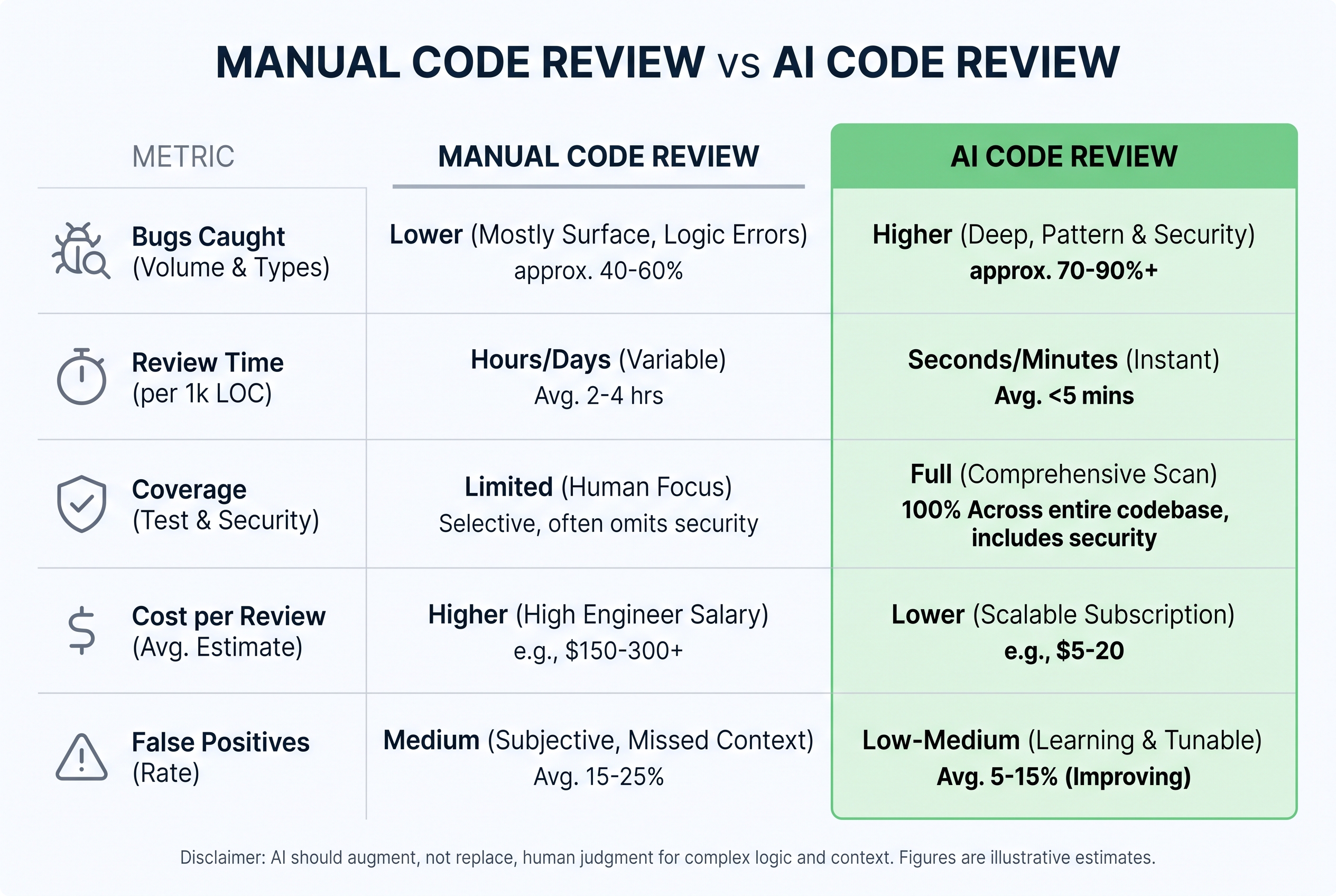
Manual vs AI Code Review
| Dimension | Manual Review | AI Code Review |
|-----------|---------------|----------------|
| Speed | 30-60 min per PR | 10-30 seconds |
| Coverage | 60-70% of lines | 100% of lines |
| Consistency | Varies by reviewer | Identical every time |
| Security focus | Depends on expertise | OWASP Top 10 always |
| False positives | Low (5-10%) | Medium (15-25%, tunable) |
| Cost | $45-90 per review | $0.50-2 per review |
| Availability | Business hours | 24/7 |
| Scalability | Linear with team | Instant |
The 6-Step Rollout Plan
Step 1: Baseline Your Current Review Metrics (Week 1)
Measure your current review cycle time, defect escape rate, and reviewer workload. You need a baseline to measure improvement against.
Step 2: Choose Your Tool (Week 2)
Evaluate tools based on your tech stack, CI/CD pipeline, and security requirements. GitHub Copilot, SonarQube, Snyk Code, and CodeRabbit all integrate differently.
Step 3: Run in Shadow Mode (Week 3-4)
Deploy the AI in observation mode — it reviews every PR but doesn't post comments. Compare its findings against human reviewer findings. Measure detection rate and false positive rate.
Step 4: Enable AI Comments (Week 5-6)
Turn on AI review comments on PRs. Start with severity "high" and "critical" only. Let developers see the AI's suggestions alongside human review.
Step 5: Integrate with CI/CD (Week 7-8)
Make AI review a CI/CD checkpoint. PRs can't merge until the AI approves (or a human overrides). This ensures every PR gets reviewed, even when human reviewers are busy.
Step 6: Tune and Optimize (Week 9+)
Adjust false positive thresholds, add custom rules for your codebase, and train the AI on your historical bug patterns. The system improves over time.
CI/CD Integration
AI code review becomes most powerful when integrated into your CI/CD pipeline:
- Pre-commit hooks: Catch issues before the PR is even created
- PR-level review: AI comments appear as soon as the PR is opened
- Merge gate: AI approval required before merge (with human override)
- Post-merge monitoring: AI continues to analyze merged code for regressions
Why 58% Still Rely on Manual Reviews
1. False Positive Concerns
Teams worry that AI will flood PRs with noise. Reality: modern tools have 15-25% false positive rates, tunable down to 5-10%. Start strict, loosen over time.
2. "AI Can't Understand Context"
True — AI doesn't understand business logic. But it catches the 80% of issues that are pattern-based: security vulnerabilities, style violations, common bug patterns. Let humans focus on the 20% that requires context.
3. Tool Fragmentation
Enterprises have existing toolchains. Adding another tool feels like overhead. Reality: modern AI review tools integrate with GitHub, GitLab, Bitbucket, Jenkins, and CircleCI in minutes.
4. Developer Resistance
Developers sometimes feel AI review is "surveillance." Frame it correctly: AI review is a safety net, not a performance monitor. It catches mistakes before they become incidents.
The Bottom Line
A single production bug costs $1.7 million. AI code review costs $0.50-2 per PR. The math is straightforward. The 42% of enterprises that have adopted AI code review are catching 40% more bugs, cutting review time by 70%, and shipping faster with fewer incidents.
The 58% still relying on manual-only review are one bad PR away from a $1.7 million lesson.