AI-Powered Customer Lifetime Value Prediction: How Enterprises Boost Revenue by 62% with Predictive Analytics
By Delos Intelligence — 2026-08-13
Most companies still estimate customer lifetime value using simple formulas. AI-powered CLV prediction changes this by analyzing hundreds of variables in real time, delivering a 62% improvement in revenue per customer.
Why 73% of Enterprises Cannot Predict Customer Value Accurately
Most companies estimate customer lifetime value using simple formulas. AI-powered CLV prediction changes this by analyzing hundreds of variables: purchase history, browsing behavior, support interactions, demographic data, seasonal patterns, and macroeconomic indicators. The result is a dynamic, continuously updated CLV score for every individual customer.
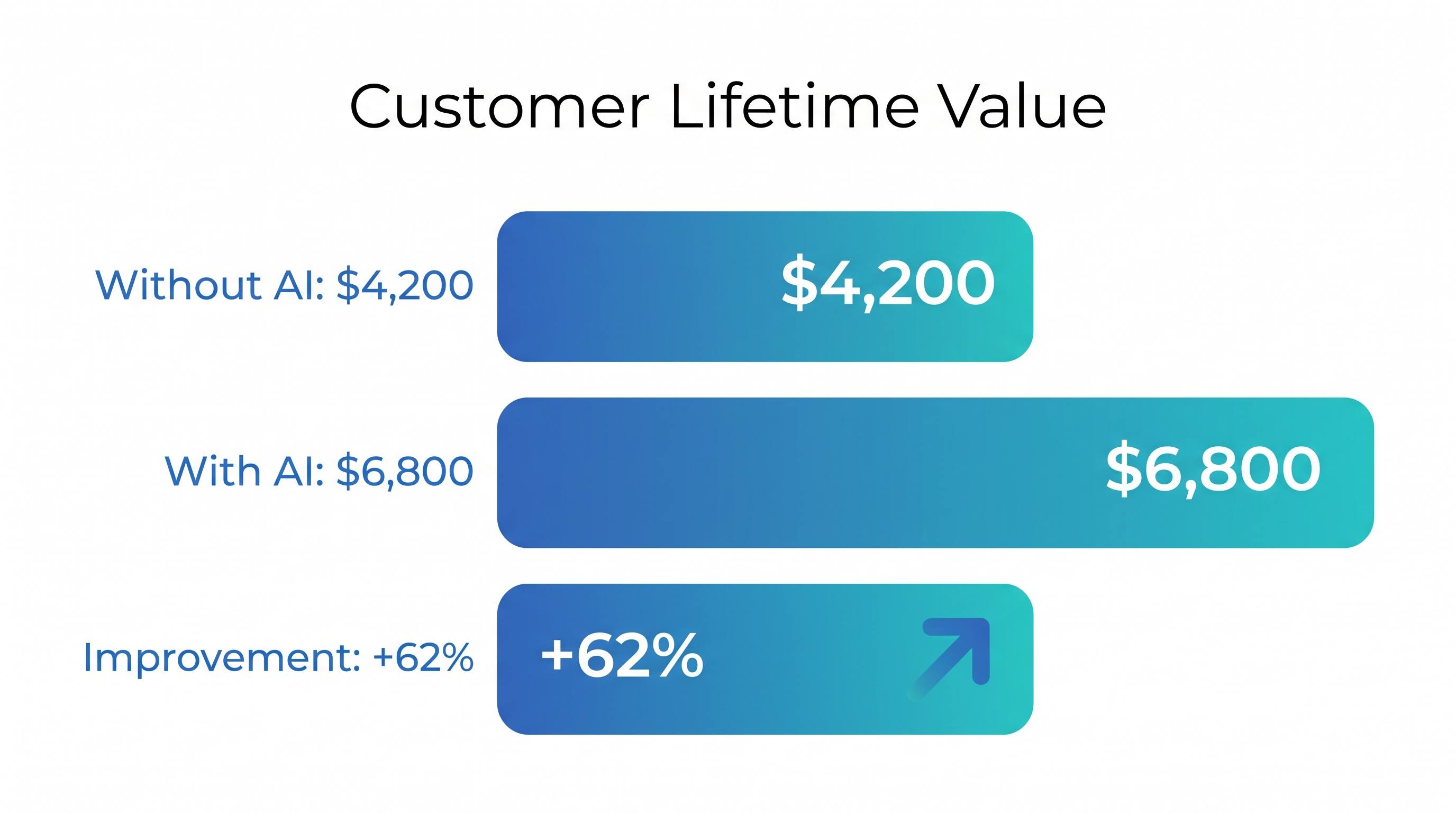
When you mispredict customer lifetime value, the consequences cascade: misallocated acquisition spend, wasted retention budget, and inaccurate revenue forecasts that miss the mark by 30-40%. A 2025 McKinsey study found that enterprises using AI-driven CLV models saw a 62% improvement in revenue per customer compared to those using traditional methods.
How AI-Powered CLV Prediction Works
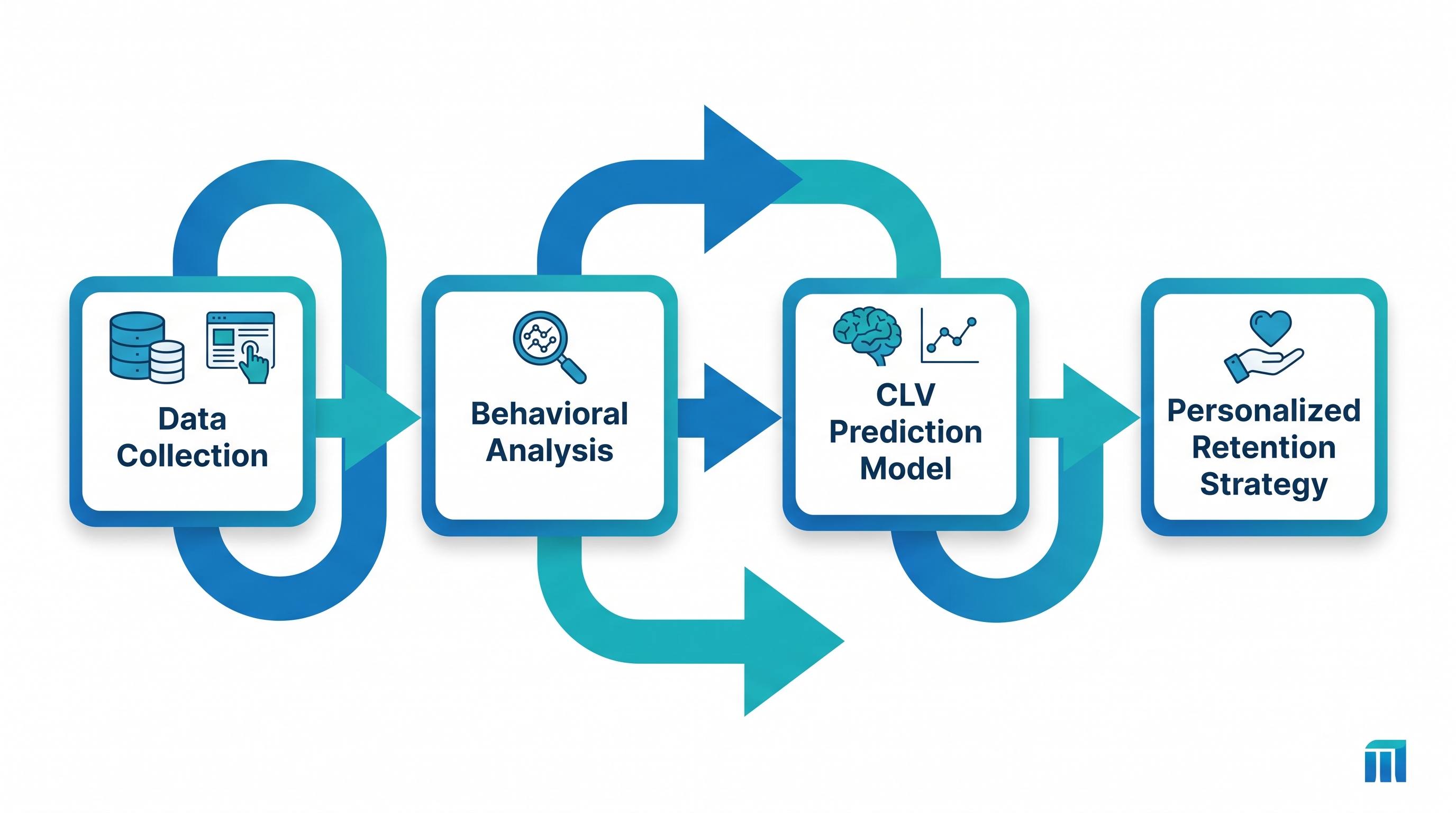
The AI approach replaces static formulas with dynamic machine learning models that learn from every customer interaction.
Data Inputs That Matter
Modern CLV models ingest and correlate:
1. Transactional data: Purchase frequency, order value, product mix, return rates
2. Behavioral signals: Website browsing patterns, email engagement, app usage frequency
3. Service interactions: Support ticket volume, resolution time, satisfaction scores
4. External factors: Seasonality, market trends, competitive activity, economic indicators
Model Architectures
The most effective CLV prediction systems use gradient boosting models for tabular transactional data, recurrent neural networks for sequential behavioral patterns, survival analysis models to predict churn probability, and ensemble methods that combine multiple model outputs for robustness.
5 Enterprise Use Cases for AI-Powered CLV Prediction
1. Precision Customer Segmentation
Instead of segmenting customers by demographic categories, AI clusters them by predicted lifetime value trajectory. A telecommunications company used this to identify a segment of customers currently spending $30/month but predicted to reach $200/month within 18 months. They redirected retention efforts and saw a 34% reduction in churn among high-potential accounts.
2. Optimized Acquisition Channel Mix
When you know the predicted CLV of customers acquired through each channel, you can shift budget toward channels that bring high-value customers. A SaaS enterprise discovered that their lowest-volume channel produced customers with 3.2x the CLV of their highest-volume channel. They reallocated 40% of acquisition budget and increased overall portfolio CLV by 28%.
3. Personalized Retention Interventions
AI predicts not just whether a customer will churn, but when and why. A retail bank implemented targeted interventions and reduced churn among high-CLV customers by 41%.
4. Dynamic Pricing and Offer Optimization
When you know a customer predicted CLV, you can make smarter pricing decisions. An e-commerce platform used AI-driven CLV to personalize first-order discounts and saw a 19% increase in 12-month customer value.
5. Product Recommendation Engine Enhancement
CLV-aware recommendation engines suggest what will maximize long-term value. A streaming service integrated CLV predictions and saw a 23% increase in average subscription duration.
Implementation Roadmap
Phase 1: Data Foundation (Weeks 1-4)
Consolidate customer data from CRM, transactional, and behavioral systems. Clean and standardize data schemas. Establish baseline CLV using traditional methods for comparison.
Phase 2: Model Development (Weeks 5-10)
Train initial CLV prediction models on historical data. Validate against holdout periods. Compare model performance against baseline.
Phase 3: Integration (Weeks 11-14)
Connect CLV predictions to marketing automation, CRM, and analytics platforms. Build dashboards for sales, marketing, and customer success teams.
Phase 4: Optimization (Ongoing)
Monitor model drift and retrain quarterly. A/B test CLV-driven interventions against control groups.
Key Metrics to Track
- Predicted vs. actual CLV accuracy: target within 15% at 12 months
- Revenue per customer: target +25% within 12 months
- Retention rate among top-quartile CLV customers: target +20%
- Time to identify high-value customers: target reduction from 12 months to 3 months
Common Pitfalls to Avoid
Overfitting to historical data: Include external variables and retrain regularly. Ignoring the long tail: AI reveals value in the middle 60% that traditional methods miss entirely. Treating CLV as a number, not an action: Every prediction should map to a specific business workflow.
The Bottom Line
AI-powered customer lifetime value prediction is a strategic capability that determines where you invest acquisition budget and how you allocate retention resources. Enterprises that implement it systematically see 25-62% improvements in revenue per customer within the first year.
This article was written with AI assistance.