From Chatbots to Autonomous Agents: The Evolution of AI Customer Support
By Delos Intelligence — 2026-07-07
Customer support AI has undergone three distinct transformations in a decade — from rule-based scripts to RAG-enhanced assistants to fully autonomous agents that resolve 70-80% of tickets without human intervention. Here's where we are, how we got here, and what's next.
The Three Eras of AI Customer Support
Customer support has always been a high-volume, repetitive, and expensive function — making it one of the first enterprise domains to attract AI investment. But the AI that powers customer support in 2026 bears almost no resemblance to the chatbots that frustrated customers a decade ago. Three distinct eras define the evolution.
Era 1: Rule-Based Chatbots (2015-2020)
The first generation of customer support AI was built on decision trees and pattern matching. A customer typed a query; the system matched keywords to a predefined script; a canned response was returned. These systems were deterministic, predictable, and limited.
They handled exactly the scenarios their designers anticipated and failed completely on everything else. "I want to cancel my subscription" might work. "I need to pause my account because I'm going through a difficult time" would not. The handoff to human agents was constant — most first-generation chatbots resolved fewer than 20% of queries without escalation.
Customer satisfaction was poor. Users quickly learned to type "agent" or "human" to bypass the bot entirely. The technology created work rather than reducing it: maintaining decision trees was labor-intensive, and failed bot interactions often left customers more frustrated than if they'd waited for a human directly.
Era 2: RAG-Enhanced Assistants (2020-2024)
The introduction of large language models transformed what was possible. Instead of matching keywords to scripts, LLM-based assistants could understand natural language, handle novel phrasings, and generate contextually appropriate responses. RAG extended this by grounding responses in actual company knowledge — product documentation, policy manuals, historical tickets — rather than hallucinated generalities.
Resolution rates climbed dramatically. RAG-enhanced assistants could handle 40-60% of queries without human escalation. Response quality improved significantly — customers received accurate, specific answers rather than generic deflections. And the maintenance burden dropped: instead of updating decision trees, teams updated knowledge bases that the AI could immediately leverage.
But limitations remained. These systems could understand and respond, but they couldn't act. They could tell a customer their refund policy but couldn't process the refund. They could explain how to reset a password but couldn't reset it. For anything requiring action in backend systems, human agents were still required.
Era 3: Autonomous Support Agents (2024-Present)
The current era is defined by AI agents that don't just respond — they act. Autonomous support agents integrate with CRM systems, ticketing platforms, payment processors, and product databases. They can look up order status, process refunds, update account details, escalate complex cases with full context, and follow multi-step resolution workflows — all without human intervention.
The resolution rate jump is significant: best-in-class autonomous support agents now resolve 70-80% of inbound tickets without any human touch. Average handle time for resolved tickets drops from minutes to seconds. And because the agent has complete context — full customer history, previous interactions, account status — the quality of resolutions often exceeds what human agents provide under time pressure.
!Evolution diagram from traditional chatbot to RAG assistant to autonomous AI agent
What Makes an Autonomous Support Agent Different?
The shift from RAG assistant to autonomous agent isn't just about capability — it's about architecture. Three characteristics define a genuinely autonomous support agent:
Tool use and system integration. The agent can call external APIs and take actions in connected systems. It doesn't just retrieve information — it writes back. This requires careful permission design: the agent should have exactly the access it needs to resolve the tickets it handles, and no more.
Multi-step reasoning and planning. Complex support scenarios require multiple steps: verify identity, check order status, confirm eligibility for refund, process refund, send confirmation email, update CRM. An autonomous agent can execute this entire sequence while maintaining context across steps, adapting when unexpected states are encountered.
Escalation intelligence. Knowing when not to act autonomously is as important as knowing when to act. Autonomous agents must recognize scenarios that require human judgment — complaints with legal implications, customers in distress, novel situations outside their training distribution — and escalate with full context rather than a cold handoff.
The ROI of Autonomous AI Customer Support
The business case for autonomous support agents is compelling and measurable. Across enterprise deployments, the consistent metrics are:
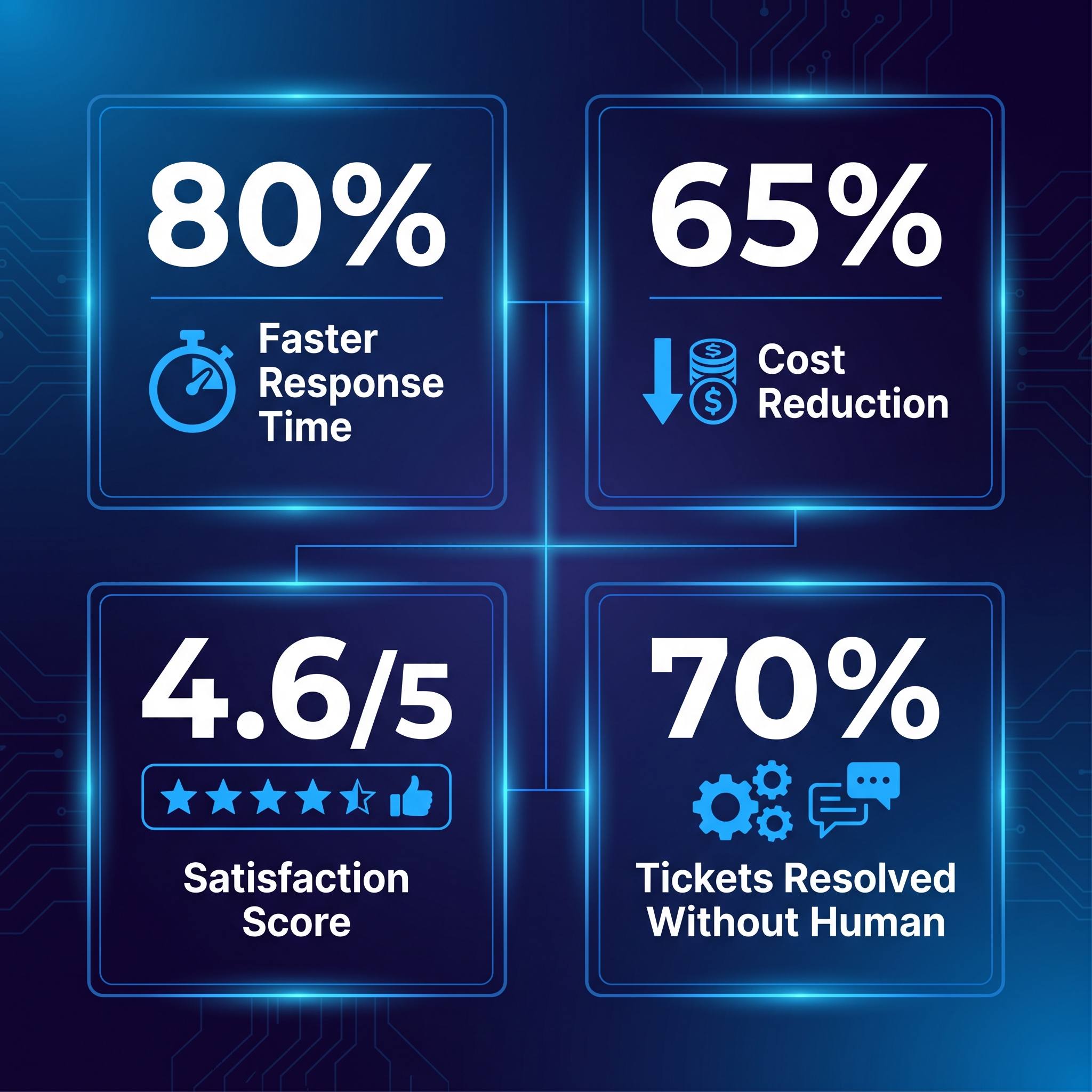
- Resolution rate: 70-80% of tickets resolved without human intervention (up from 15-20% with first-generation chatbots)
- Handle time: Average resolution time for AI-handled tickets drops from 4-8 minutes to under 60 seconds
- Cost per ticket: 65-75% reduction in cost per resolved ticket compared to fully human-handled support
- Customer satisfaction: CSAT scores typically increase 12-18 points — customers prefer fast, accurate resolution over slow human responses
- Agent satisfaction: Human agents report higher job satisfaction when freed from repetitive tier-1 tickets to focus on complex, high-value interactions
For a mid-size enterprise handling 10,000 support tickets per month, these numbers translate to €1.2-2.4 million in annual savings while simultaneously improving customer experience — a combination that's rare in enterprise technology investment.
Implementation Strategy: Building Your AI Support Stack
Step 1: Audit Your Current Support Workflows
Before deploying AI, understand what you're replacing. Analyze your ticket data: What are the top 20 ticket categories by volume? What percentage of tickets in each category are resolved in the first interaction? What's the average handle time? What percentage require backend system access?
This analysis reveals your automation opportunity. Categories with high volume, high first-contact resolution rates, and clear resolution paths are prime candidates for autonomous handling. Categories requiring nuanced judgment, regulatory expertise, or emotional intelligence are better candidates for AI-assisted (rather than autonomous) handling.
Step 2: Choose the Right Agent Architecture
Not all support scenarios require the same architecture. A tiered approach works best:
Tier 1 (fully autonomous): High-volume, well-defined scenarios with clear resolution paths. Order status, password resets, subscription changes, basic refunds. The agent handles these end-to-end.
Tier 2 (AI-assisted): Complex scenarios where AI drafts the response and takes preparatory actions, but a human reviews before sending. Complaints with potential legal implications, large refund requests, account security issues.
Tier 3 (AI-routed): Scenarios the AI recognizes as requiring full human handling. It routes intelligently, provides complete context to the human agent, and handles the administrative work (logging, CRM updates) so the human can focus entirely on resolution.
Step 3: Train on Your Knowledge Base
Generic AI models don't know your products, policies, or procedures. Effective support agents require a curated knowledge base: product documentation, policy manuals, common resolution workflows, escalation criteria, and a library of resolved historical tickets.
Quality matters more than quantity. A well-structured knowledge base of 500 high-quality documents outperforms a poorly structured collection of 5,000. Invest in knowledge curation before deployment — it's the primary determinant of agent accuracy.
Step 4: Deploy with Human-in-the-Loop
Never go fully autonomous on day one. Start with AI drafting responses for human review. This builds confidence, surfaces edge cases, and generates the feedback data needed to improve the agent. Move to autonomous handling incrementally, starting with your highest-confidence, lowest-risk ticket categories.
Build explicit feedback mechanisms: when human agents override AI responses, capture why. This feedback is gold for improving the agent's accuracy and expanding its autonomous handling scope.
Step 5: Scale and Optimize
Once autonomous handling is established, focus on expanding coverage and improving quality. Analyze tickets that still require human intervention — are there patterns that could be addressed with additional knowledge or capability? Monitor CSAT scores by ticket type to identify where the agent is underperforming. Track escalation rates and investigate spikes.
The best support AI implementations are never "done." They're continuously improving as the knowledge base grows, models improve, and feedback loops generate better training signal.
The Human Factor: Why Agents Don't Replace Your Team
The most successful AI support deployments share a counterintuitive characteristic: they make human support agents more valuable, not redundant. When AI handles 70-80% of tickets autonomously, human agents are freed to focus entirely on the complex, high-stakes interactions where human judgment genuinely matters.
The result is a bifurcation of the support function. AI handles speed and scale. Humans handle complexity and empathy. A customer with a straightforward order issue gets a faster, more accurate resolution from the AI. A customer in genuine distress gets a human who has time to listen because they're not buried in routine tickets.
Organizations that communicate this clearly — to their teams and to their customers — see the highest adoption rates and the best outcomes. The framing matters: AI support is not about replacing people, it's about letting people do the work that only people can do.
What's Next: Predictive and Proactive Support
The next frontier for AI customer support is moving from reactive to proactive. Instead of waiting for customers to contact support, AI systems will identify customers likely to have issues before they occur and reach out proactively.
A customer whose order has an unusual shipping delay gets an automated proactive message with an updated ETA and a discount code — before they ever contact support. A customer whose usage patterns suggest they're not getting value from a feature gets a proactive tutorial. A customer whose payment method is about to expire gets a reminder before their service is interrupted.
This shift from reactive to proactive fundamentally changes the economics of support: preventing a contact is always cheaper than resolving one, and proactive outreach typically generates higher satisfaction scores than reactive resolution.
Conclusion
The evolution from rule-based chatbots to autonomous support agents represents one of the most significant transformations in enterprise operations over the past decade. The technology has matured from a frustrating novelty to a genuine competitive advantage — one that simultaneously reduces costs, improves customer satisfaction, and elevates the work of human support professionals.
The enterprises that have invested in this evolution are reaping compounding returns: better data, better models, better outcomes. Those still relying on first or second-generation approaches are increasingly disadvantaged — not just in cost, but in the customer experience they can deliver.
The path forward is clear. Audit your current support workflows. Identify your automation opportunity. Build the knowledge base. Deploy incrementally with human oversight. Measure relentlessly. The enterprises that execute this playbook in 2026 will have support operations that their competitors will struggle to match for years.