AI Customs Compliance: Eliminate Supply Chain Delays
By Delos Intelligence — 2026-08-19
15-25% of international shipments face compliance delays. AI-powered customs automation cuts holds from 4% to 0.8%, accelerates clearance from days to hours, and captures $3.7M+ in annual savings.
The Hidden Tax on Global Trade
Global exporters face a compliance burden that most underestimate until it stops a shipment. Customs clearance delays cost the global economy an estimated $45 billion annually in demurrage charges, expediting fees, and lost business. The average shipment requires compliance checks across 7-12 regulatory frameworks — export controls, sanctions screening, tariff classification, country of origin rules, product-specific regulations, and documentation requirements that change without warning.
Manual compliance teams, working from static databases and spreadsheet-based workflows, simply cannot keep pace. The result: 15-25% of international shipments experience some form of delay attributable to compliance issues, with 3-5% facing formal holds or penalties.
AI-powered customs and trade compliance platforms are eliminating this gap.
Why Trade Compliance Is an AI-Ready Problem
Trade compliance has several characteristics that make it exceptionally well-suited for AI automation:
High data volume, structured patterns. Every shipment generates a consistent set of data points: HS tariff codes, country of origin, declared value, product descriptions, shipper/consignee entities. AI models thrive on this structured, repetitive data.
Rule-based but highly complex. Compliance decisions follow rules, but the rules are numerous, interconnected, and change frequently. AI systems can encode thousands of regulatory rules and update them in real-time as regulations change — something no human team can match.
High cost of errors. A misclassified shipment can mean penalties of 2-4x the duty owed, shipment seizure, or debarment from export programs. The financial incentive to get compliance right is enormous.
Explainability requirements. Customs authorities require documentation of compliance decisions. Modern AI systems produce audit trails that satisfy regulatory requirements — in some cases exceeding what manual processes provide.
The Six AI Capabilities That Eliminate Compliance Delays
1. Automated HS Tariff Classification
Harmonized System (HS) tariff classification is the foundation of customs compliance, and it is notoriously error-prone when done manually. The HS system contains 5,000+ codes organized in a hierarchical taxonomy, with product descriptions that require deep technical knowledge to navigate.
AI classification models trained on historical classification decisions and product databases achieve 92-96% accuracy on first-pass classification — compared to 78-82% for experienced human classifiers working without AI assistance.
More importantly, AI models are consistent: they apply the same classification logic to the same product every time, eliminating the variance that creates audit exposure.
2. Real-Time Sanctions and Entity Screening
Sanctions lists — OFAC SDN, EU Consolidated List, UN Security Council, HM Treasury — are updated daily and contain 45,000+ restricted entities. Manual screening against these lists is slow and prone to false negatives from name variations, aliases, and transliteration differences.
AI screening systems use entity matching algorithms that handle:
- Name variations and transliterations (Muammar Gaddafi / Moammar Kadhafi / ...)
- Corporate ownership chains that obscure ultimate beneficial owners
- Geographic entity resolution (same company name in different jurisdictions)
- Real-time list updates without manual database maintenance
Leading platforms screen 10,000+ entities per minute with 99.7% true positive rate.
3. Automated Export Control Classification
Export control compliance — EAR, ITAR, EU Dual Use Regulation — requires determining whether products require export licenses based on their technical characteristics and intended end use. This determination involves:
- ECCN classification under the Commerce Control List
- Denied party screening of end users and end uses
- Country chart analysis to determine license requirements by destination
- License exception analysis to identify available exemptions
AI systems automate 80-85% of these determinations, flagging only genuinely complex or high-risk cases for human review.
4. Country of Origin Determination
Rules of origin are among the most complex areas of trade compliance, particularly for manufactured products with multi-country supply chains. Determining whether a product "substantially transforms" in a given country — or meets the specific product rules under FTAs like USMCA, CPTPP, or EU-UK TCA — requires analysis of:
- Bill of materials and sourcing data
- Manufacturing process documentation
- Value-added calculations by jurisdiction
- Tariff shift analysis under FTA-specific rules
AI platforms automate origin determination by integrating with ERP and supply chain systems, pulling real-time BOM data and applying FTA-specific rules to calculate preferential origin eligibility. Companies using automated origin determination capture 15-30% more FTA duty savings than those relying on manual processes.
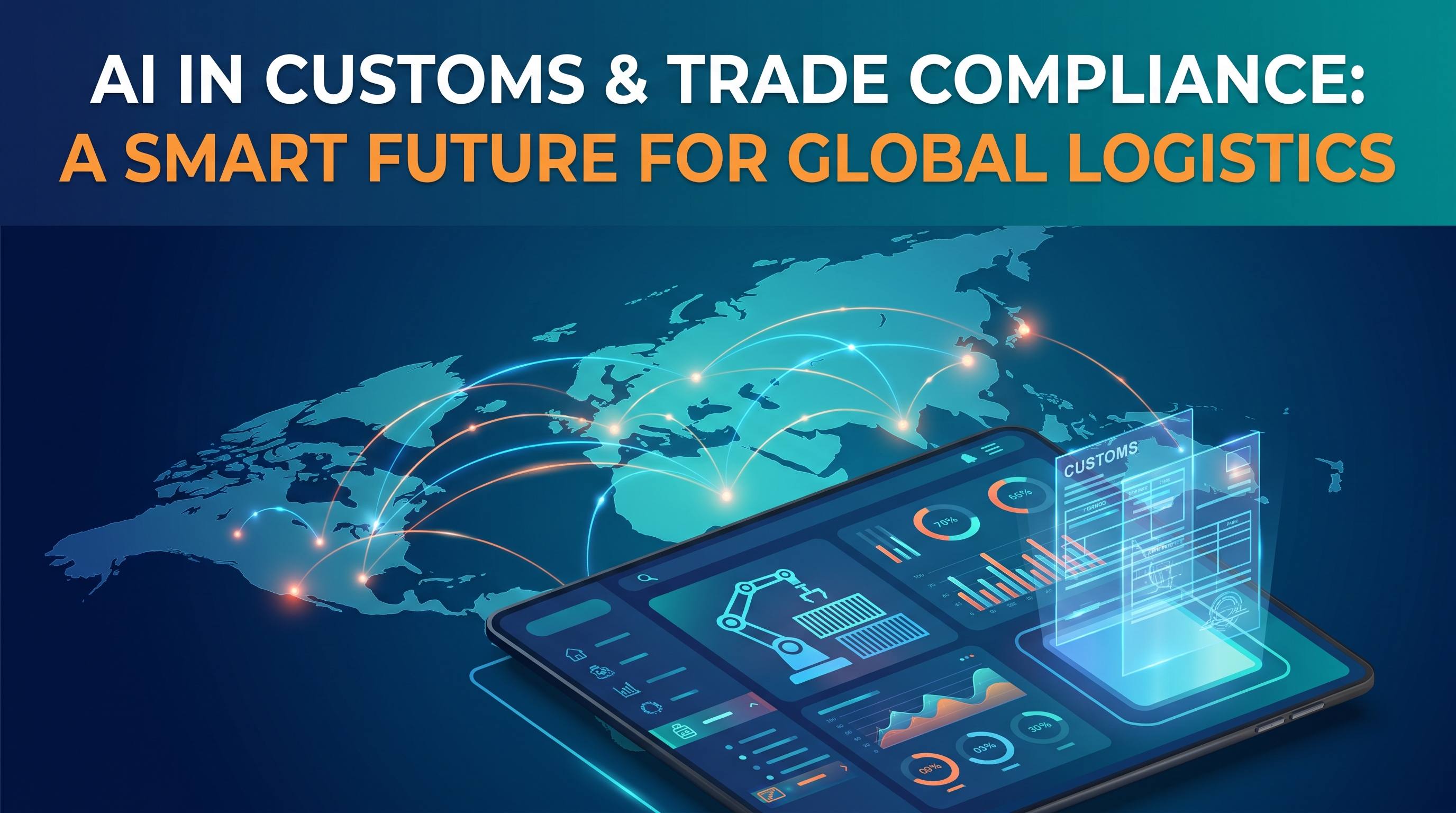
!AI Customs Compliance Workflow
5. Documentation Generation and Validation
Customs clearance requires a stack of documents — commercial invoice, packing list, bill of lading, certificate of origin, export license (where required), and product-specific certificates. Errors in any of these documents trigger holds.
AI document systems:
- Auto-populate customs documents from ERP data, eliminating manual transcription errors
- Validate document consistency (values match across invoice, packing list, and declaration)
- Flag missing required documents before shipment tender
- Generate certificates of origin with FTA-specific formats
6. Predictive Compliance Risk Scoring
Beyond individual document checks, AI risk scoring systems analyze each shipment holistically, combining:
- Historical compliance performance of the shipper and carrier
- Destination country risk profiles
- Product-specific regulatory flags
- Transaction value and quantity anomalies
High-risk shipments are flagged for enhanced review; low-risk shipments flow through automated clearance pathways. This prioritization allows compliance teams to focus human attention where it matters most.
The Business Case: What AI Compliance Delivers
| Metric | Manual Compliance | AI-Powered Compliance |
|---|---|---|
| HS classification accuracy | 78-82% | 92-96% |
| Sanctions screening speed | Hours/day | Real-time |
| Compliance holds rate | 3-5% of shipments | 0.5-1% |
| Documentation errors | 8-12% of shipments | 1-2% |
| Customs clearance time | 2-4 days | 4-8 hours |
| FTA duty capture rate | 60-70% of eligible | 85-95% of eligible |
| Cost per shipment (compliance) | $45-$120 | $8-$25 |
For an exporter shipping 5,000 international shipments per year:
- Compliance hold reduction (4% → 0.8%): 160 fewer holds × $15,000 average hold cost = $2.4M saved
- FTA duty savings improvement (70% → 92% capture): $1.1M additional savings on $8M annual duty exposure
- Documentation error reduction: $180K saved in rework and penalty risk
- Total annual value: $3.7M+
Implementation Approach
Week 1-2: Data Audit
Map all trade data sources: ERP, TMS, customs broker systems, product master data. Identify gaps in HS classification coverage and FTA eligibility documentation.
Month 1: HS Classification Pilot
Deploy AI classification on a subset of product catalog (100-500 SKUs). Compare AI classifications against historical customs filings. Achieve sign-off from customs counsel before expanding.
Month 2-3: Sanctions and Entity Screening
Replace or augment existing screening tool with AI screening. Configure risk tolerance thresholds and escalation workflows. Integrate with order management system for pre-shipment screening.
Month 3-4: Documentation Automation
Connect AI platform to ERP for automated document population. Configure validation rules and missing-document alerts. Integrate with customs broker EDI for automated filing.
Month 4-6: Full Deployment and FTA Optimization
Complete origin determination automation across supply chain. Generate FTA eligibility reports for top 20 product families. Begin capturing duty savings from newly identified FTA eligibility.
Compliance with the EU AI Act
AI systems used in customs classification and sanctions screening fall under the EU AI Act's "high-risk" category when used as the primary compliance decision tool. Requirements include:
- Human oversight for adverse decisions (shipment holds, license denials)
- Explainability documentation for classification decisions
- Regular accuracy auditing and model monitoring
- Data quality documentation for training sets
Enterprise platforms designed for customs compliance are building these requirements into their architecture ahead of the enforcement deadlines.
The Bottom Line
AI-powered customs and trade compliance is not about replacing compliance expertise — it is about giving compliance professionals tools that keep pace with the complexity and volume of modern global trade.
The companies that implement AI compliance now are eliminating the delays, penalties, and missed FTA savings that put them at a structural cost disadvantage versus competitors with automated workflows. The technology is proven, the ROI is clear, and the regulatory environment is increasingly supportive of AI-assisted compliance — provided the systems are designed with appropriate oversight.
Start with HS classification. Prove the accuracy. Expand to sanctions screening and origin determination. The savings compound with each layer.