AI Data Governance: The Enterprise Framework for Data Quality, Lineage, and Compliance
By Delos Intelligence — 2026-07-30
Poor data quality costs enterprises $12.9M yearly. AI data governance automates quality, lineage, and compliance — the foundation for trustworthy AI.
Why Data Governance Matters More in the AI Era
Data is the fuel that powers enterprise AI — but without robust governance, that fuel becomes a liability. A 2024 Gartner survey found that 87% of organizations have low data quality maturity, and poor data quality costs enterprises an average of $12.9 million annually. When that flawed data trains a model, the damage compounds: biased predictions, hallucinated outputs, regulatory fines, and eroded customer trust.
Governance in the AI era must answer three questions for every piece of data: Where did it come from? (lineage), Is it accurate? (quality), and Are we allowed to use it? (compliance).
The Four Pillars of an AI Data Governance Framework
!Data governance maturity: Manual vs AI-powered
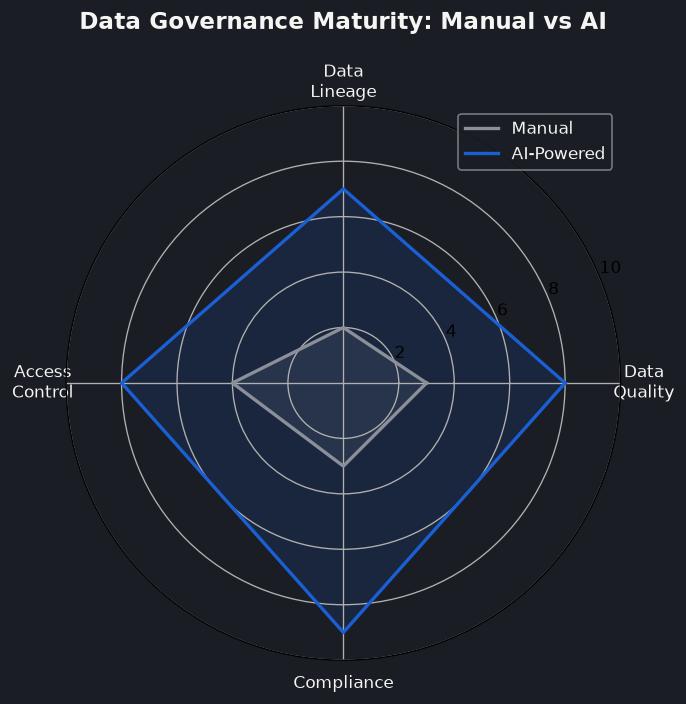
1. Data Quality
Data quality in the AI context means assessing accuracy, completeness, consistency, timeliness, and relevance across every dataset. Automated profiling tools scan millions of records in minutes, flagging outliers, missing values, and schema drift that human reviewers would miss.
2. Data Lineage
Lineage answers: where did this data come from, and what happened to it along the way? Modern tools capture end-to-end data flows automatically. When a model produces an unexpected result, teams can trace backward through the pipeline in seconds rather than days.
3. Access Control & Security
AI models often require broad data access — but that doesn't mean everyone gets access. Role-based access control (RBAC), data masking, and purpose-based restrictions ensure sensitive data is only used where authorized. The principle of least privilege must extend to model training pipelines.
4. Compliance & Regulatory Alignment
From GDPR to the EU AI Act, AI data compliance means proving — not just claiming — that your data practices meet legal requirements. Automated policy enforcement, continuous monitoring, and real-time alerting turn compliance from a periodic audit exercise into an always-on capability.
How AI Automates Data Governance
Intelligent Metadata Management
AI-powered catalogues automatically classify, tag, and describe datasets using NLP. AI infers schema, detects PII, and generates human-readable descriptions — keeping the data catalogue alive and current.
Anomaly Detection at Scale
Machine learning models detect quality issues in real time: sudden schema changes, unexpected null rates, distribution shifts. These models surface problems before they propagate downstream.
Automated Policy Enforcement
AI agents interpret governance policies in natural language and enforce them across data pipelines. When a new regulation drops, the policy is updated once — and the agent ensures compliance everywhere.
Continuous Compliance Monitoring
AI-driven monitoring tools continuously scan data flows for compliance violations and generate audit-ready reports automatically. What once took a team of analysts weeks now happens continuously.
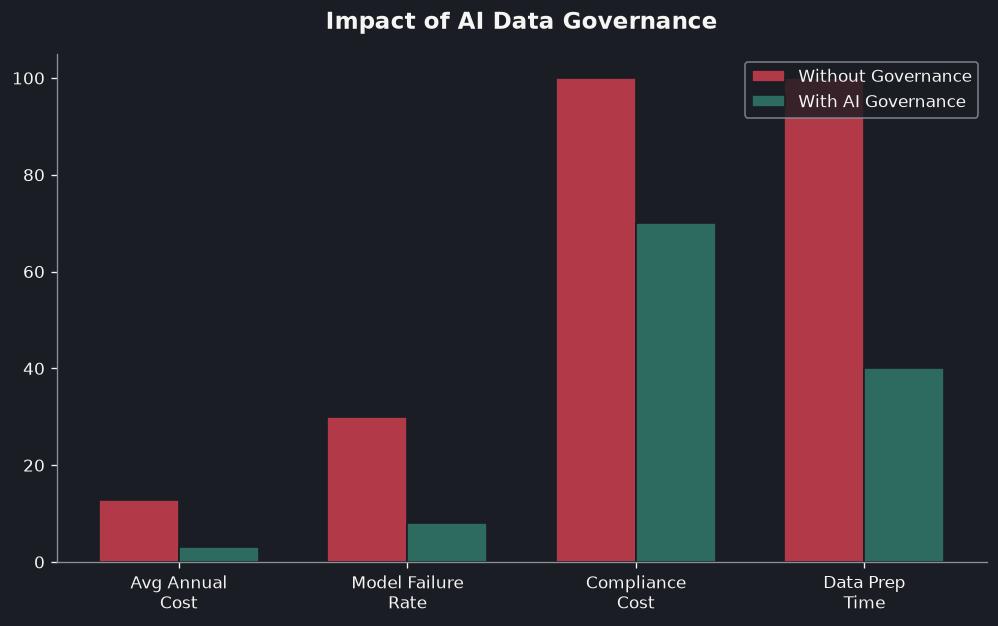
!Impact of AI data governance on key metrics
Key Benefits of AI-Powered Data Governance
- Faster AI deployment cycles: 40–60% reduction in data preparation time
- Stronger regulatory posture: Proactive governance reduces compliance costs by 30% or more (DAMA-DMBOK)
- Higher model accuracy: Organizations with mature data governance see 20–30% fewer model failures (Gartner)
- Cross-team alignment: A shared governance framework creates a single source of truth about data assets
- Trust at scale: Every dataset carries a quality score, lineage trail, and compliance stamp
A Practical Implementation Roadmap
Phase 1: Assess & Inventory (Weeks 1–4)
Catalogue your data assets and assess current governance maturity. Identify the datasets that feed your most critical AI systems. Map existing policies, tools, and gaps.
Phase 2: Automate the Foundations (Months 2–3)
Deploy automated data profiling and lineage capture for priority datasets. Implement quality scoring and basic anomaly detection. Set up access control policies.
Phase 3: Embed Compliance & Monitoring (Months 4–6)
Layer in automated policy enforcement and continuous compliance monitoring. Connect your governance platform to your model registry so every model is linked to its data lineage.
Phase 4: Scale & Optimise (Months 7–12)
Extend governance coverage to all AI data pipelines. Implement advanced capabilities: AI-driven metadata management, predictive quality monitoring, and automated remediation workflows.
Getting Started: The First 30 Days
1. Week 1: Inventory your top 10 AI-critical datasets. Document what they contain, where they come from, and who owns them.
2. Week 2: Run an automated quality assessment on those datasets. Score them on completeness, accuracy, and freshness.
3. Week 3: Map the lineage for your highest-risk dataset end-to-end. Identify every system that touches it.
4. Week 4: Draft a one-page governance policy covering quality thresholds, access rules, and compliance requirements for AI data.
AI data governance isn't a barrier to innovation — it's the foundation that makes innovation sustainable. By automating quality, lineage, and compliance, enterprises can move faster with confidence, knowing their AI systems are built on data they can trust.
Sources: DAMA International · Gartner Data & Analytics