AI-Powered HR Analytics: How Enterprises Predict Attrition 6 Months Early (And Why 71% Still Rely on Exit Interviews)
By Delos Intelligence — 2026-07-19
Employee turnover costs enterprises between 50% and 200% of each departing employee's annual salary. AI-powered HR analytics predicts attrition up to 6 months before it happens, cutting turnover costs by 40%. Yet 71% still rely on exit interviews.
The Cost of Reactive HR
The traditional approach to employee retention is fundamentally broken. Companies wait for exit interviews to understand why people leave, but exit interviews capture sentiment after the decision is already made. The data is retrospective, not predictive.
Consider the numbers. A mid-size enterprise with 2,000 employees and a 15% annual turnover rate loses 300 employees per year. At an average salary of 60,000 euros and a replacement cost of 90,000 euros per departure (recruitment, onboarding, lost productivity, knowledge drain), the annual cost exceeds 27 million euros.
!Traditional exit interviews vs AI attrition prediction comparison
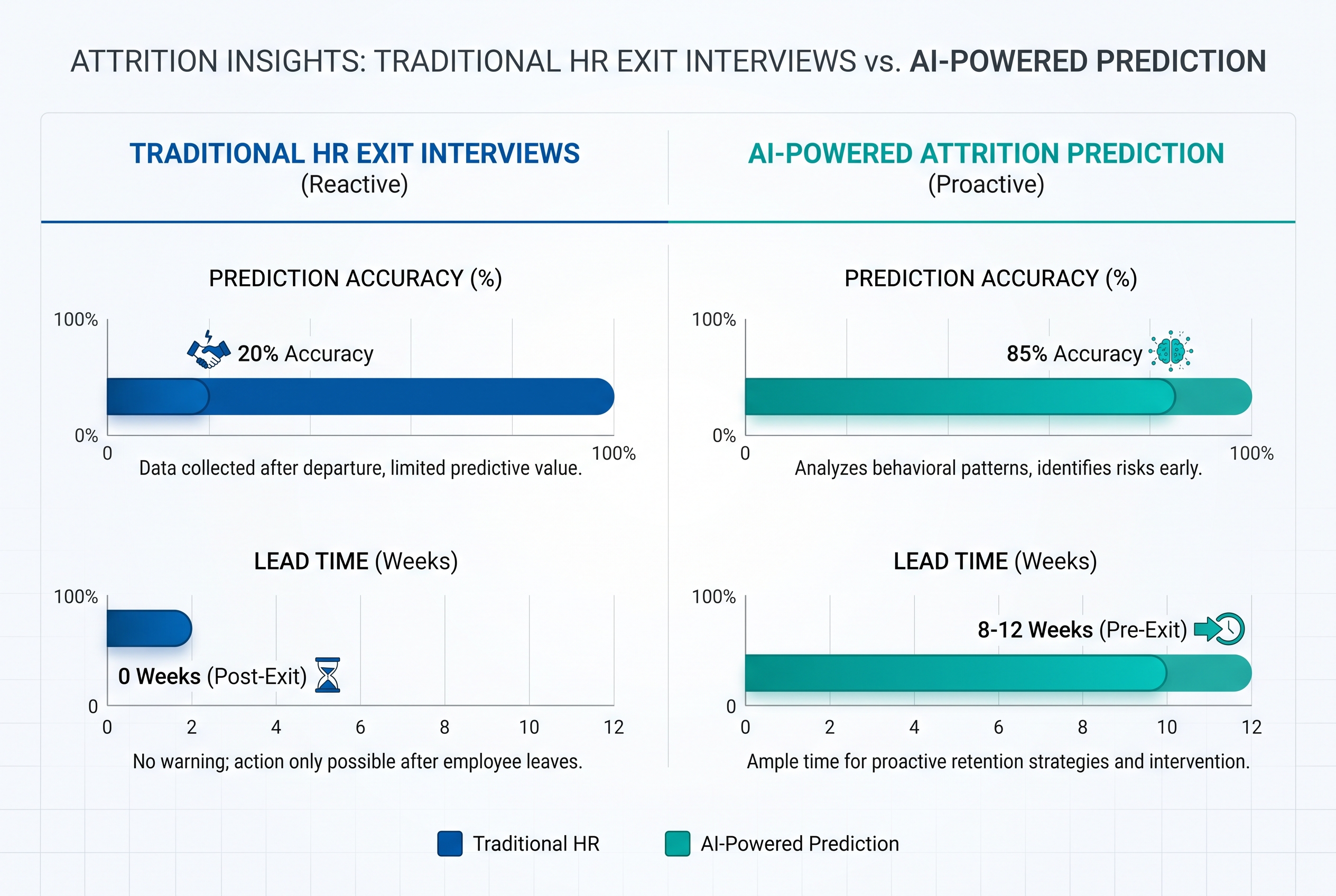
Yet 71% of HR teams still rely primarily on annual engagement surveys and exit interviews to understand workforce sentiment. These tools have a fundamental limitation: they measure the past, not the future.
How AI Attrition Prediction Works
AI-powered HR analytics platforms analyze dozens of behavioral signals to predict which employees are at risk of leaving, often before the employees themselves have consciously decided to move on.
The Key Signals
Modern attrition prediction models combine multiple data streams:
- Engagement patterns: Declining participation in meetings, reduced response times on internal communications, lower contribution to collaborative documents
- Performance trajectory: Subtle changes in output quality, missed deadlines, reduced initiative on new projects
- Network analysis: Shrinking internal communication networks, fewer cross-functional interactions, declining centrality in team workflows
- Career signals: Time since last promotion, salary compression relative to market rates, internal job posting views without applications
- External factors: Local job market activity, competitor hiring patterns, industry turnover benchmarks
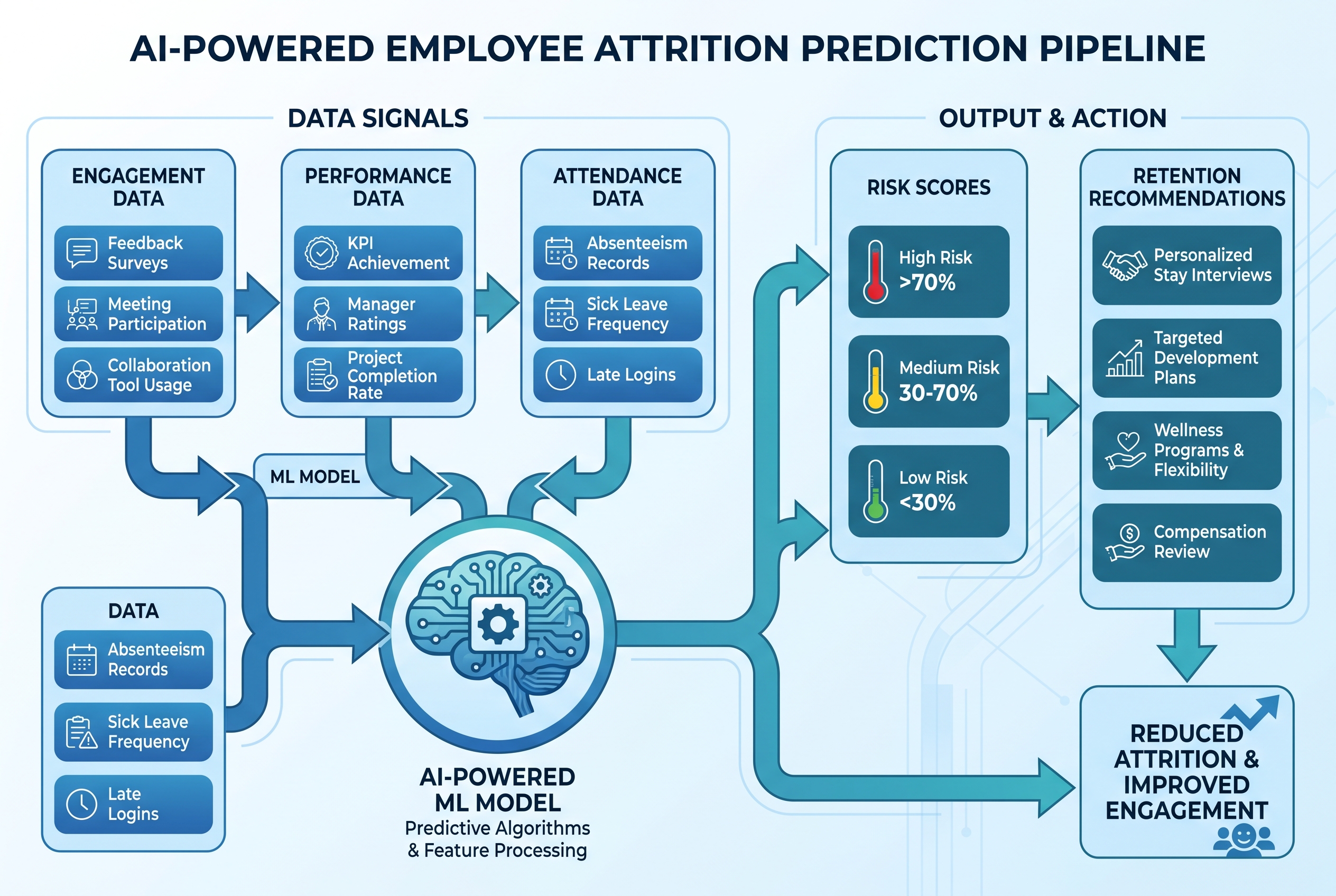
!AI attrition prediction pipeline flowchart
The Prediction Pipeline
The process works in four stages. First, the system ingests data from HRIS, email metadata, collaboration tools, and performance management systems. Second, it normalizes and anonymizes the data to protect individual privacy. Third, machine learning models trained on historical departure patterns assign each employee a risk score. Fourth, the platform generates actionable recommendations for managers.
The key insight is that attrition is rarely a sudden decision. It follows a predictable pattern of disengagement that typically begins 3 to 6 months before a resignation letter is submitted.
Real-World Impact
Enterprises that have deployed AI-powered attrition prediction report significant results:
- IBM reduced voluntary attrition by 20% using a predictive retention system that forecasts departure risk with 95% accuracy
- AT&T implemented AI workforce analytics and cut turnover by 15% in critical roles
- A Fortune 500 retailer identified 300 at-risk employees in the first 90 days and retained 180 of them through targeted interventions
The average enterprise implementing AI HR analytics sees a 25-40% reduction in unplanned attrition within the first year.
Why 71% Still Haven't Started
Despite the clear ROI, adoption remains low. The barriers fall into three categories:
Data privacy concerns: HR analytics touches sensitive employee data. Enterprises worry about GDPR compliance, employee surveillance perceptions, and potential bias in prediction models. These concerns are valid but addressable through proper anonymization, transparent communication, and bias auditing.
Integration complexity: Most enterprises have fragmented HR data across 5-10 different systems. Consolidating this data into a single analytics pipeline requires significant IT investment and cross-functional alignment.
Cultural resistance: Managers often view predictive HR analytics as replacing their judgment rather than augmenting it. The most successful implementations frame AI as a decision-support tool, not a decision-maker.
Getting Started: A Practical Roadmap
For enterprises ready to move beyond exit interviews:
1. Start with existing data: You do not need new tools to begin. Your HRIS, performance management system, and collaboration platform already contain the signals. Start by analyzing historical departure patterns to identify the top 5 predictive signals in your organization.
2. Prioritize privacy by design: Build anonymization into the data pipeline from day one. Aggregate risk scores at the team level rather than individual level for initial deployments. Communicate transparently with employees about what is being analyzed and why.
3. Focus on high-impact roles first: Not all departures have equal impact. Prioritize prediction and retention efforts for roles where replacement is most expensive and most difficult, such as senior engineers, key account managers, and specialized domain experts.
4. Pair predictions with action: A risk score without an intervention is useless. Train managers on retention conversations, create personalized development plans for at-risk employees, and measure the impact of interventions over time.
The Bottom Line
Every resignation letter that reaches your desk represents a failure of prediction. AI-powered HR analytics gives enterprises the ability to see around corners, to identify disengagement before it becomes departure, and to act while retention is still possible.
The enterprises that figure this out will keep their best people. The ones that do not will keep conducting exit interviews with employees they have already lost.