AI Inventory Management: How Enterprises Cut Stockouts by 50% (And Why 63% Still Haven't Started)
By Delos Intelligence — 2026-07-19
Global retailers lose $1.7 trillion annually to stockouts and overstocks. AI inventory management cuts stockouts by 50%, reduces dead stock by 30%, and lifts forecast accuracy from 75% to 92%. Yet 63% of enterprises haven't started. Here's what the leaders do differently.
The $1.7 Trillion Problem Hiding in Your Warehouse
Every year, global retailers lose $1.7 trillion to stockouts and overstocks combined. That's not a typo. Trillion.
For a $50 million business, a stockout rate above 5% means losing $5 to $7.5 million in potential revenue annually. And the damage doesn't stop at lost sales: over 50% of consumers who encounter a stockout simply abandon the purchase and go to a competitor.
Meanwhile, dead stock — the inventory that sits in warehouses gathering dust — ties up capital, eats storage costs, and quietly erodes margins. The average small business carries $142,000 in excess inventory. Overstocking increases storage costs by 20 to 30%.
The root cause? Traditional inventory management is fundamentally reactive. Static reorder points, manual safety stock calculations, and spreadsheet-driven forecasting simply can't keep up with demand volatility, supply chain disruptions, and shifting consumer behavior.
AI inventory management flips the model from reactive to predictive. And the enterprises that have adopted it are seeing results that make the investment impossible to ignore.
What AI Inventory Management Actually Does
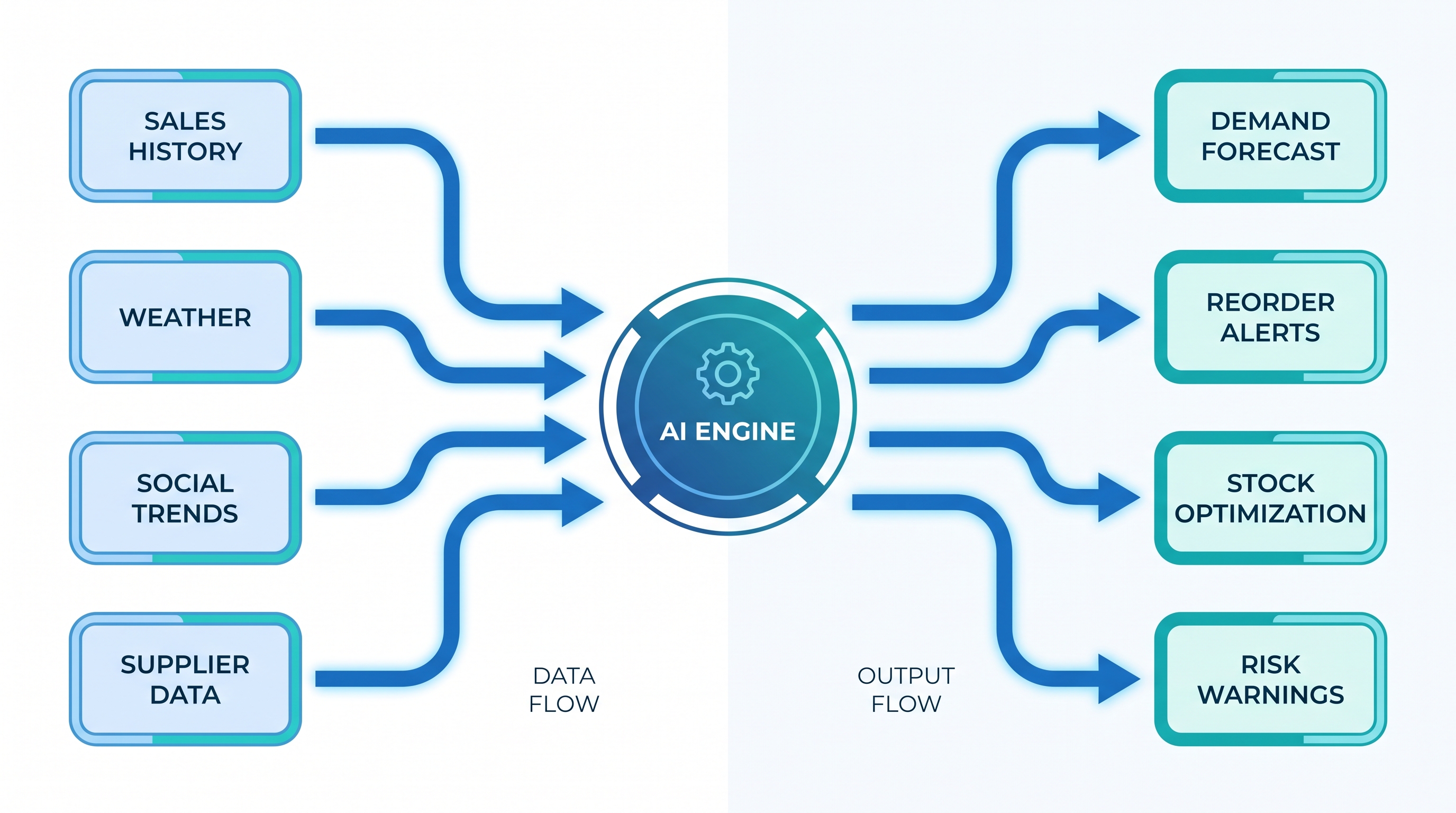
AI inventory management uses machine learning algorithms to analyze vast datasets — historical sales, real-time market signals, weather patterns, social media trends, supplier performance data, and macroeconomic indicators — to predict demand, optimize stock levels, and automate replenishment decisions.
The core capabilities break down into four pillars:
1. Predictive Demand Forecasting
Traditional forecasting methods (exponential smoothing, ARIMA, moving averages) rely on historical averages and manual adjustments. They're rigid, slow to adapt, and prone to human bias.
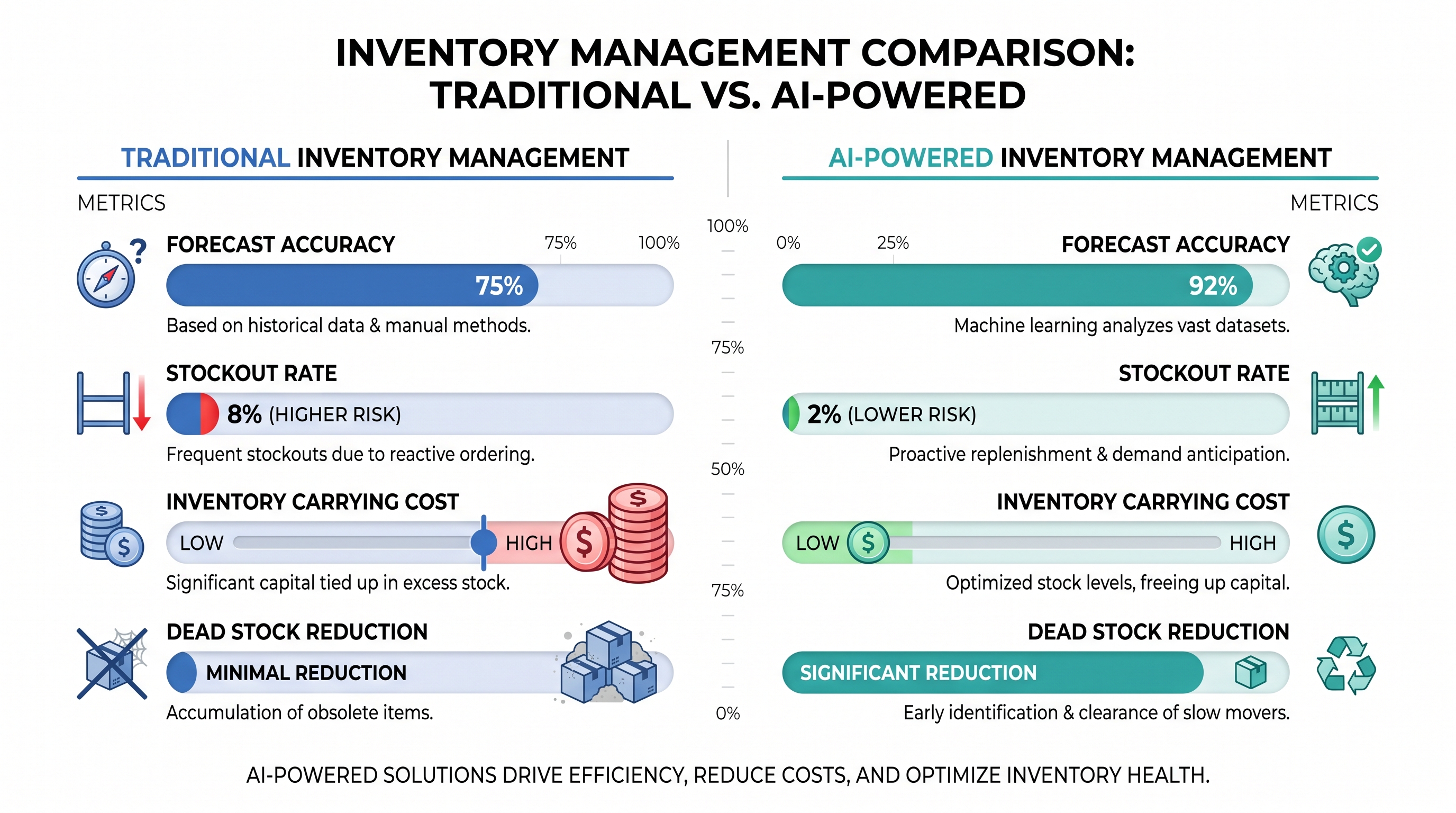
AI-driven forecasting is dynamic. It learns continuously, recognizes non-linear relationships, and incorporates external variables that traditional models ignore. The result: forecast accuracy jumps from a typical 75% to over 90%.
AI reduces forecast errors by 30 to 50% compared to traditional methods. For seasonal products, the improvement is even more dramatic — up to 40% reduction in seasonal stockouts.
2. Dynamic Safety Stock Optimization
Static safety stock buffers are either too large (tying up capital) or too small (risking stockouts). AI recalculates safety stock continuously based on real-time demand variability, supplier lead times, and service level targets.
This dynamic approach reduces inventory levels by 10 to 15% while maintaining or improving service levels. The capital freed up can be reinvested in growth initiatives rather than sitting in a warehouse.
3. Automated Replenishment
AI systems can automatically generate purchase orders when stock falls below optimized thresholds, factoring in supplier lead times, demand forecasts, and even upcoming promotions or seasonal events.
Companies using automated replenishment see a 35% decrease in stockouts and a significant reduction in manual workload for procurement teams.
4. Real-Time Visibility and Risk Detection
AI provides end-to-end supply chain visibility, monitoring supplier performance, tracking shipments, and flagging potential disruptions before they impact inventory levels.
Only 9% of businesses currently have full supply chain visibility. 63% have limited or no visibility. AI closes this gap by integrating data from multiple sources into a single, real-time dashboard.
!AI inventory management pipeline: data inputs, AI engine, and outputs
The Numbers That Matter
Here's what enterprises are actually achieving with AI inventory management:
- Stockout reduction: 25 to 50% decrease in stockout incidents
- Forecast accuracy: improvement from 75% to over 92%
- Inventory cost reduction: 10 to 25% lower carrying costs
- Dead stock reduction: up to 30% less obsolete inventory
- Inventory accuracy: improvement from 66% to 97% with item-level tracking
- Service levels: 65% improvement in product availability
McKinsey reports that AI-enabled distribution delivers 5 to 20% logistics cost reduction and 20 to 30% inventory reduction. The AI-driven inventory optimization market is growing at 18% CAGR, projected to reach $27 billion by 2030.
!Traditional vs AI-powered inventory management comparison
Real-World Case Studies
Walmart: 30% Fewer Stockouts, Hundreds of Millions Saved
Walmart deployed AI-driven demand forecasting across its global supply chain, covering the US, Mexico, Canada, and Costa Rica. The system analyzes sales data, customer behavior, weather patterns, and external factors to predict demand and optimize stock levels.
Results: forecast errors reduced by 30%, stockouts decreased by 15 to 25%, inventory costs cut by up to 30%, and labor expenses lowered by 20%. During hurricane disruptions, Walmart's AI system reroutes shipments and adjusts stock levels within hours — a process that previously took days.
Walmart's Trend-to-Product system tracks social media and search trends to generate product concepts for sourcing, compressing projects that previously took months into weeks.
Amazon: AI-Powered Fulfillment at Scale
Amazon's AI advancements include demand forecasting models, generative AI for supply chain mapping, and robotics with agentic AI systems. These tools improve delivery accuracy, shipping speed, and product availability while reducing cost per package.
Amazon's predictive inventory system positions stock in fulfillment centers before orders are placed, based on regional demand patterns. The result: same-day and next-day delivery for millions of products, with minimal overstock.
Albertsons: 15% Faster Shelf Replenishment
Albertsons uses AI for real-time store operations, including labor allocation based on predicted inbound shipments. During peak seasons, AI enables 15% faster product movement to shelves. The system also analyzes unstructured supplier data (emails, PDFs) to identify delivery risks and changes, enhancing procurement responsiveness.
Why 63% of Enterprises Haven't Started
Despite the clear ROI, adoption remains surprisingly low. Here's what's holding enterprises back:
Data Quality Issues
AI models are only as good as the data they're trained on. 43% of small businesses don't monitor inventory at all. 63% of supply chain managers still rely on Excel. Fragmented, inconsistent data makes AI implementation feel like a mountain to climb.
Integration Complexity
Connecting AI systems to existing ERP, WMS, and POS systems requires technical expertise and careful change management. 41% of companies cite talent shortages as a barrier. 42% point to privacy concerns.
The Pilot Trap
Only 33% of companies have scaled AI beyond pilot projects. Many enterprises run successful proofs of concept but never move to production. The gap between "AI works in a lab" and "AI runs our inventory" is where most initiatives die.
Leadership Hesitation
With 84% of organizations increasing AI investments in 2026, the laggards are increasingly falling behind. Companies that delay adoption face a compounding disadvantage: competitors with AI-optimized inventory capture market share through better availability and lower prices.
How to Get Started: A Practical Roadmap
Step 1: Assess Your Current State
Audit your inventory data quality, accuracy, and completeness. Identify your top stockout categories and highest dead stock items. Establish baseline metrics: forecast accuracy, stockout rate, inventory turnover, carrying cost as percentage of inventory value.
Step 2: Start with One Category
Don't try to AI-optimize your entire inventory at once. Pick a high-impact product category with good data quality and clear demand patterns. Run a 90-day pilot with measurable targets.
Step 3: Integrate External Data Signals
The biggest forecasting gains come from incorporating external data: weather patterns, social media trends, competitor pricing, economic indicators, local events. This is where AI dramatically outperforms traditional methods.
Step 4: Automate Replenishment Gradually
Start with AI-recommended reorder points that humans approve. As confidence builds, move to fully automated replenishment for stable, high-volume SKUs. Keep human oversight for new products, promotions, and high-risk categories.
Step 5: Scale What Works
Once your pilot category shows results, apply the same approach to adjacent categories. Build internal expertise. Document what works and what doesn't. Scale incrementally.
The Cost of Waiting
Every month without AI inventory management, enterprises lose money through stockouts, dead stock, and inefficient replenishment. The math is straightforward:
- A business losing $5M annually to stockouts could recover $2.5M with a 50% reduction
- A business carrying $142K in excess inventory could free up $35K to $42K with a 25% reduction
- A business with 75% forecast accuracy is leaving 17 percentage points of improvement on the table
The AI inventory management market is projected to grow from $9.5 billion in 2025 to $27 billion by 2030. By 2026, over 75% of enterprise organizations will have integrated AI-powered solutions into inventory management. The question isn't whether to adopt AI for inventory — it's whether you'll be among the leaders or the laggards.
The technology is proven. The ROI is clear. The case studies are real. The only question left is: what's your plan?