AI Model Distillation: How Enterprises Can Shrink LLMs Without Losing Intelligence
By Delos Intelligence — 2026-07-10
AI model distillation transfers knowledge from large frontier models to smaller, faster, cheaper ones — cutting inference costs by up to 90% while retaining 95%+ of performance. Here is how enterprises are deploying it.
What Is AI Model Distillation?
AI model distillation is a compression technique that transfers knowledge from a large, powerful model (the teacher) to a smaller, faster one (the student). The student learns to mimic the teacher's outputs — not just the final predictions, but the internal probability distributions that encode the teacher's nuanced understanding of the data.
The result: a model that's 10-100x smaller, runs 3-10x faster, and costs up to 90% less to operate — while retaining 95% or more of the teacher's performance on most tasks.
!AI Model Distillation Process
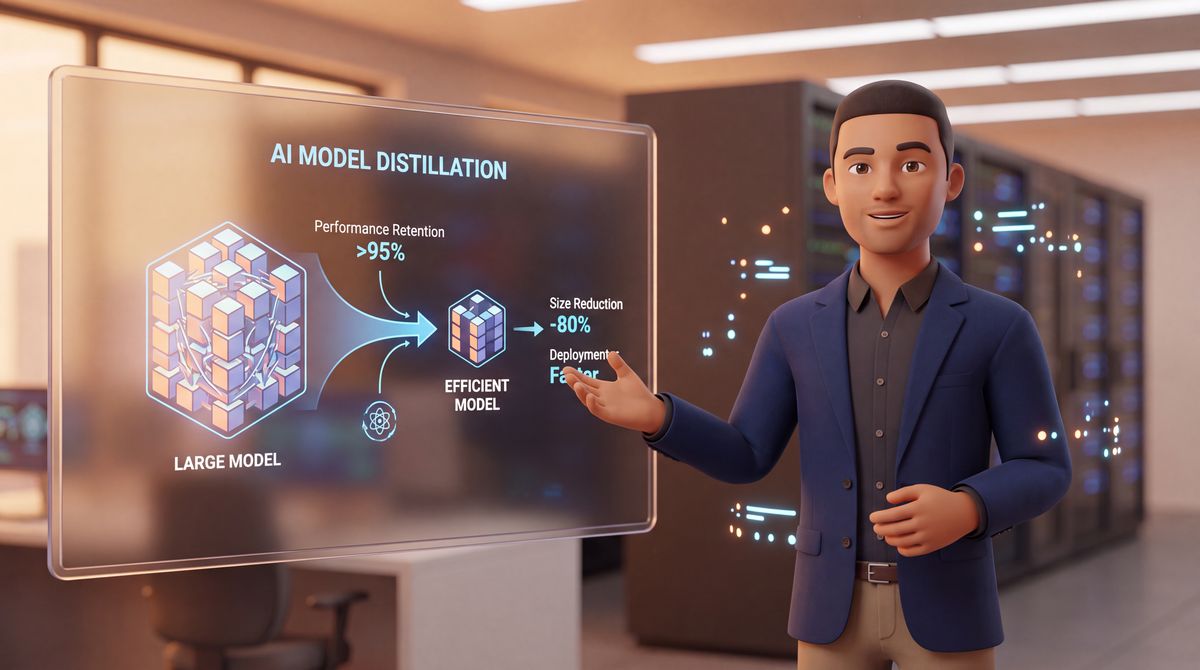
For enterprises, this is the key to deploying AI at scale without breaking the budget. You get the intelligence of a frontier model at a fraction of the cost.
The Teacher-Student Architecture
Distillation works because of a simple insight: a large model's internal representations contain far more information than its final output alone. When a teacher model classifies an image, it doesn't just say dog or cat — it produces a probability distribution across all classes. This distribution, called a soft label, carries rich information about the relationships between categories.
A soft label might say: 90% dog, 8% cat, 1.5% car, 0.5% house. The fact that the model thinks cat is more likely than car tells the student something about visual similarity. These soft labels are far more informative than hard labels (just dog), and they're what make distillation so effective.
Temperature Scaling
Soft labels are controlled by a temperature parameter. At low temperatures, the distribution is sharp — the model is confident. At high temperatures, it's softer — the model reveals more of its internal uncertainty. The optimal distillation temperature is typically 2-5, balancing information richness with signal clarity. The student is trained on a weighted combination of the soft labels (distillation loss) and the true hard labels (task loss), giving it both the teacher's nuanced understanding and the ground truth.
Enterprise Benefits: Why Distillation Matters
1. Cost Reduction
This is the #1 driver. A distilled model that replaces a 70B parameter teacher with a 7B student cuts inference costs by up to 90%. For an enterprise spending 00K/year on LLM inference, that's 50K in annual savings — without significant quality loss.
2. Speed and Latency
Smaller models run faster. A 7B distilled model can generate responses in 200-400ms, compared to 1-3 seconds for a 70B model. For real-time applications — customer support, sales coaching, code completion — this latency difference is the difference between a tool people use and one they abandon.
3. Privacy and Data Sovereignty
Distilled models are small enough to run on-premise or on local hardware. For enterprises in healthcare, finance, and defense, this means AI capabilities without sending sensitive data to cloud APIs. Your data never leaves your infrastructure.
4. Deployment Flexibility
A 7B model can run on a single GPU, a mobile phone, or even a browser via WebGPU. This unlocks AI use cases at the edge — on factory floors, in retail stores, on medical devices — where cloud connectivity is unreliable or too slow.
!Distillation Benefits Comparison
Real-World Examples
DistilBERT
Hugging Face's DistilBERT is the canonical example: a 60% smaller, 60% faster version of BERT that retains 97% of performance on GLUE benchmarks. It's now one of the most widely deployed NLP models in production — used by thousands of companies for sentiment analysis, classification, and entity recognition.
GPT-4 to GPT-4o-mini
OpenAI's GPT-4o-mini is widely considered a distilled version of GPT-4's capabilities — offering near-GPT-4 quality at 1/30th the cost. It powers the majority of ChatGPT interactions, demonstrating that distillation is not just an academic technique but a core commercial strategy.
Enterprise Custom Distillation
A financial services firm distilled their internal GPT-4-powered compliance analysis agent into a 7B model running on-premise. The distilled model retained 96% accuracy on compliance classification tasks while cutting inference costs from 2,000/month to 00/month — and keeping all financial data within their firewall.
Implementation: How to Distill Your Own Model
1. Select your teacher: Choose the best-performing model for your task (GPT-4, Claude Opus, or your fine-tuned model).
2. Generate training data: Run the teacher on your domain dataset, capturing both outputs and soft label distributions (logprobs).
3. Choose a student architecture: Select a smaller model family — Llama 3 8B, Mistral 7B, or Phi-3 for text; MobileNet or EfficientNet for vision.
4. Train with distillation loss: Fine-tune the student on the teacher's outputs using a combination of KL divergence loss (matching soft labels) and standard cross-entropy loss (matching true labels).
5. Evaluate and iterate: Benchmark the student against the teacher on your evaluation set. Target 95%+ performance retention. If below threshold, increase training data or adjust temperature.
Challenges and Limitations
Distillation isn't a silver bullet. Complex reasoning tasks — multi-step mathematical proofs, nuanced legal analysis, creative writing — may lose more than 5% of teacher quality. The student inherits the teacher's biases. And distillation requires significant compute upfront to generate training data from the teacher.
The Future: Self-Distilling Models
The frontier is moving toward models that distill themselves during training — learning compact internal representations without a separate teacher. OpenAI's o1 series and Google's Gemini Nano already incorporate self-distillation principles, producing smaller variants natively.
For enterprises, the message is clear: you don't need to pay frontier-model prices for every AI task. Distillation lets you deploy intelligence at scale, at a cost that makes sense, with the privacy your regulators demand.