AI-Powered Accounts Receivable: How CFOs Slash Days Sales Outstanding (DSO) by 45% and Accelerate Cash Flow
By Delos Intelligence — 2026-08-15
Discover how AI-powered accounts receivable transforms invoice-to-cash workflows, cutting Days Sales Outstanding (DSO) by 45% and automating cash application.
The Hidden Cash Flow Crisis in B2B Finance
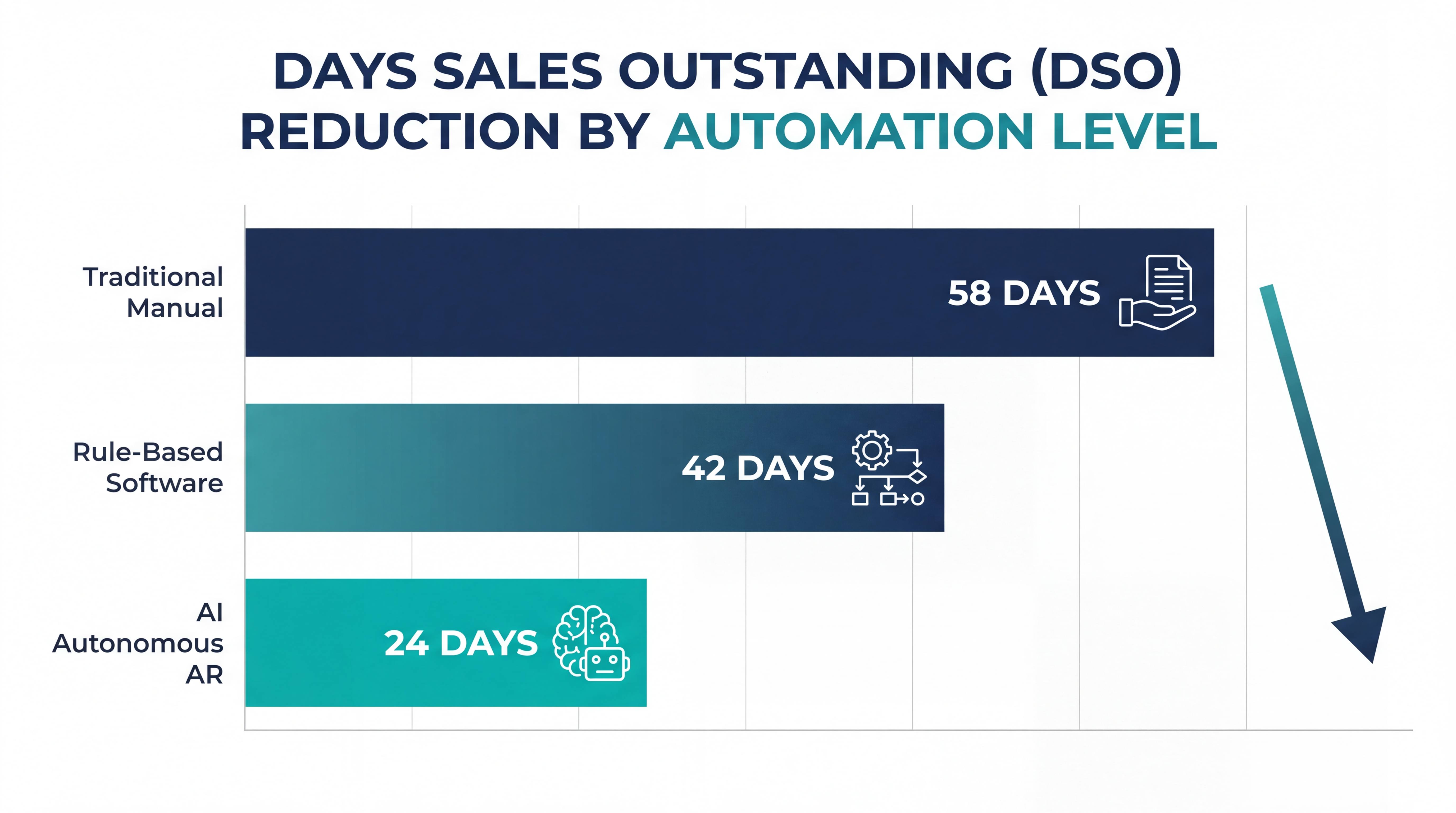
Every CFO knows the formula: revenue minus costs equals profit. But there is a third variable that quietly erodes enterprise financial health month after month: the gap between invoiced revenue and collected cash. Days Sales Outstanding (DSO), the average number of days a company takes to collect payment after a sale, sits at 42 days for the average enterprise and climbs past 60 days for companies in complex B2B sectors like manufacturing, professional services, and software.
That gap has a price. For a company with $500M in annual revenue, every 10 additional days of DSO traps roughly $13.7M in working capital that could be invested, used to retire debt, or returned to shareholders. Across the enterprise landscape, uncollected receivables represent one of the largest untapped liquidity pools in corporate finance.
AI-powered accounts receivable is changing this. By automating cash application, predicting payment behavior, personalizing dunning workflows, and accelerating dispute resolution, AI reduces DSO by an average of 45% while cutting AR team workload by 60%.
Why Traditional AR Processes Break Down at Scale
The fundamental challenge in accounts receivable is volume. A mid-market enterprise with $200M in revenue processes thousands of invoices monthly across hundreds of customers, each with different payment terms, remittance formats, and dispute patterns. Managing this manually creates predictable failure modes:
1. Cash Application Bottlenecks
Bank lockbox files, ACH remittances, wire transfers, and check payments arrive in incompatible formats. Matching payments to open invoices manually consumes enormous AR team capacity and introduces posting delays that distort real-time cash visibility. The average manual cash application rate is 65%, leaving 35% of payments requiring manual exception handling.
2. Reactive Collections Workflows
Traditional dunning sequences send the same reminder emails on fixed schedules regardless of customer payment history, relationship value, or likelihood of payment. This one-size-fits-all approach annoys good customers and fails to reach problematic ones at the optimal intervention point.
3. Slow Dispute Resolution
Invoice disputes are the single largest driver of DSO extension. When a customer disputes a line item, the resolution process typically involves email chains, document retrieval, and manual review cycles that stretch 20 to 45 days. During that time, the full invoice balance remains outstanding.
!DSO Reduction with AI-Powered AR
How AI Transforms the Invoice-to-Cash Cycle
Intelligent Cash Application: 95% Automated Matching
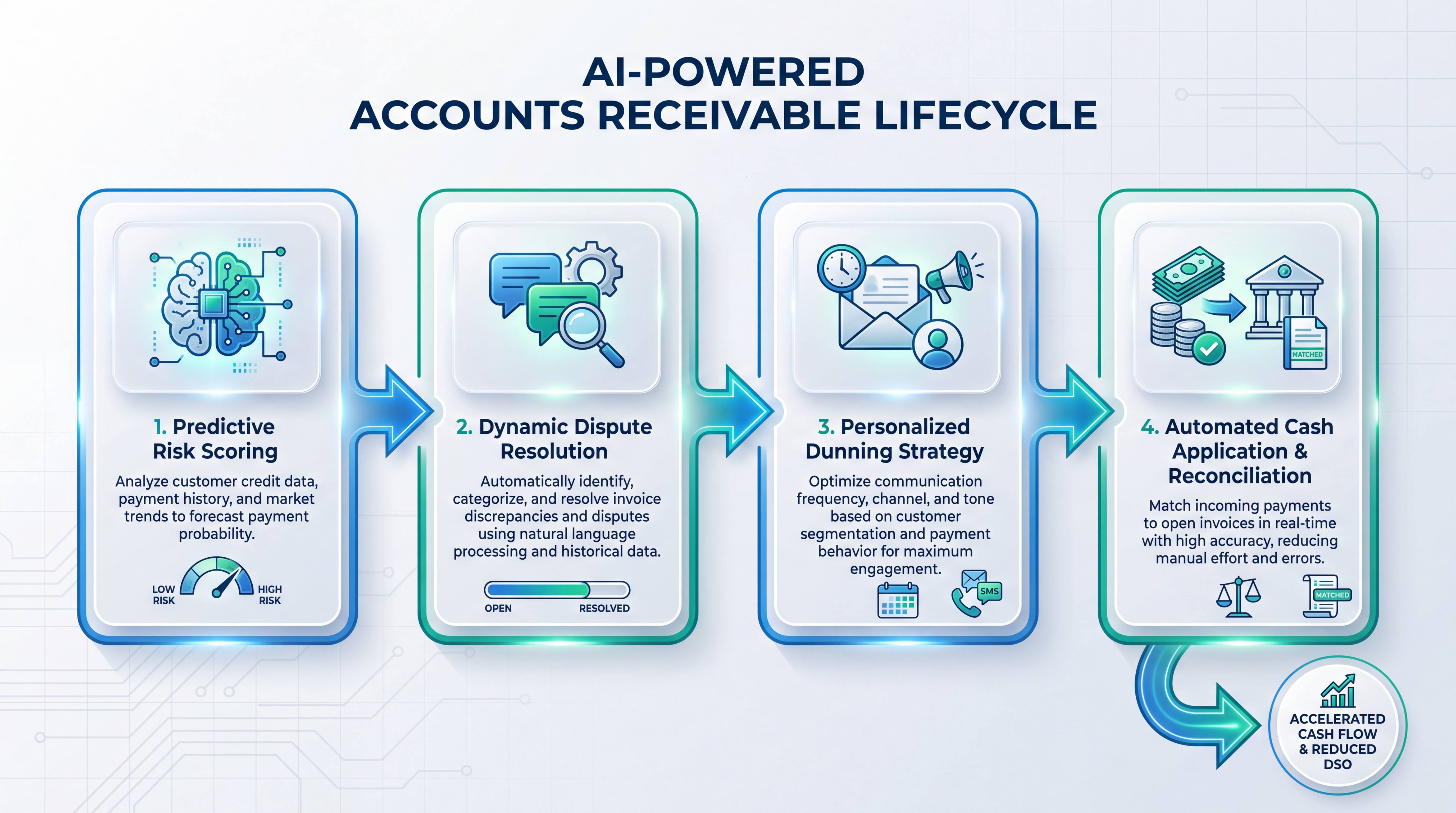
AI models trained on historical remittance patterns, customer behavior, and invoice structures achieve 95%+ automated cash matching rates. The system handles complex scenarios that defeat rule-based matching: partial payments across multiple invoices, remittances with missing reference numbers, payments with currency conversion variances, and deductions that require validation against promotional agreements.
When the AI cannot match with sufficient confidence, it surfaces exceptions with predicted matches and confidence scores, allowing human reviewers to process exceptions 3 times faster than traditional methods.
Predictive Payment Scoring
Rather than treating all outstanding invoices identically, AI assigns dynamic payment probability scores to every open receivable. The model analyzes:
- Customer payment history: Patterns across previous invoice cycles, seasonality effects, and behavioral drift signals
- Invoice characteristics: Amount, terms, product type, and dispute frequency for similar invoices
- External signals: Industry payment trends, customer credit profile changes, and macroeconomic indicators
This scoring enables AR teams to prioritize collection efforts precisely: focusing intensive outreach on accounts showing early deterioration signals before they become overdue, while applying lighter-touch automation to reliably paying customers.
Personalized Dunning Automation
AI-driven dunning sequences adapt in real time to individual customer profiles. A strategic enterprise account receives executive-level escalation through account management channels. A transactional customer with a history of responding to SMS reminders gets automated text messages 3 days before due date. A customer showing signs of cash flow stress receives a payment plan offer rather than a demand notice.
This personalization drives 35% higher response rates compared to uniform dunning sequences and significantly reduces the friction that damages customer relationships.
!AI-Powered AR Lifecycle: From Invoice to Cash
Automated Dispute Detection and Accelerated Resolution
AI models scan incoming payments, short payments, and customer communications to identify disputes before they formally enter the dispute queue. When a customer pays 97% of an invoice without explanation, the AI flags this as a likely pricing dispute, pre-retrieves the relevant contract terms and pricing documentation, and routes the case to the appropriate resolution team with a pre-drafted response.
This proactive approach reduces dispute cycle time by 60%, from an average of 30+ days to under 12 days, which directly compresses DSO for the affected invoices.
The Quantified Business Impact
Enterprises deploying AI-powered AR automation report consistent, measurable improvements across the invoice-to-cash lifecycle:
- 45% reduction in DSO: Average DSO falls from 42 days to 23 days within 12 months of deployment
- 95% automated cash application rate: Eliminating the manual matching burden that consumes 30-40% of AR team capacity
- 60% faster dispute resolution: Automated document retrieval and pre-drafted responses compress resolution cycles
- 25% reduction in bad debt write-offs: Earlier intervention and risk scoring prevent collectability from deteriorating
- $8-15M in freed working capital for every $500M in annual revenue, deployable for investment or debt reduction
A Fortune 500 manufacturer deployed AI AR automation across its $1.2B receivables portfolio. Within 9 months, DSO dropped from 58 days to 31 days, freeing $80M in working capital. The AR team of 45 people shifted 60% of their capacity from manual processing to strategic credit management and customer relationships.
Implementation Roadmap
Phase 1: Cash Application Automation (Weeks 1-6)
Deploy AI-powered cash matching for all incoming payment formats. Establish exception management workflows for unmatched items. Baseline current match rates and processing times.
Phase 2: Predictive Scoring and Dunning (Weeks 7-14)
Train payment prediction models on 18-24 months of historical AR data. Configure personalized dunning sequences by customer segment and risk tier. Launch automated outreach workflows.
Phase 3: Dispute Intelligence (Weeks 15-20)
Integrate dispute detection with ERP, contract management, and pricing systems. Deploy automated document retrieval and pre-drafted response workflows. Connect to customer portals for self-service dispute submission.
Phase 4: Continuous Optimization (Ongoing)
Monitor model accuracy against actual payment outcomes. Retrain models quarterly. Expand automation scope to include intercompany reconciliation and deduction management.
The CFO Imperative
In an environment of elevated interest rates and tightening credit conditions, working capital optimization has moved from a CFO nice-to-have to a board-level priority. AI-powered accounts receivable delivers the fastest and most reliable path to releasing trapped cash without asset sales or new credit facilities.
The enterprises deploying it now are not just improving a back-office process. They are building a strategic financial capability that compounds with every month of data, every customer interaction, and every resolution workflow. Those still managing AR in spreadsheets are paying a liquidity cost that their competitors are eliminating.
This article was written with AI assistance.