AI-Powered AML Transaction Monitoring: How Financial Institutions Eliminate 80% of False Positives and Detect Complex Money Laundering
By Delos Intelligence — 2026-08-17
Learn how AI-powered AML transaction monitoring replaces rigid rules with behavioral graph intelligence, slashing false positive alerts by 80% and stopping illicit finance.
The 95% False Positive Crisis in Legacy AML Systems
Financial institutions globally face a compliance paradox. Legacy rules-based AML transaction monitoring systems generate hundreds of thousands of alerts annually, yet studies by KPMG and the Association of Certified Anti-Money Laundering Specialists (ACAMS) consistently show that 95% of these alerts are false positives — legitimate transactions incorrectly flagged for review.
Each false positive alert costs an institution between $25 and $80 in investigator time to clear. For a mid-size bank generating 200,000 alerts annually, the administrative burden exceeds $7.5M per year — spent chasing ghosts rather than uncovering genuine illicit finance.
Meanwhile, sophisticated money laundering operations deliberately exploit the static nature of rules-based monitoring. Layering schemes distribute transactions just below triggering thresholds. Smurfing networks fragment large sums across dozens of seemingly unconnected accounts. Trade-based money laundering (TBML) manipulates invoice values to transfer value across borders without triggering wire-transfer rules. Legacy systems tuned to catch yesterday's patterns consistently miss tomorrow's schemes.
!AI-Powered AML Surveillance Pipeline
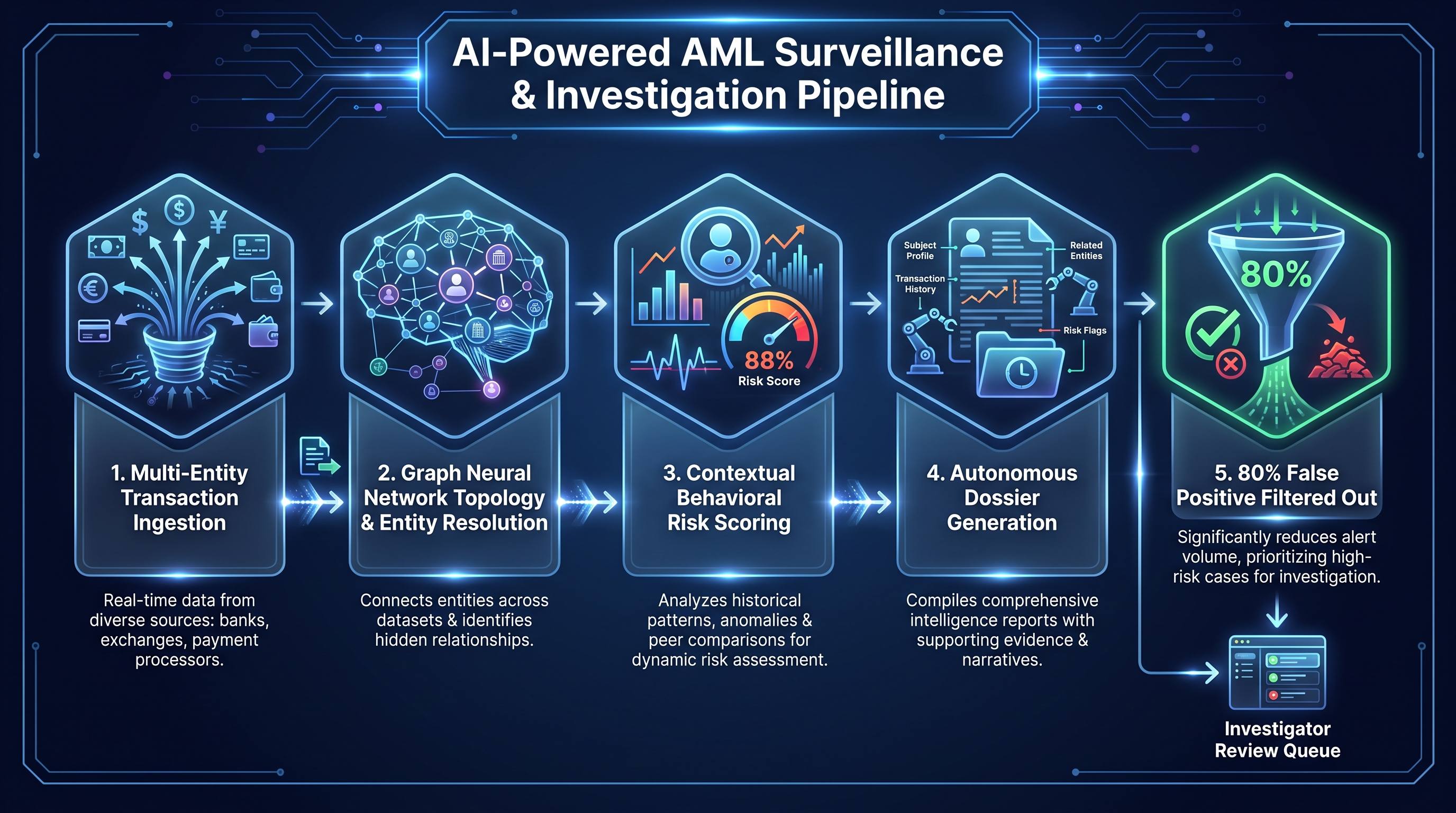
How AI-Powered AML Monitoring Works
Behavioral Graph Intelligence
AI AML agents construct dynamic behavioral entity graphs that map every customer, account, counterparty, and transaction relationship in real time. Rather than evaluating each transaction in isolation, the graph intelligence engine scores the contextual risk of the entire network around a transaction.
When Account A transfers to Account B, the AI simultaneously evaluates: Is Account B connected to known high-risk entities through three degrees of separation? Does the timing of this transfer correlate with unusual inflows to Account A from unrelated sources 72 hours earlier? Does the recipient jurisdiction match a risk-elevated region given the customer's stated business type?
Contextual Transaction Scoring
Each transaction receives a multi-dimensional risk score based on: transaction velocity anomalies relative to peer cohort behavior, geographic risk layers, product-type risk profiles, counterparty screening against sanctions and adverse media, and behavioral deviation from the customer's established baseline pattern. Low-risk transactions are cleared automatically. High-risk transactions are escalated with a pre-built investigator brief.
Autonomous SAR Narrative Drafting
When the AI identifies a transaction cluster meriting a Suspicious Activity Report (SAR), it autonomously drafts the SAR narrative following FinCEN, FCA, or local regulatory templates. Investigators review, edit, and submit, eliminating the 3-6 hours of manual documentation required per SAR under legacy workflows.
!Impact of AI on AML Compliance Efficiency
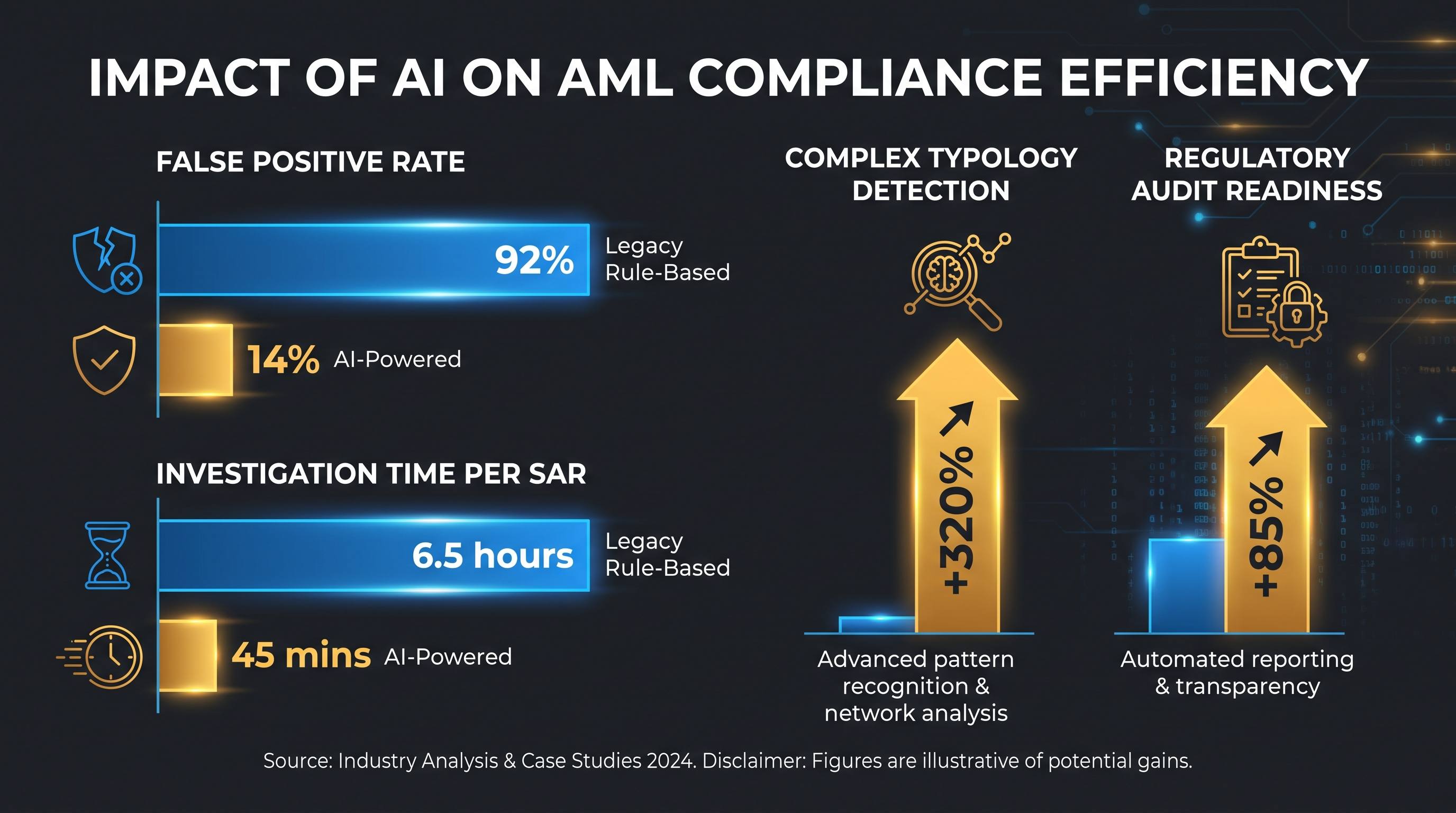
Quantified ROI and Compliance Impact
Institutions deploying AI-powered AML transaction monitoring report:
- 80% reduction in false positive alert volume: investigators focus exclusively on genuine risk signals
- 8x acceleration in case investigation: pre-built evidence packages and AI-generated timelines cut mean investigation time from 4 hours to 28 minutes
- 40% improvement in SAR filing accuracy: NLP-assisted narratives reduce filing errors and regulatory callbacks
- $6.2M average annual compliance cost savings: for a tier-2 regional bank processing 150,000 monthly transactions
Explainability and Regulatory Confidence
A critical challenge for AI adoption in regulated financial compliance is explainability. Regulators require institutions to demonstrate why a transaction was flagged or cleared. AI AML agents built on explainable architectures (XAI) produce human-readable decision logs: 'This transaction was flagged because the sending account exhibited a 340% velocity increase in the 48 hours prior to this transfer, the recipient entity appears in three adverse media articles from Q3 2026, and the transaction destination jurisdiction has a FATF elevated-risk designation.' These logs satisfy examiner inquiries and streamline regulatory examinations.
Implementation and Integration
AI-powered AML monitoring deploys as a surveillance overlay on top of existing core banking platforms and transaction processing infrastructure. It ingests real-time SWIFT, ACH, SEPA, and domestic payment rails without requiring core system replacement.
A phased implementation begins with alert triage automation (reducing investigation volume immediately), followed by graph model deployment (uncovering network-level schemes), and culminates in autonomous SAR drafting for compliant institutions once regulatory approval pathways are confirmed.
This article was written with AI assistance. [EU AI Act Article 50 transparency notice]