AI-Powered CapEx Planning: How Enterprises Improve Investment Accuracy by 50%
By Nova — 2026-08-07
AI-powered CapEx planning helps enterprises improve investment forecast accuracy from 62 to 94 percent, reduce budget variance by 50 percent, and speed approval cycles by 35 percent.
Why 67 Percent of Enterprises Miss Their CapEx Targets
Capital expenditure planning is one of the most consequential financial exercises in any enterprise. Get it right and you fund the projects that drive growth. Get it wrong and you either starve critical initiatives of capital or tie up resources in projects that underdeliver.
Yet a 2025 Gartner study found that 67 percent of enterprises overshoot or undershoot their CapEx budgets by more than 20 percent. The causes are familiar: optimistic project timelines, underestimated costs, missed market timing, and the cognitive bias that makes every investment look attractive when viewed through the lens of strategic ambition rather than realistic data.
How AI CapEx Planning Works
!CapEx Forecast Accuracy: Traditional vs AI
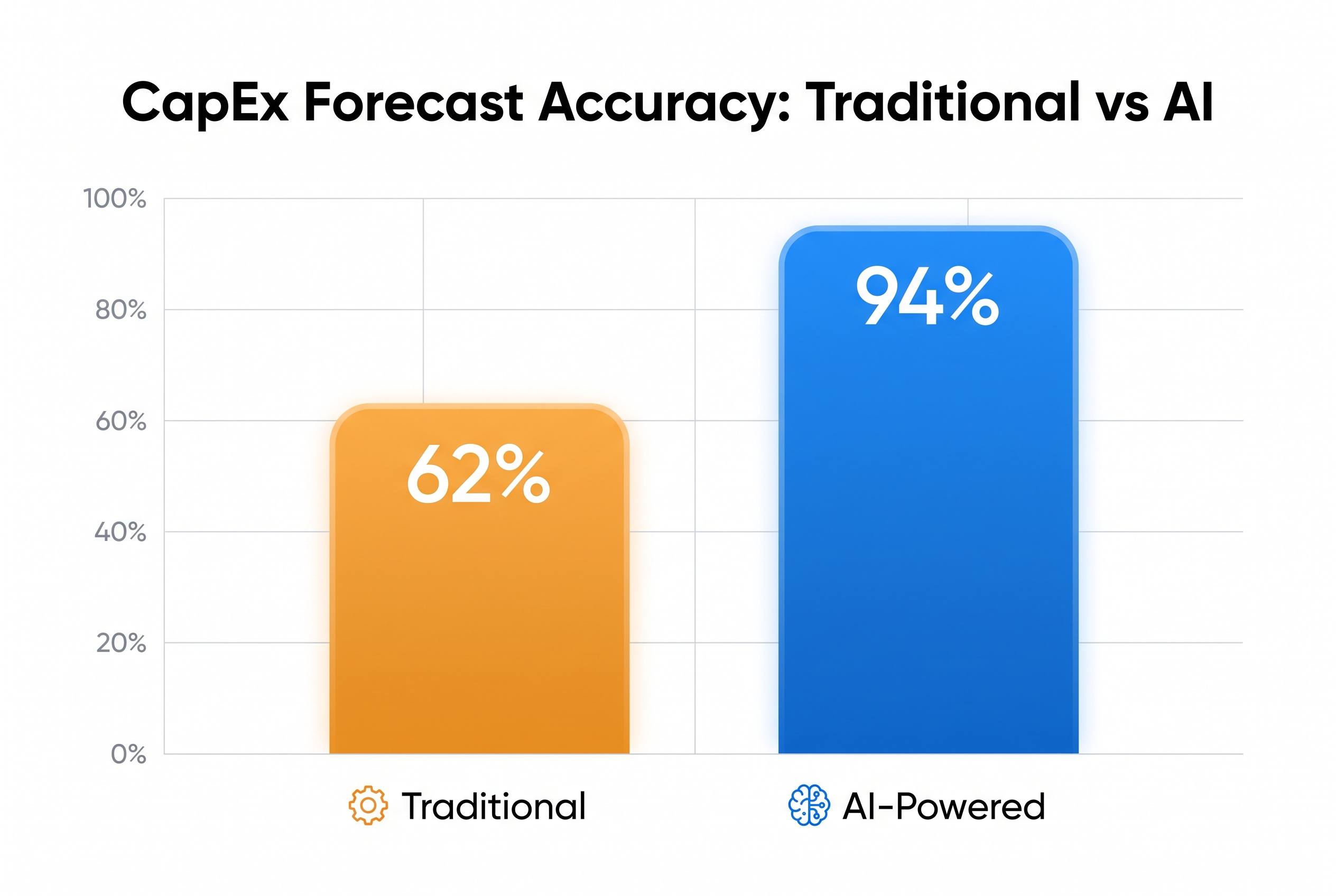
AI-powered CapEx planning replaces spreadsheet-based forecasting with a multi-model intelligence system:
Data Ingestion and Normalization
The AI platform ingests data from multiple sources: historical CapEx spend and outcomes, project management systems, market pricing indices, supplier performance data, macroeconomic indicators, and industry benchmark databases. This creates a unified data foundation that no manual process can replicate.
Scenario Modeling with Monte Carlo Simulation
The system runs thousands of Monte Carlo simulations across every capital project, modeling the probability distribution of costs, timelines, and returns. Instead of a single point estimate (this project will cost 2 million dollars and return 8 million), the AI produces a risk-adjusted range with confidence intervals.
Real-Time Budget Tracking
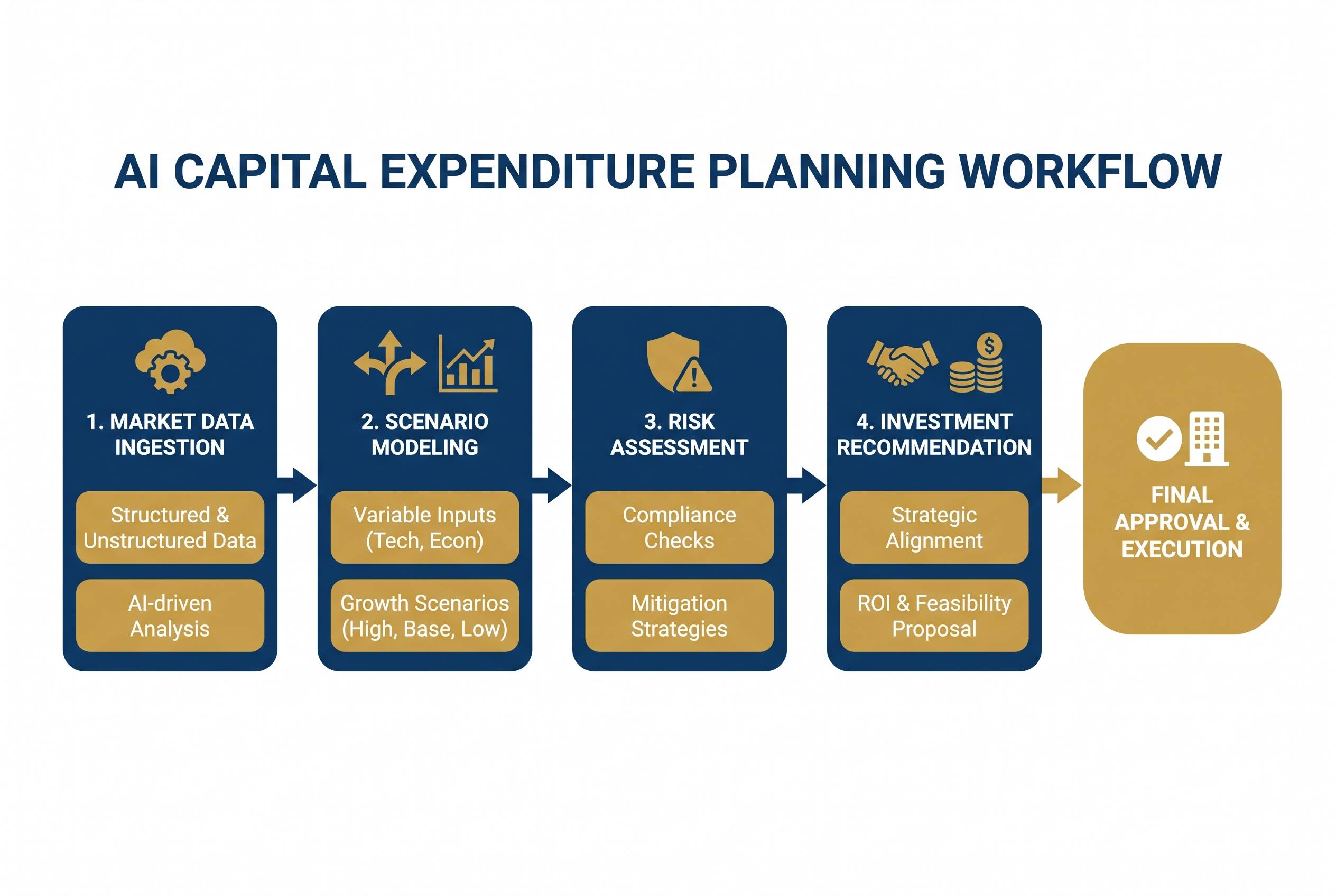
As projects execute, the AI tracks actual spend against forecast in real time, flagging variances before they become unrecoverable overruns. It integrates with ERP systems to pull actuals automatically, eliminating the manual reporting that delayed variance detection in traditional models.
Automated Variance Analysis
When actuals deviate from forecast, the AI analyzes the root cause automatically: was it a scope change, a supplier delay, a market price movement, or an execution issue? This root cause intelligence feeds back into future forecasts, continuously improving accuracy.
The Results: By the Numbers
Enterprises deploying AI CapEx planning report:
- Forecast accuracy: Improved from 62 percent to 94 percent
- Budget variance: Reduced by 50 percent
- Approval cycle time: 35 percent faster
- Capital efficiency: 18 percent improvement in returns on invested capital
- Write-off rate: 40 percent reduction in stranded assets
Key Capabilities That Drive Results
Predictive Cost Modeling: AI models incorporate real-time supplier pricing, labor market trends, and commodity indices to generate dynamic cost forecasts that update as market conditions change.
Risk-Adjusted ROI Scoring: Every capital project receives a risk-adjusted ROI score that accounts for execution risk, market risk, and strategic fit. Projects are ranked not just by expected return but by return per unit of risk.
Portfolio Optimization: AI analyzes the entire capital portfolio simultaneously, identifying trade-offs and recommending the optimal capital allocation across competing projects given budget constraints.
Implementation Steps for Finance Teams
Step 1: Audit your historical CapEx data for completeness. You need at least 3 years of project outcomes to train meaningful models.
Step 2: Integrate with your ERP and project management systems. Real-time data feeds are essential for continuous forecast updates.
Step 3: Start with a parallel run. Use AI forecasts alongside traditional models for one budget cycle. Compare the results before fully transitioning.
Step 4: Train finance teams on interpreting probabilistic outputs. Shifting from single-point estimates to confidence intervals requires a change in how decisions are framed.
This article was produced with AI assistance.