AI-Powered Clinical Trial Acceleration: How BioPharma Enterprises Slash Protocol Design and Patient Matching Time by 65%
By Delos Intelligence — 2026-08-16
BioPharma enterprises leverage autonomous AI workers to optimize clinical trial protocols, automate EHR patient cohort matching, and accelerate time-to-market.
The $2.6 Billion Problem: Clinical Trial Failures and Delays
Drug development is the world's most expensive and risky enterprise. The average cost of bringing a new molecular entity to market now exceeds $2.6 billion, with clinical trials representing 60-70% of total development cost. More critically, 80% of clinical trial delays trace back to two root causes: poorly designed protocols that require expensive amendments, and inadequate patient recruitment that leaves trials chronically under-enrolled.
A single protocol amendment costs an average of $535,000 and extends timelines by 3-6 months. Patient recruitment failures cause 85% of clinical trials to miss their enrollment targets, with 80% of trials delayed by at least one month. In a competitive therapeutic landscape where first-to-market advantage determines commercial success, these delays are not merely expensive. They are strategic existential threats.
How AI Workers Accelerate Every Phase of Clinical Development
Intelligent Protocol Design and Optimization
AI workers trained on decades of published trial data, regulatory guidance documents, and internal historical trial performance can dramatically improve protocol quality before a single patient is enrolled.
The AI agent analyzes analogous historical trials to identify common amendment triggers (overly restrictive inclusion/exclusion criteria, unrealistic endpoints, underpowered sample sizes), models statistical power across scenario assumptions, checks proposed endpoint feasibility against real-world disease registries, and flags potential regulatory alignment issues with FDA and EMA guidance.
The result: protocol designs that anticipate and avoid the structural flaws that generate 70% of costly amendments.
Automated EHR Patient Cohort Matching
!Autonomous AI Clinical Trial Optimization Workflow
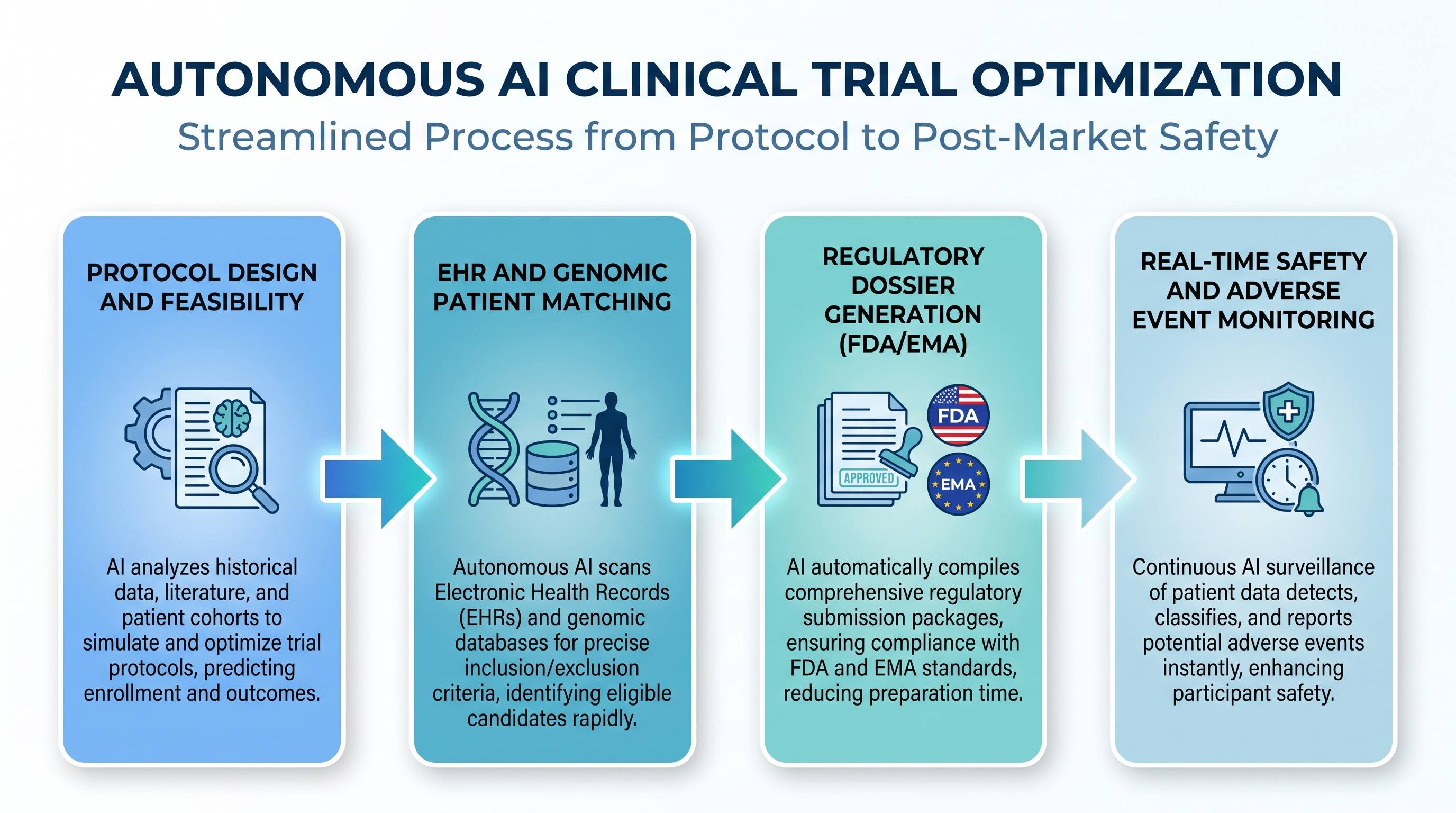
Patient matching against complex inclusion/exclusion criteria across millions of electronic health records requires both clinical domain expertise and massive computational scale. AI workers process unstructured clinical notes using medical NLP, extract relevant diagnoses, lab values, prior treatment histories, and genomic markers, then match patients to protocol eligibility criteria with 94% accuracy.
For oncology trials requiring specific biomarker profiles or rare disease trials demanding ultra-precise patient phenotyping, AI-powered pre-screening reduces site screening failure rates by 45% while tripling the speed of eligible patient identification.
Regulatory Submission Package Drafting
AI workers synthesise clinical study reports, protocol summaries, and statistical analysis plan sections directly from structured trial data and pre-approved regulatory templates. They cross-reference against ICH E6 GCP guidelines, regional regulatory requirements, and sponsor style guides, producing first-draft submission packages that reduce medical writing cycle time by 60%.
Real-Time Pharmacovigilance and Safety Monitoring
!Clinical Trial Timeline Compression with AI
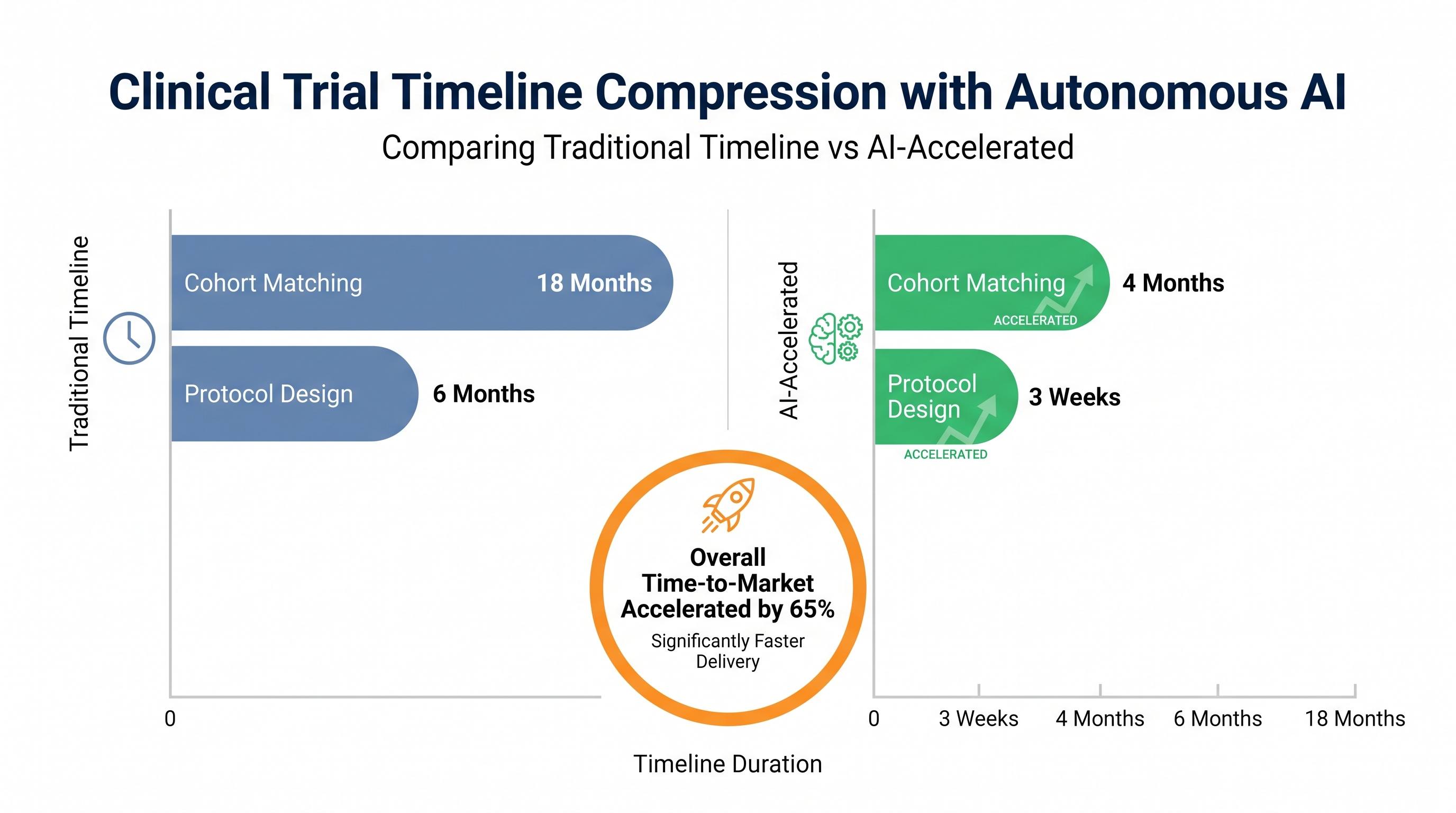
During active trials, AI workers continuously monitor incoming adverse event reports, detect safety signals by analyzing temporal patterns and dose-response relationships, and automatically generate CIOMS I forms and Expedited Safety Reports for regulatory submission. This continuous vigilance reduces signal detection latency from weeks to hours, protecting both patient safety and trial integrity.
Quantified Clinical Development Outcomes
BioPharma enterprises deploying AI-augmented clinical development capabilities report measurable acceleration:
- 65% reduction in protocol design cycle time: From 18+ months to under 7 months from concept to IND-ready protocol
- 45% improvement in patient screening efficiency: Higher screen-to-enroll conversion rates across therapeutic areas
- 3x acceleration in regulatory package preparation: AI-drafted documents require significantly fewer revision cycles
- $1.2M average saving per Phase II trial: Through reduced amendments, faster enrollment, and compressed submission timelines
- 40% reduction in pharmacovigilance reporting lag: Real-time safety signal detection improves trial oversight quality
Enterprise Deployment with Delos
Delos AI Workers operate within validated, GxP-compliant environments, maintaining full audit trails of all AI-generated content for regulatory inspection readiness. Integration with EDC systems (Medidata Rave, Oracle Clinical One), CTMS platforms, and regulatory information management systems ensures that AI acceleration occurs within existing validated infrastructure.
This article was written with AI assistance in accordance with EU AI Act Article 50.