AI-Powered Commercial Insurance Underwriting: How Insurers Accelerate Risk Assessment by 70% and Optimize Loss Ratios
By Delos Intelligence — 2026-08-23
Explore how commercial insurers leverage AI agents to automate submission ingestion, exposure modeling, appetite triage, and loss ratio optimization.
The Commercial Underwriting Bottleneck
Commercial insurance underwriters face a structural capacity crisis. The average commercial lines submission takes 8 to 14 days to progress from ACORD-formatted submission receipt to bindable quote, with complex accounts requiring 4 to 6 weeks of exposure analysis, reinsurance consultation, and actuarial modeling. During this window, brokers simultaneously shop submissions across 5 to 10 competing markets.
The consequences are measurable: insurers lose 35 to 45 percent of commercially viable submissions due to quoting latency, while underwriters spend 70 percent of their time on administrative data extraction and spreadsheet manipulation rather than risk judgment and broker relationship management.
AI workers are rewriting the economics of commercial underwriting. By automating ACORD parsing, exposure database enrichment, appetite triage, and predictive loss modeling, AI-powered underwriting workflows compress submission-to-quote cycles from weeks to hours while improving loss ratio performance through more granular risk differentiation.
The Four Structural Inefficiencies in Commercial Lines Underwriting
1. ACORD Parsing and Supplemental Data Entry: Commercial submissions arrive as 20 to 80 page PDF packages containing ACORD forms, loss runs, engineering surveys, and financial statements. Manual data entry into underwriting workbenches consumes 3 to 5 hours per submission.
2. Exposure Database Aggregation: Underwriters manually query Verisk, Dun & Bradstreet, Google Street View, building permit databases, and FEMA flood maps. Aggregating exposure data for a mid-market account routinely takes 4 to 8 hours.
3. Appetite Misalignment and Ghost Submissions: Without real-time appetite screening, underwriters invest hours evaluating submissions that fall outside risk appetite parameters. Ghost submissions, accounts unlikely to bind regardless of price, consume 30 to 40 percent of underwriter capacity.
4. Loss Ratio Opacity: Traditional actuarial pricing models are updated annually or semi-annually, creating systematic lag between emerging loss trends and pricing responses. Underwriters lack real-time feedback loops on individual account performance against modeled expectations.
!AI Commercial Underwriting Workflow Architecture
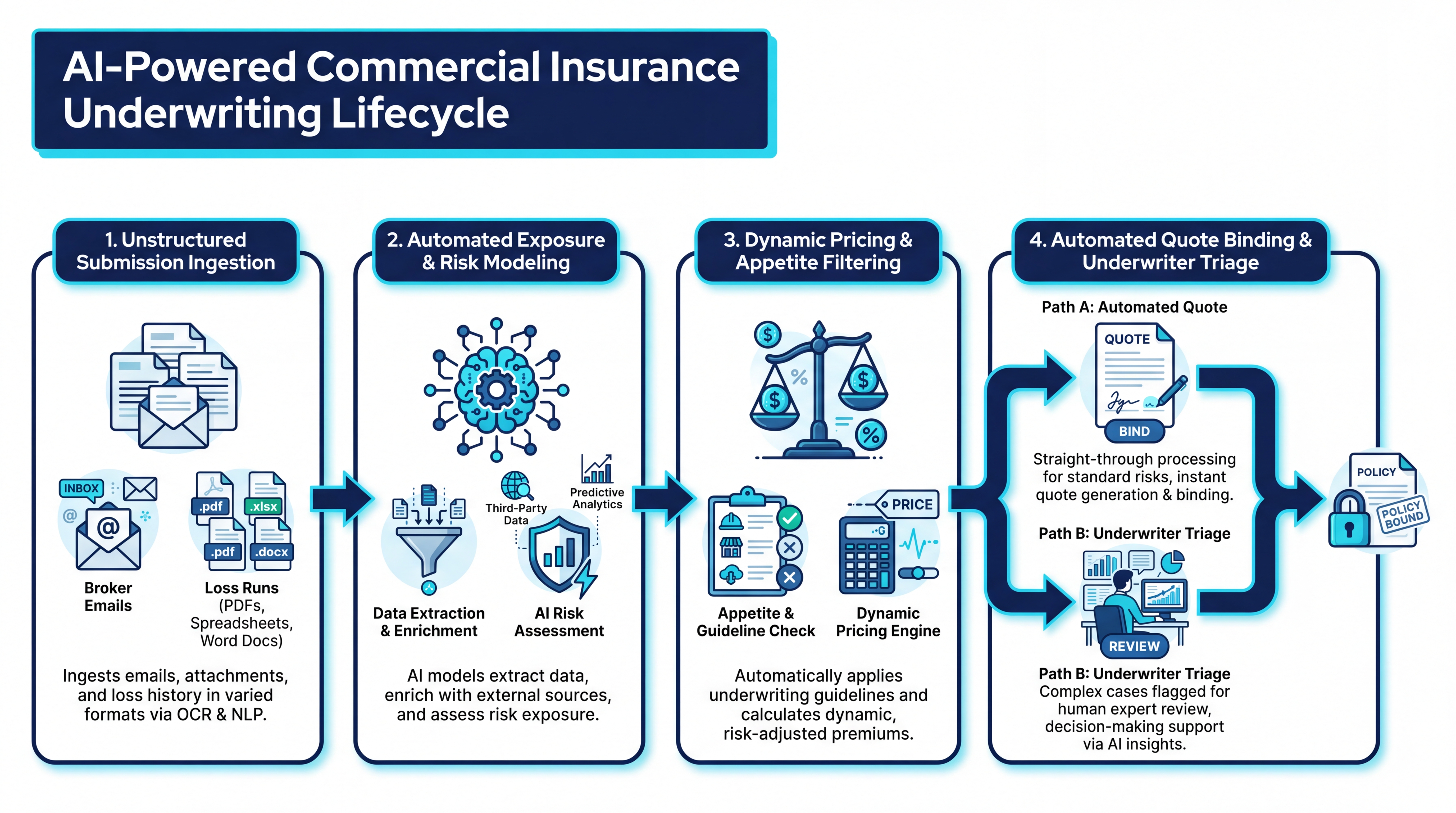
How AI Workers Automate Commercial Underwriting
Intelligent Submission Ingestion and ACORD Parsing
AI workers ingest commercial submissions in any format, including PDFs, Excel spreadsheets, email attachments, and broker portal APIs, applying multi-modal extraction to parse ACORD 125, 126, 127, and supplemental forms into structured underwriting data objects. Named entity recognition models identify locations, operations descriptions, revenue figures, and loss history with greater than 98 percent field extraction accuracy.
Automated Exposure Database Enrichment
Once submission data is structured, AI workers simultaneously query Verisk ISO datasets, RMS and AIR catastrophe exposure models, FEMA NFIP flood zone maps, USGS seismic hazard zones, and commercial property databases to generate a fully enriched exposure profile within minutes rather than hours.
For liability lines, AI agents query state workers compensation bureau filings, OSHA violation registries, occupational classification databases, and industry loss benchmarks to construct a comprehensive risk profile without underwriter intervention.
Predictive Appetite Scoring and Triage
A gradient boosted ensemble model trained on 5 to 10 years of historical submission outcomes scores every incoming submission against the underwriting appetite matrix, generating:
- Bind Probability Score: Estimated likelihood the account will bind at current pricing levels.
- Appetite Alignment Score: Composite assessment of class of business fit, geographic concentration impact, and reinsurance treaty compatibility.
- Priority Routing Flag: Immediate escalation of high-value, high-appetite accounts to senior underwriters within minutes of receipt.
!Commercial Underwriting Performance Impact
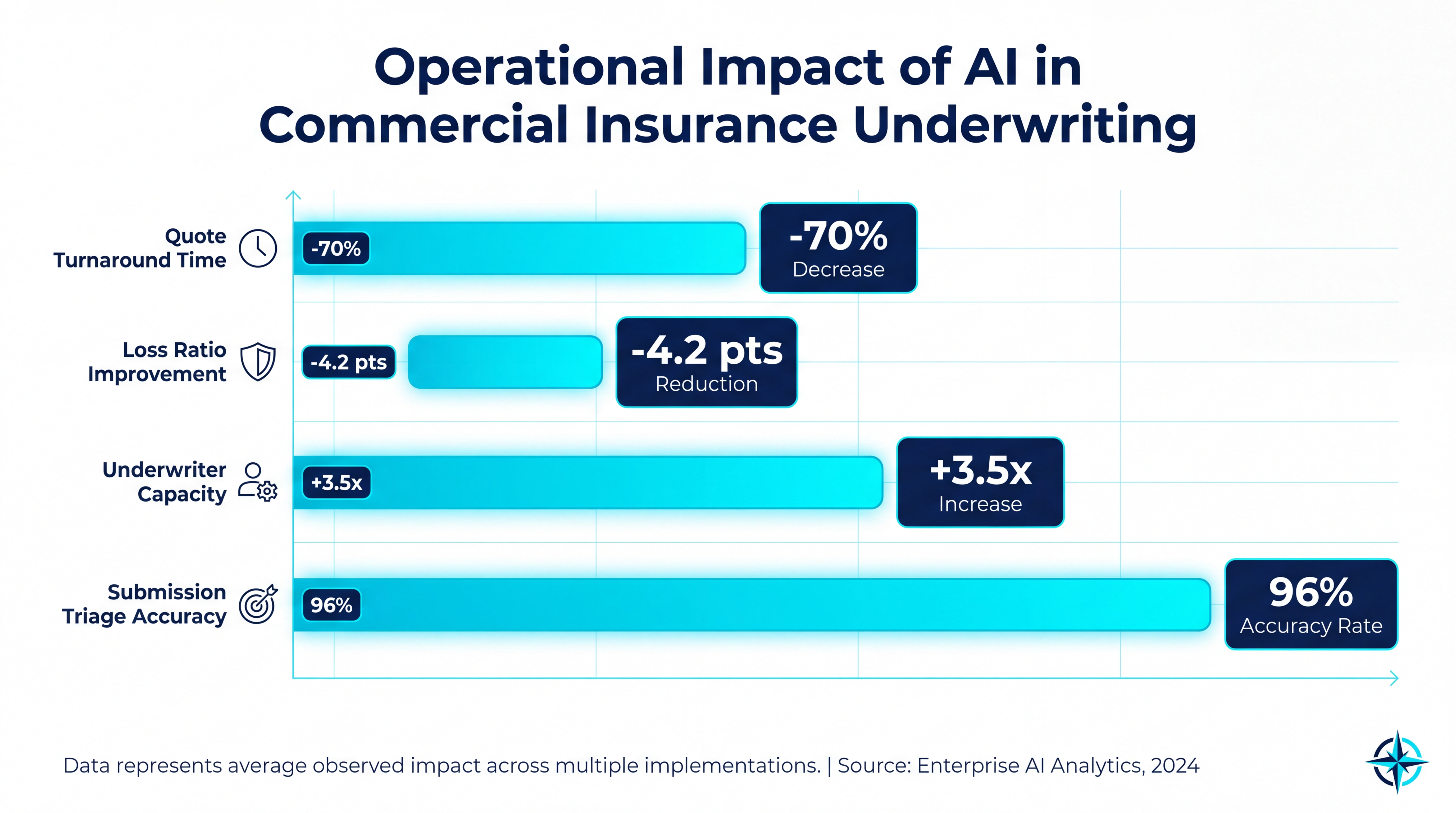
Operational and Financial Impact
| Performance Metric | Traditional | AI-Powered | Improvement |
|---|---|---|---|
| Submission-to-quote cycle time | 8 to 14 days | 6 to 18 hours | -70% |
| Underwriter administrative time | 70% of capacity | 25% of capacity | -45pp |
| Ghost submission rate | 38% of submissions | 9% of submissions | -29pp |
| Loss ratio on AI-priced accounts | Market average | -3.8pp better | +3.8pp |
| Renewal retention rate | 72% | 84% | +12pp |
Governance, Explainability, and Regulatory Compliance
All AI pricing recommendations carry full model explainability outputs, including contributing factor attribution, comparable risk benchmarking, and confidence intervals. This enables underwriters to defend pricing decisions to regulators, reinsurers, and internal audit functions.
State insurance department rate filing compliance is maintained through configurable guardrails that prevent AI models from recommending rates outside approved filed ranges, with automatic escalation triggers for accounts requiring prior approval.
Implementation Roadmap for Commercial Lines Leaders
1. Submission Ingestion Integration: Connect AI workers to your existing broker portal, email submission inbox, and InsurTech submission APIs.
2. Exposure Enrichment Pipeline Configuration: Integrate with your licensed Verisk, RMS, and catastrophe modeling data subscriptions.
3. Appetite Model Training: Train predictive appetite and bind probability models on 3 to 5 years of historical submission and bind data.
4. Underwriter Workflow Integration: Embed AI-generated risk summaries and pricing recommendations into existing underwriting workbench platforms.
5. Performance Feedback Loop: Activate continuous model retraining as actual loss development data is ingested against modeled expectations.