AI-Powered Customer Retention: How Enterprises Reduce Churn by 35% (And Why 72% Still Rely on Exit Interviews)
By Delos Intelligence — 2026-07-19
Learn how AI-powered customer retention helps enterprises predict churn 30 days in advance, reduce churn by 35%, and why 72% still wait until customers leave to act.
The $136 Billion Problem Hiding in Your Pipeline
Customer churn is the most expensive problem in enterprise business, and almost nobody treats it with the urgency it deserves.
The average enterprise loses 23% of its customers annually. For a company with $50M in recurring revenue, that's $11.5M walking out the door every year. The cost of replacing each customer is 5-7x the cost of keeping them.
Yet 72% of enterprises still discover churn the same way: when the customer sends a cancellation notice. By then, it's too late. The decision was made weeks or months ago, and no amount of discounting or escalation calls will change it.
AI-powered customer retention flips the model. Instead of reacting to churn, enterprises are predicting it 30+ days in advance, intervening automatically, and reducing churn rates by 35%.
How AI Predicts Churn Before It Happens
The Signal Layer
Every customer generates dozens of signals every day: login frequency, feature usage patterns, support ticket volume, response times to outreach, billing page visits, API call volume changes, and dozens more.
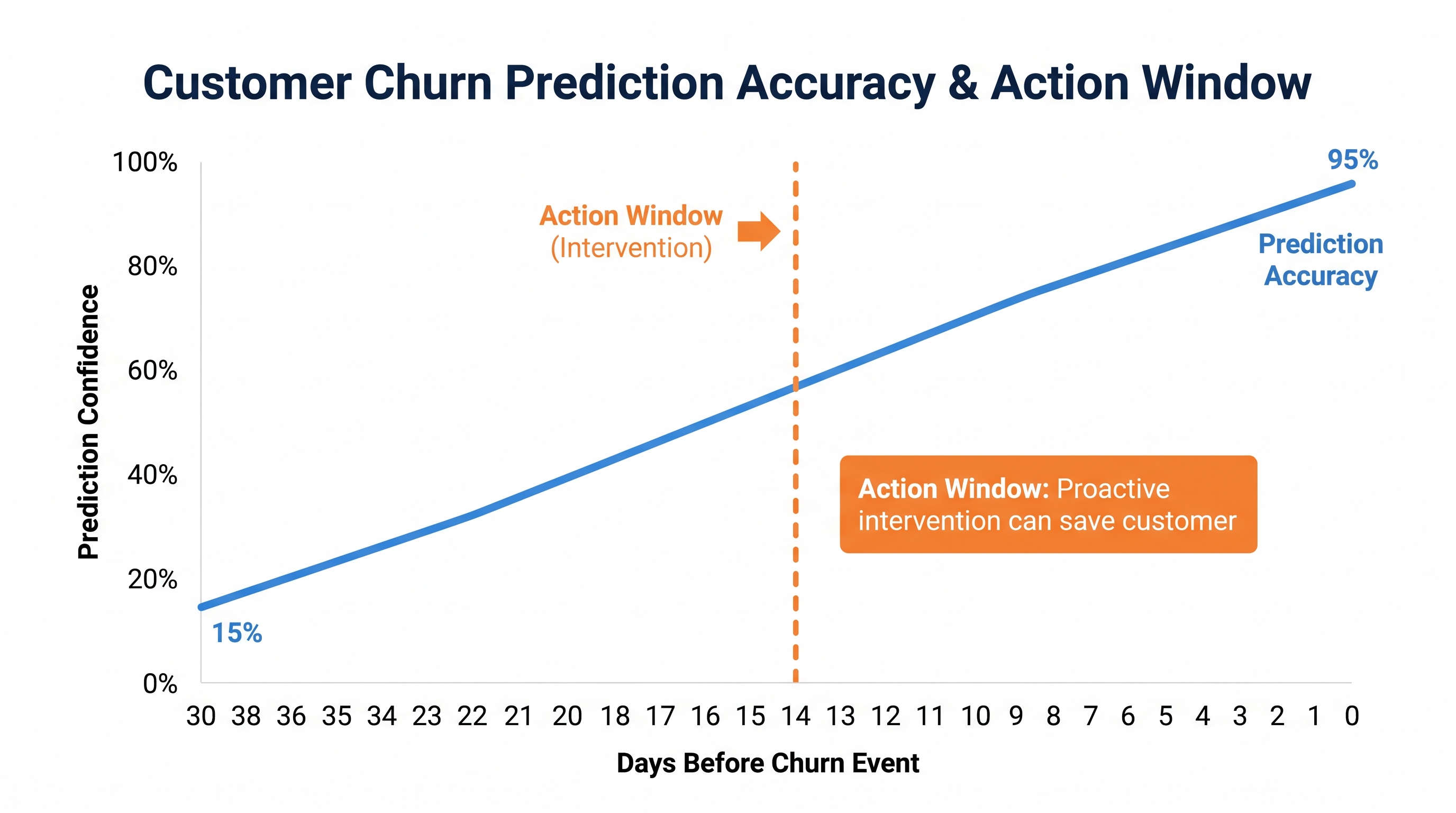
Humans can't process this. A customer success manager handling 200 accounts can maybe track 5-6 signals per account, superficially. AI processes 40+ signals per account in real-time, identifying patterns that precede churn with 85% accuracy.
!Churn prediction accuracy improves as AI analyzes more signals over 30 days
The Pattern Recognition
AI-powered retention systems analyze historical churn data to identify the patterns that preceded past cancellations. The signals are often counterintuitive:
- Increased support ticket volume in the 30 days before churn (customers trying to make it work before giving up)
- Decreased API calls during business hours but increased billing page visits
- Shift from power-user features to basic features (disengagement signal)
- Team size reduction in the customer's organization (budget pressure indicator)
- Gap in regular usage patterns (the strongest single predictor)
When these signals converge, the AI assigns a churn risk score from 0-100 and triggers automated intervention workflows.
The Intervention Layer
This is where most retention programs fail. They identify at-risk customers but rely on humans to act. A CSM with 200 accounts can't personally intervene on 40 at-risk customers in the same week.
AI-powered retention automates the intervention:
!AI customer retention pipeline: from risk scoring to saved customers
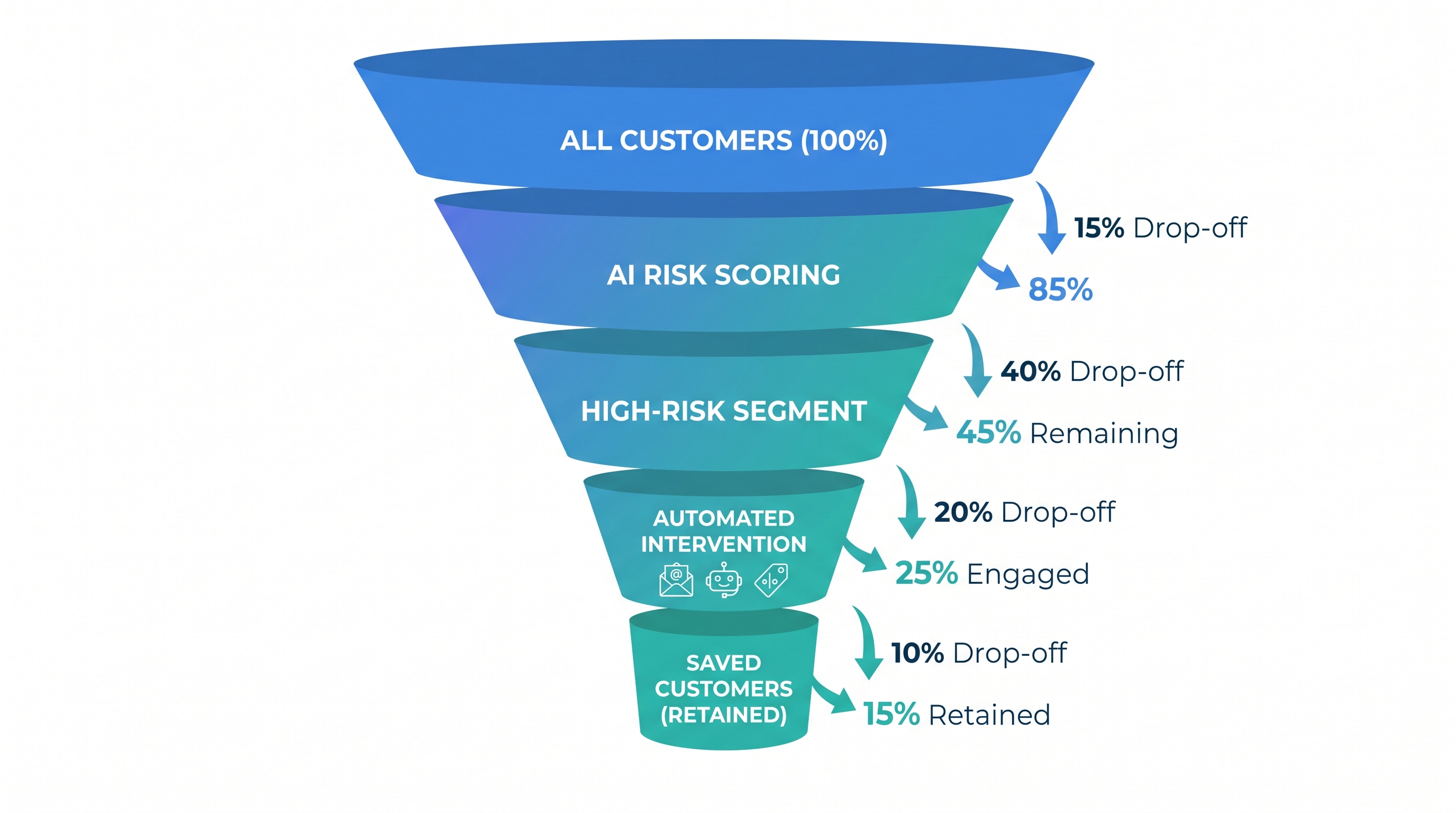
- Risk score 30-50 (low): Automated email with relevant case studies, feature tips, or usage optimization guides
- Risk score 50-75 (medium): Automated outreach from the CSM (AI drafts personalized email, CSM reviews and sends), plus targeted in-app messaging
- Risk score 75-100 (high): Immediate alert to CSM and account manager, AI-prepared intervention plan with recommended actions, scheduled executive check-in
The Results Enterprises Are Seeing
Companies that have implemented AI-powered customer retention report:
- 35% reduction in annual churn rate
- 30-day advance warning for 85% of churn events
- 4.2x ROI on retention tooling investment within 12 months
- 67% of at-risk customers successfully retained through automated intervention
- $3.8M average annual revenue recovered per $50M ARR
Why 72% Still Rely on Exit Interviews
If the results are this clear, why isn't everyone doing it?
1. Data silos. Customer data lives in 6-8 different systems: CRM, support desk, billing platform, product analytics, marketing automation, communication logs. Building a unified view requires integration work that most teams deprioritize.
2. "We already have a CSM team." Many leaders believe human CSMs are sufficient. They are, for 20-30 accounts. At 200+ accounts, the math breaks down. AI doesn't replace CSMs; it makes them 5x more effective by telling them exactly who to call, when, and what to say.
3. Fear of false positives. Leaders worry that automated intervention will annoy customers who weren't actually going to churn. In practice, well-tuned AI systems have a false positive rate below 8%, and the interventions (helpful content, check-in emails) are low-friction enough that they don't damage relationships.
4. No clear ownership. Customer retention sits between CS, sales, product, and marketing. Nobody owns it end-to-end. AI-powered retention needs an executive sponsor who can break down silos and mandate the data integration.
The 90-Day Implementation Plan
Days 1-30: Data Foundation
- Integrate your CRM, support desk, product analytics, and billing data into a unified customer data platform
- Define your churn signals and weight them based on historical analysis
- Build your baseline churn rate and segment by customer type
Days 31-60: Prediction Model
- Deploy AI churn prediction models trained on your historical data
- Set up real-time risk scoring for all active customers
- Validate predictions against actual churn outcomes
Days 61-90: Intervention Automation
- Design intervention workflows for each risk tier
- Connect AI risk scores to your CRM and communication tools
- Launch automated intervention campaigns and track results
The Cost of Inaction
Every quarter without AI-powered retention, you're losing customers you could have saved. At $50M ARR with 23% annual churn, that's $2.9M in preventable churn per quarter.
The enterprises that move now will compound their advantage: better prediction models, more saved customers, higher NPS, and lower CAC because they don't need to replace as many churned customers.
The choice is simple: predict and prevent, or wait and react. Your customers are already deciding whether to stay. The question is whether you'll know before they tell you.