AI-Powered Employee Onboarding and Offboarding: How Enterprises Cut Provisioning Time by 85% and Eliminate Security Risks
By Delos Intelligence — 2026-08-20
Discover how enterprise AI workers automate HR provisioning and deprovisioning, slashing onboarding time by 85% while closing critical security gaps.
The Cross-Functional Provisioning Bottleneck
Every enterprise hire triggers a cascade of interdependent provisioning tasks. The average enterprise takes 3 to 7 days to grant a new employee full system access. Across HR, IT helpdesk, security, and line-of-business teams, each access request traverses multiple approval queues, ticketing systems, and manual configuration steps.
This delay carries real consequences. A new Sales Engineer without CRM access cannot engage prospects. A developer waiting for cloud environment provisioning cannot ship code. Industry data shows that delayed access costs enterprises an average of 11 productive hours per new hire, and in high-velocity orgs, that scales to millions annually.
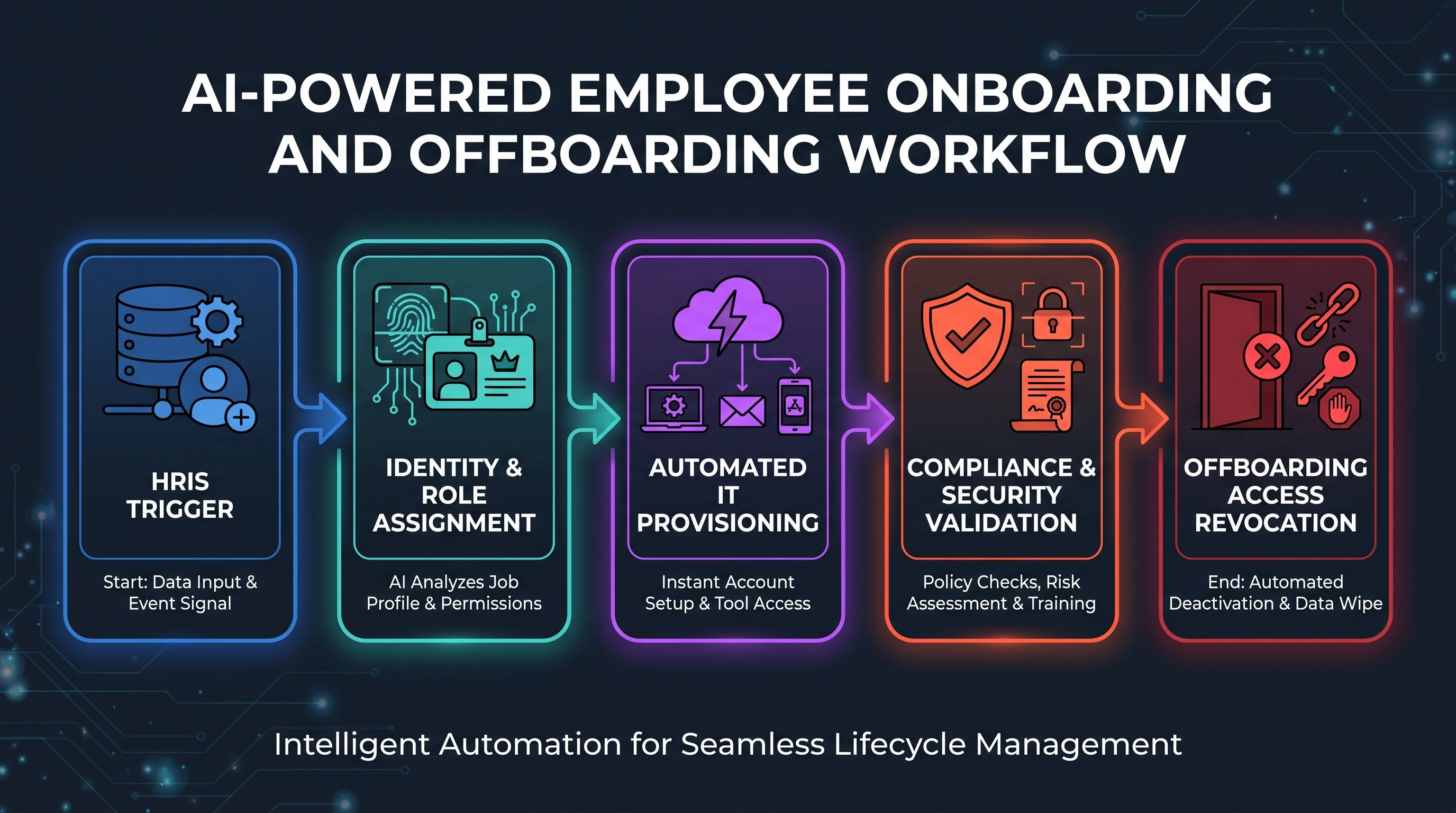
!AI-Powered Employee Provisioning Workflow
The Hidden Risk: Orphaned Access and Shadow Permissions
If onboarding is slow, offboarding is dangerous. When employees resign, are terminated, or change roles, the deprovisioning process is frequently incomplete. Departed employees retain access to cloud environments, SaaS tools, and sensitive repositories long after departure. This shadow access creates critical compliance exposure under SOC 2, ISO 27001, and GDPR.
Manual offboarding checklists, even when thorough, miss secondary accounts, OAuth-connected apps, API tokens, and shadow credentials. The average enterprise has 3.2 ungoverned access pathways per departing employee.
How Autonomous AI Workers Transform the Provisioning Lifecycle
Zero-Day Access Provisioning
AI workers integrate with HRIS platforms (Workday, SAP SuccessFactors), identity providers (Okta, Azure AD, Google Workspace), and ITSM systems (ServiceNow, Jira) to trigger provisioning the moment an employment record is created or a role change is approved. Access bundles are determined by role-based access control (RBAC) policies, with AI workers mapping job titles to predefined entitlement templates.
Intelligent Role-Based Entitlement Matching
AI workers analyze the new hire's role, department, seniority level, and geographic location to recommend the minimal required access set. This principle of least privilege reduces over-provisioning by 62% compared to manual processes.
Automated Offboarding Deprovisioning
When an employee record is marked inactive, AI workers execute a complete deprovisioning sweep: revoking SSO sessions, disabling directory accounts, rotating API tokens, removing OAuth authorizations, and archiving data according to retention policies. The entire process completes in under 15 minutes.
Compliance Audit Trails
Every provisioning and deprovisioning action is logged with timestamps, actor identity, and decision rationale. These immutable audit trails satisfy SOX, HIPAA, and ISO 27001 audit requirements without manual evidence collection.
!Operational Impact of AI-Powered Onboarding and Offboarding

Enterprise ROI Benchmarks
| Metric | Manual Process | AI-Automated | Improvement |
| :--- | :--- | :--- | :--- |
| Average time to full access | 3-7 days | Under 4 hours | -85% |
| Offboarding completion rate | 67% within 24h | 100% within 15 min | +50 pts |
| Orphaned accounts at 90 days | 31% of departures | < 0.5% | -97% |
| IT helpdesk provisioning tickets | 100% manual | < 5% requiring human touch | -95% |
Implementation Roadmap
1. Integrate HRIS and IdP: Connect HR systems and identity providers to the AI orchestration layer.
2. Define RBAC entitlement templates: Map job roles to access bundles across all enterprise systems.
3. Configure governance thresholds: Set SLAs for provisioning completion and deprovisioning sweeps.
4. Activate continuous access reviews: Schedule periodic AI-driven access certifications to catch role drift.
Conclusion
Employee onboarding and offboarding automation is one of the highest-ROI enterprise AI use cases. By eliminating manual provisioning workflows and enforcing deprovisioning completeness, enterprises simultaneously improve the employee experience and harden their security posture. The 85% reduction in provisioning time is achievable within 90 days of deployment.
This article was created with AI assistance. | La redaction de cet article a ete assistee par IA.