AI-Powered Electronic Trial Master File (eTMF): How Biopharma Leaders Accelerate Regulatory Inspection Readiness
By Delos Intelligence — 2026-08-21
Discover how biopharma sponsors and CROs use AI to automate eTMF document classification and cut filing cycles by 80%.
The eTMF Compliance Crisis in Clinical Trials
Electronic Trial Master Files are the regulatory backbone of clinical trial evidence. Under ICH E6(R3) GCP guidelines, FDA 21 CFR Part 312, and EU CTR regulations, sponsors and CROs must maintain audit-ready documentation for every trial activity: protocol amendments, investigator credentials, informed consent forms, monitoring visit reports, and regulatory correspondence. A single incomplete or misfiled document can jeopardize trial approval or trigger a clinical hold.
The DIA Reference Model Challenge
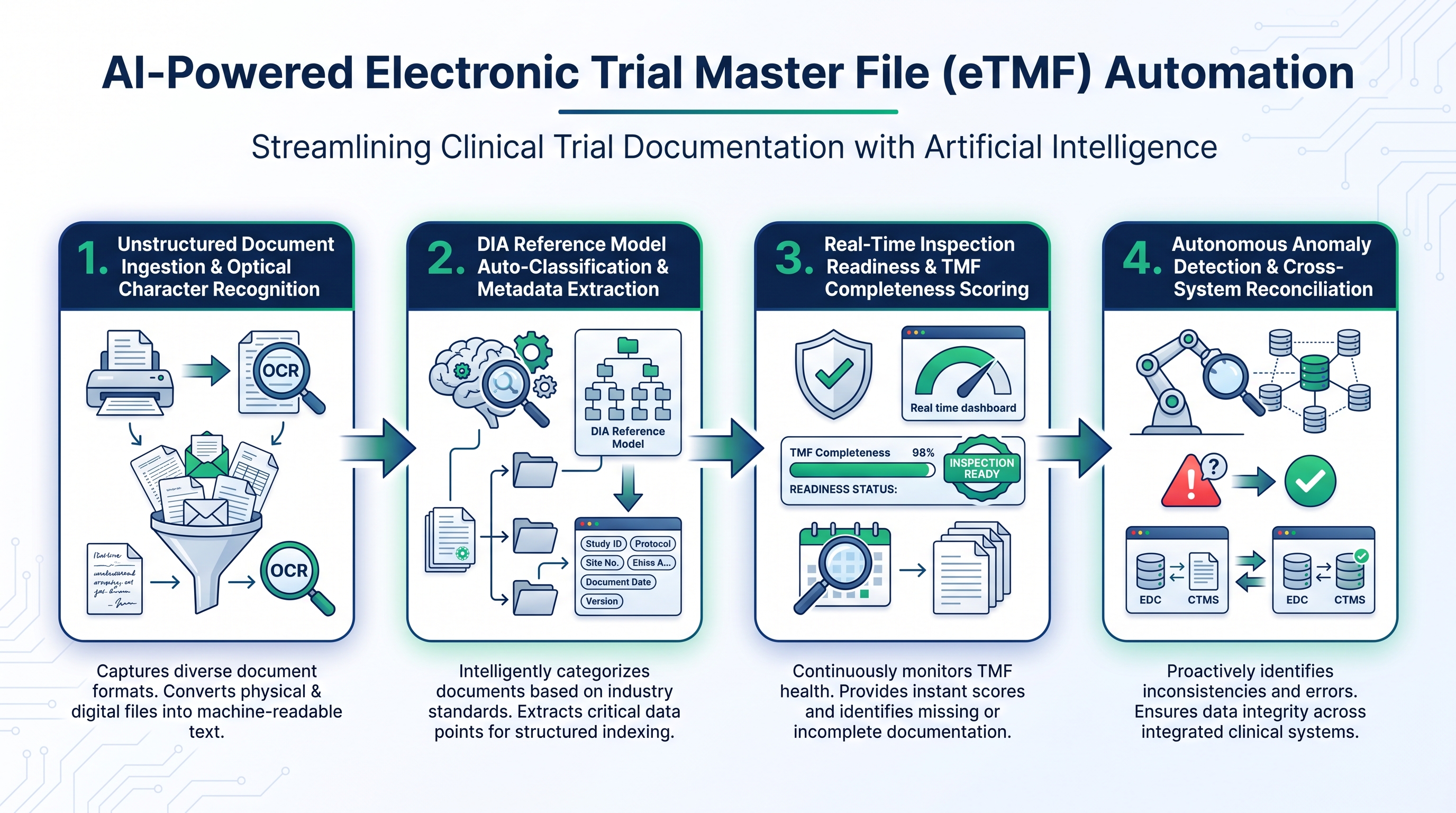
The DIA eTMF Reference Model defines 187 distinct document zones, sections, and artifacts that must be managed across the trial lifecycle. In large Phase III trials, this translates to managing 15,000 to 50,000 individual documents across multiple investigator sites, CROs, and functional outsourcing partners. Traditional eTMF platforms require human document specialists to manually classify, index, and verify each artifact, creating persistent backlogs and inspection readiness gaps.
AI-Powered eTMF: The Autonomous Document Intelligence Architecture
Intelligent Document Ingestion and Auto-Classification
AI workers connect to email systems, electronic data capture platforms, CTMS, and site document portals to automatically ingest trial documents as they are generated. Fine-tuned NLP classifiers assign each document to the precise DIA Reference Model artifact type with 97% accuracy, eliminating manual indexing queues that typically run 3-6 weeks behind filing deadlines.
Completeness Scoring and Gap Analysis
AI workers continuously evaluate completeness against the expected artifact inventory for each trial phase and site. A dynamic completeness dashboard shows inspection readiness scores by zone, section, and investigator site in real time. When gaps are detected, AI workers automatically generate filing requests to responsible parties with deadline reminders and escalation protocols.
Version Control and Supersession Management
Protocol amendments, consent form revisions, and investigator brochure updates generate complex version chains. AI workers maintain bi-temporal audit trails that preserve both the document version effective at any historical point in time and the current approved version, ensuring compliance with 21 CFR Part 11 requirements for electronic records.
Automated Regulatory Submission Packaging
When a trial reaches an NDA or MAA submission milestone, AI workers automatically compile the required eCTD document packages from the eTMF repository, validate document completeness and format compliance, and flag any deficiencies before submission. Submission preparation that previously consumed 6-8 weeks of regulatory affairs resources completes in 3 days.
!Operational Impact of AI eTMF
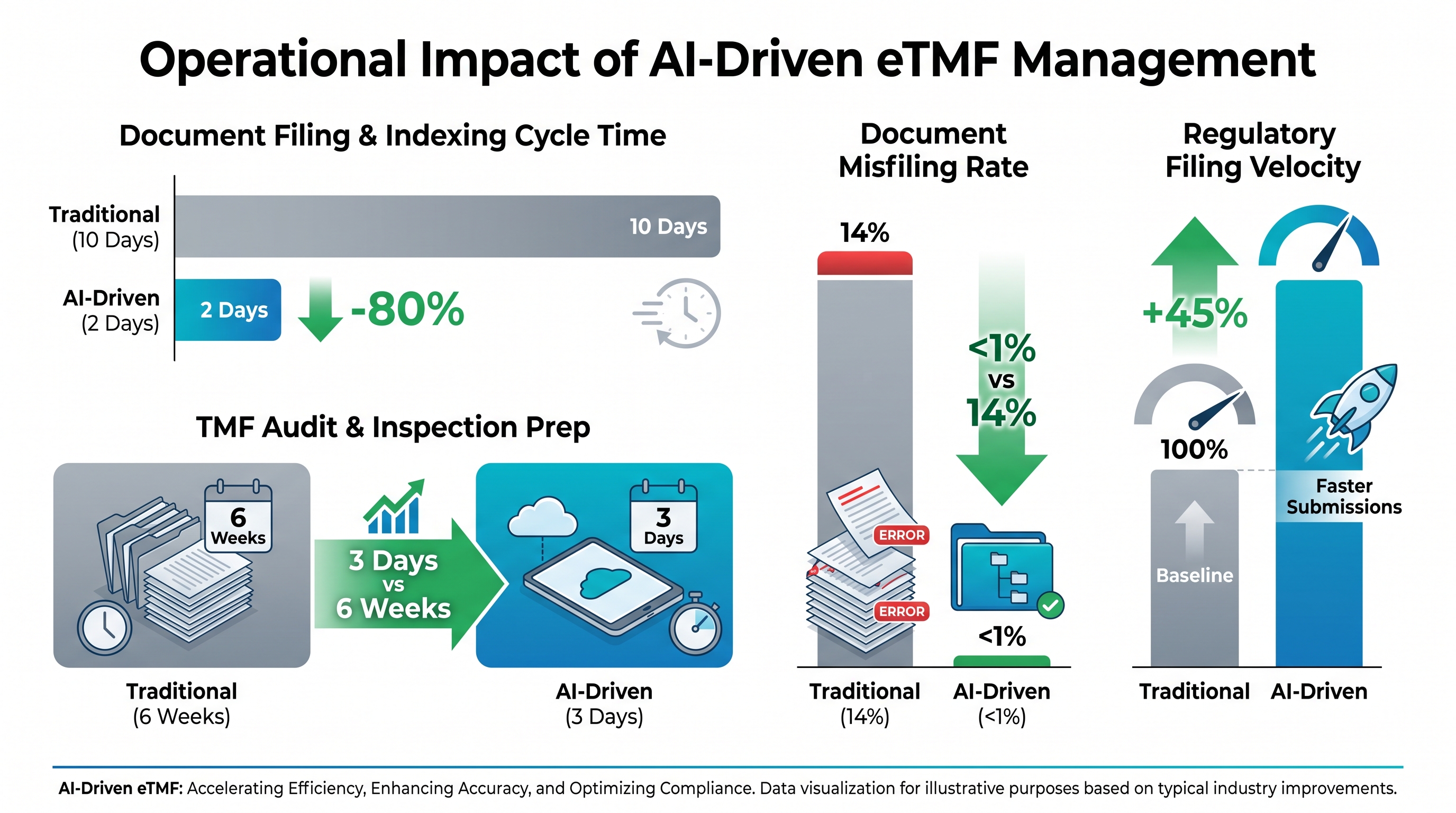
Quantified Operational and Compliance Impact
| Metric | Traditional eTMF | AI-Powered eTMF | Improvement |
|---|---|---|---|
| Document classification backlog | 3-6 weeks | Real-time | -95% |
| Inspection preparation time | 4-6 weeks | 3 business days | -80% |
| Filing cycle time per document | 8-12 days | Under 24 hours | -85% |
| Completeness score at inspection | 72% average | 98% average | +26pp |
Implementation Roadmap
Phase 1: Integrate AI eTMF with existing CTMS, EDC, and email systems. Run retrospective auto-classification on historical trial documents.
Phase 2: Activate real-time completeness monitoring. Deploy automated filing request workflows for active trials.
Phase 3: Enable automated regulatory submission packaging. Activate inspection simulation reports for upcoming authority inspections.
This article was written with AI assistance.