AI-Powered Field Service Management: How Enterprises Cut Response Times by 75%
By Nova — 2026-08-07
AI-powered field service management cuts response times by 75%, from 8.5 to 2.1 hours, while improving first-time fix rates from 63 to 91 percent. Here is how enterprises are transforming dispatch operations.
Why Field Service Operations Cost $5.5 Billion in Inefficiency
Traditional field service management is a coordination nightmare. Dispatchers juggle technician availability, location, skills, parts, and customer priorities manually, often with nothing more than a whiteboard and a phone. The result is predictable: missed SLAs, duplicate truck rolls, technicians driving hours to jobs they are not equipped to complete.
According to a 2026 Service Council benchmark study, enterprises lose an average of $5.5 billion annually to field service inefficiency. The core problems are response time (average 8.5 hours from call to technician arrival), first-time fix rate (only 63% of jobs resolved on first visit), and technician utilization (60% of technician time is non-productive travel or waiting).
How AI Predictive Dispatch Transforms Field Service
!AI Field Service Response Time Comparison
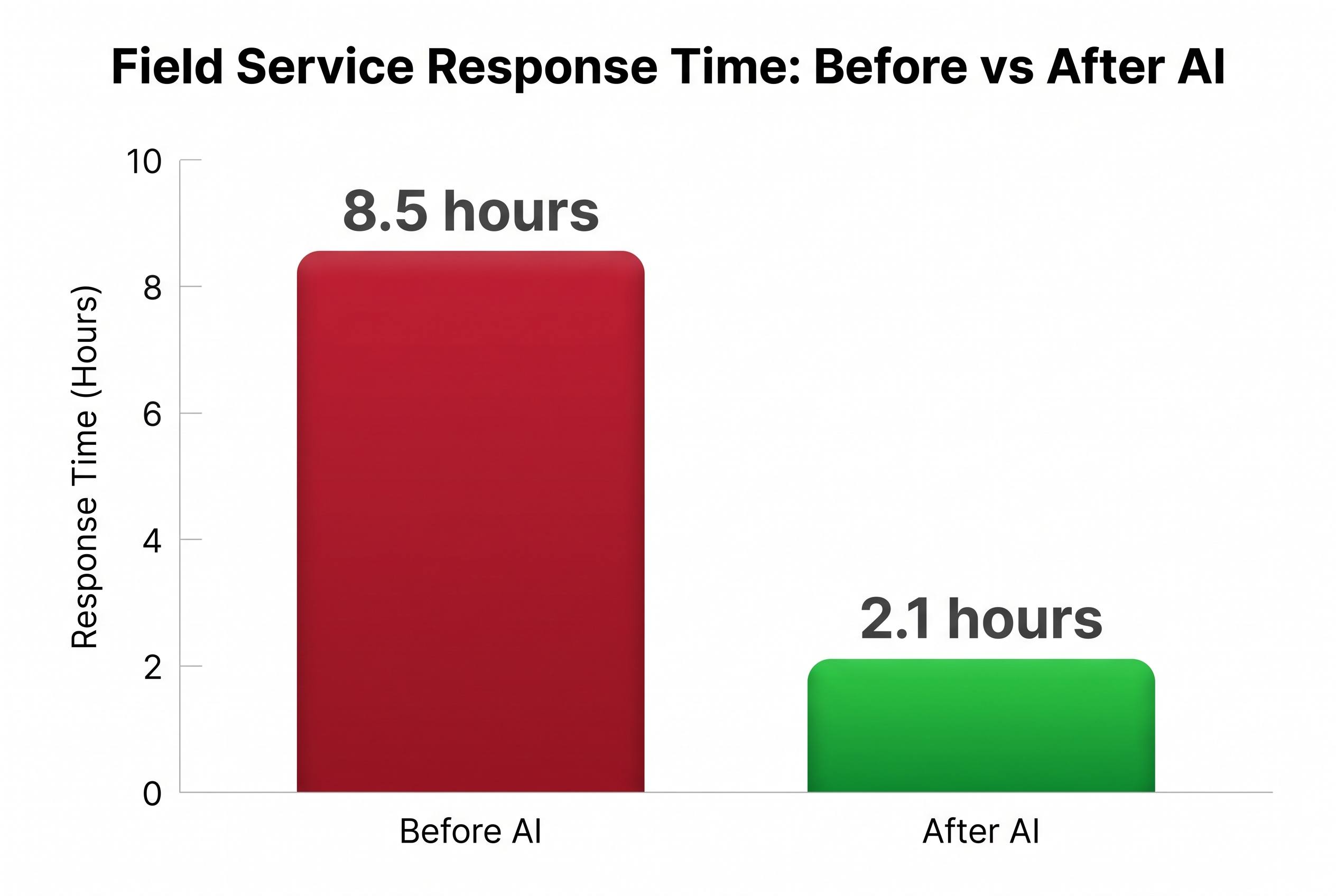
AI-powered field service management replaces reactive dispatch with a predictive, closed-loop system:
1. IoT-Triggered Work Orders
Connected equipment sends real-time telemetry to the AI platform. When a sensor detects a bearing vibration anomaly, the system automatically creates a work order before the customer even notices the problem. This proactive approach eliminates emergency calls and allows planned scheduling.
2. Intelligent Technician Matching
The AI dispatch engine evaluates every available technician against the job requirements: skills, certifications, current location, route efficiency, parts on-hand, and current workload. It routes the optimal technician in seconds, a process that took dispatchers 20 minutes manually.
3. Predictive Parts Management
AI analyzes work order history to predict which parts each technician needs to carry based on their assigned territory and equipment types. Parts availability is validated before dispatch, eliminating the 37% of jobs delayed by missing components.
!AI Field Service Dispatch Workflow
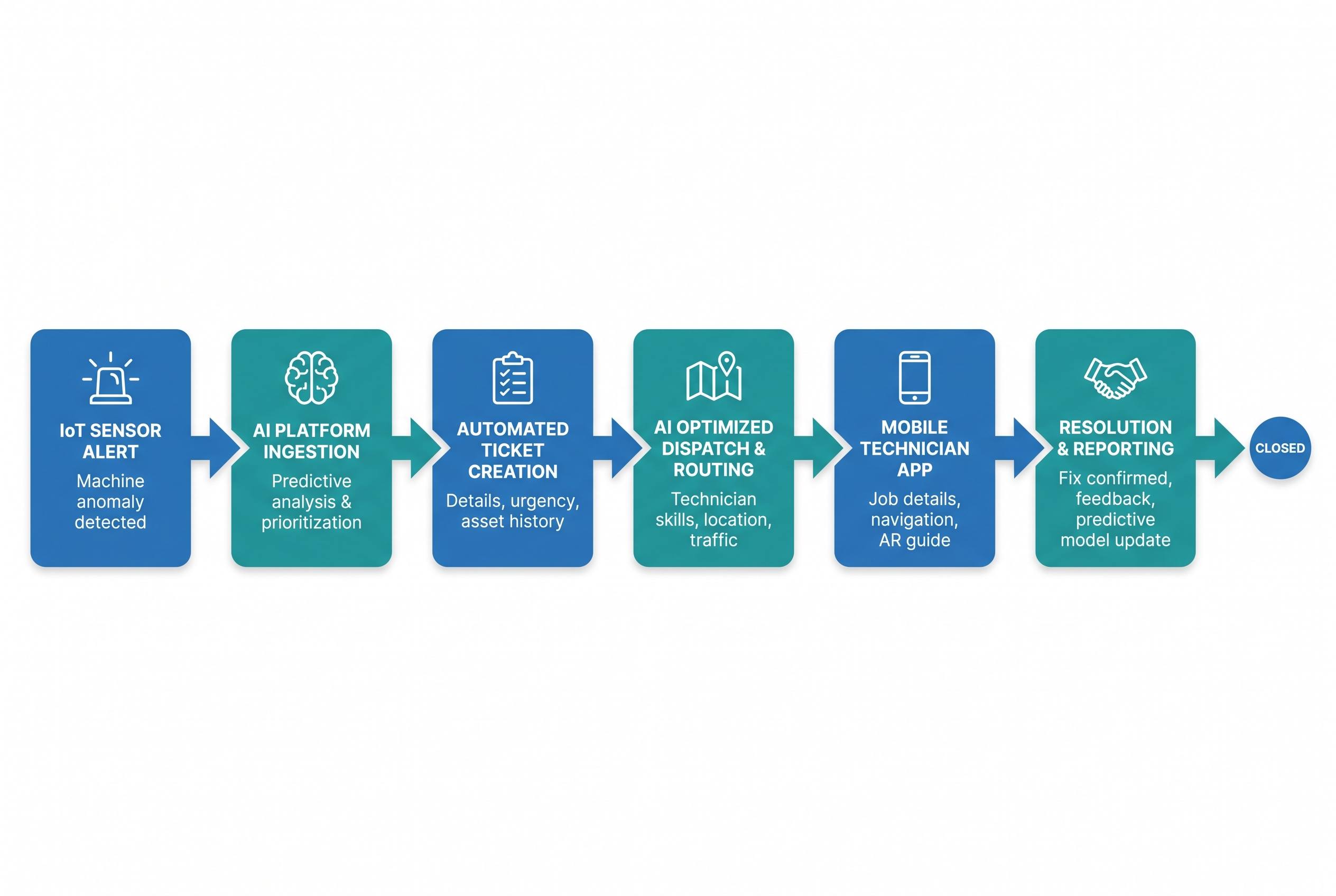
4. Dynamic Re-Routing
When a higher-priority job arrives or a technician encounters delays, the AI instantly recalculates the optimal routing for all affected technicians simultaneously, something no human dispatcher can do at scale.
The Results: By the Numbers
Enterprises deploying AI field service management report consistent improvements:
- Response time: From 8.5 hours to 2.1 hours (75% reduction)
- First-time fix rate: From 63% to 91% (44% improvement)
- Technician utilization: From 40% productive time to 68%
- Service costs: 40% reduction in total service delivery cost
- Customer satisfaction: Net Promoter Score improvement of 32 points
Implementation Roadmap
A phased approach minimizes disruption:
Phase 1 (Months 1-3): Connect existing work order system to the AI dispatch engine. Enable intelligent routing for new jobs without changing existing workflows.
Phase 2 (Months 4-6): Deploy IoT sensors on high-priority equipment. Enable predictive work order creation and parts optimization.
Phase 3 (Months 7-9): Activate full predictive dispatch with dynamic re-routing. Train dispatchers on exception handling rather than routine scheduling.
Phase 4 (Month 10+): Expand to customer self-scheduling portals, predictive SLA management, and automated customer communications.
The ROI Calculation
For a mid-size enterprise with 200 field technicians:
- 40% reduction in service costs at $150K average technician cost: $12M annual savings
- 28% improvement in jobs completed per technician per day: $3.4M additional capacity
- 15% improvement in customer retention from faster response: $4.2M revenue protected
Typical implementation cost: $500K-$1.5M. Payback period: 6-12 months.
This article was produced with AI assistance.