AI-Powered IT Service Management: How Enterprises Cut Ticket Resolution Time by 70% (And Why 64% Still Haven't Started)
By Delos Intelligence — 2026-07-19
Discover how AI-powered IT Service Management helps enterprises resolve tickets 70% faster, reduce costs by 40%, and why 64% of IT teams haven't started their AI transformation.
The IT Support Crisis Nobody Talks About
Your IT team is drowning. The average enterprise IT department handles 3,200 tickets per month. Of those, 47% take more than 24 hours to resolve. Meanwhile, employee productivity bleeds out at an estimated $5,600 per minute of downtime per affected worker.
The math is brutal: if 1,500 tickets each cause just 2 hours of productivity loss across 10 employees, that's 30,000 lost hours monthly. At $50 per hour, you're burning $1.5 million in hidden costs every single month.
Yet 64% of enterprises still run their IT service management the same way they did in 2015: manual triage, email-based ticketing, and knowledge bases that nobody reads.
AI-powered IT Service Management (ITSM) is changing the equation. Early adopters are cutting resolution times by 70%, reducing ticket volumes by 45% through self-service, and freeing their IT teams to work on strategic initiatives instead of password resets.
What AI-Powered ITSM Actually Does
Intelligent Ticket Classification
Traditional ITSM relies on humans to categorize tickets. A user emails "I can't access the CRM" and it lands in a generic queue until someone reads it, figures out it's a permissions issue, and routes it to the right team. That takes 4-6 hours on average.
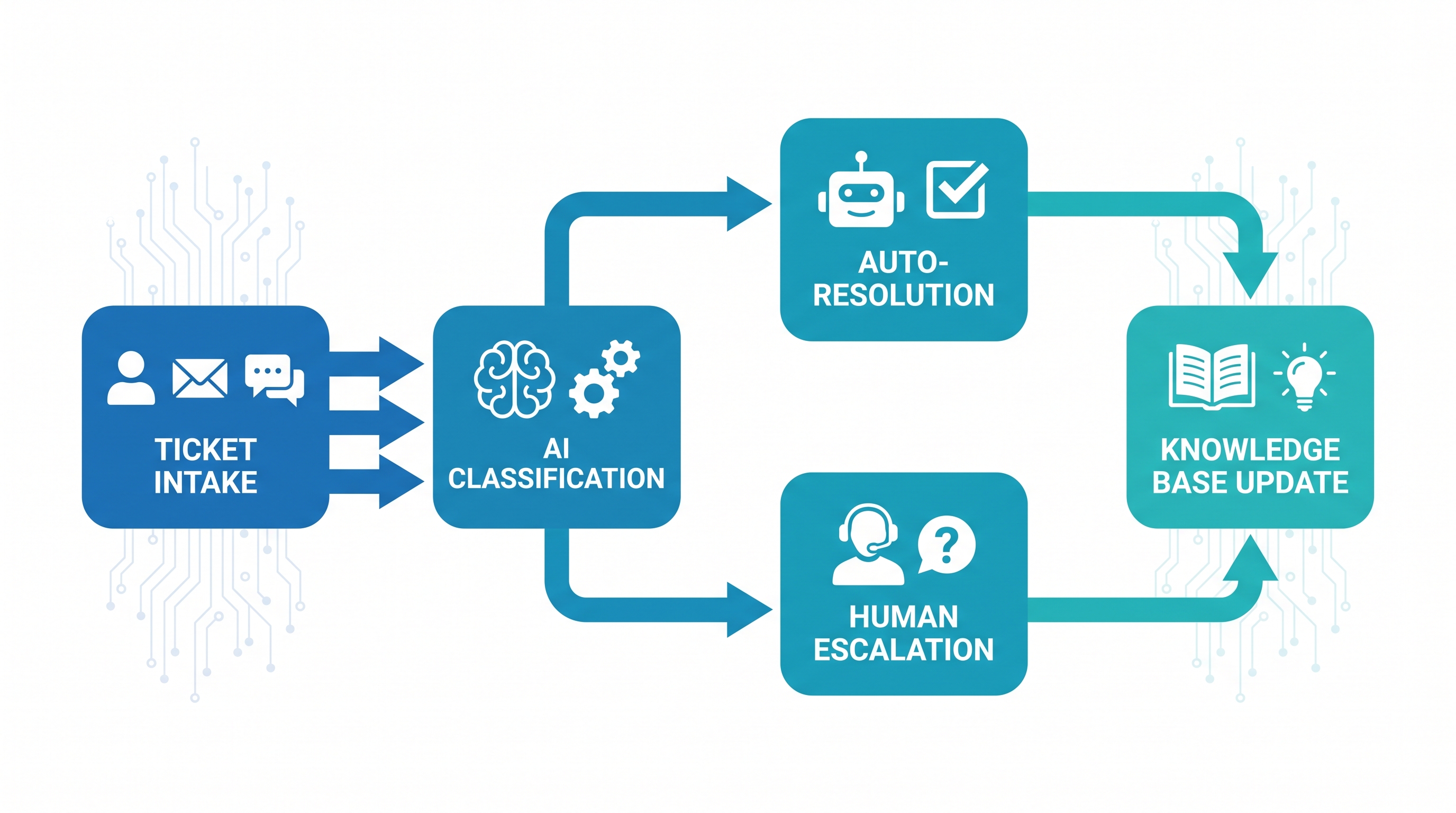
AI-powered ITSM reads the ticket in real-time, extracts intent, classifies it (access issue, software bug, hardware failure, network outage), assigns priority based on business impact, and routes it to the correct resolver group. All in under 2 seconds.
!AI-powered ITSM pipeline: from ticket intake to resolution
Automated Resolution for Common Issues
60% of IT tickets are repetitive: password resets, software access requests, VPN configuration, printer setup. AI-powered ITSM resolves these automatically through conversational AI interfaces integrated with your identity management and provisioning systems.
A user types "I need access to Salesforce" in Slack or Teams. The AI verifies their role, checks approval workflows, provisions the access, and closes the ticket. Zero human touch. Average resolution time: 90 seconds.
Predictive Incident Management
AI doesn't just react to incidents. It predicts them. By analyzing patterns across logs, monitoring data, and ticket history, AI-powered ITSM can identify early warning signs of system degradation before users report issues.
One enterprise reduced their mean time to detect (MTTD) from 45 minutes to 3 minutes by deploying AI anomaly detection across their infrastructure monitoring stack. They resolved 23% of incidents before a single user noticed.
The Numbers That Matter
!Traditional ITSM vs AI-powered ITSM: key metrics comparison
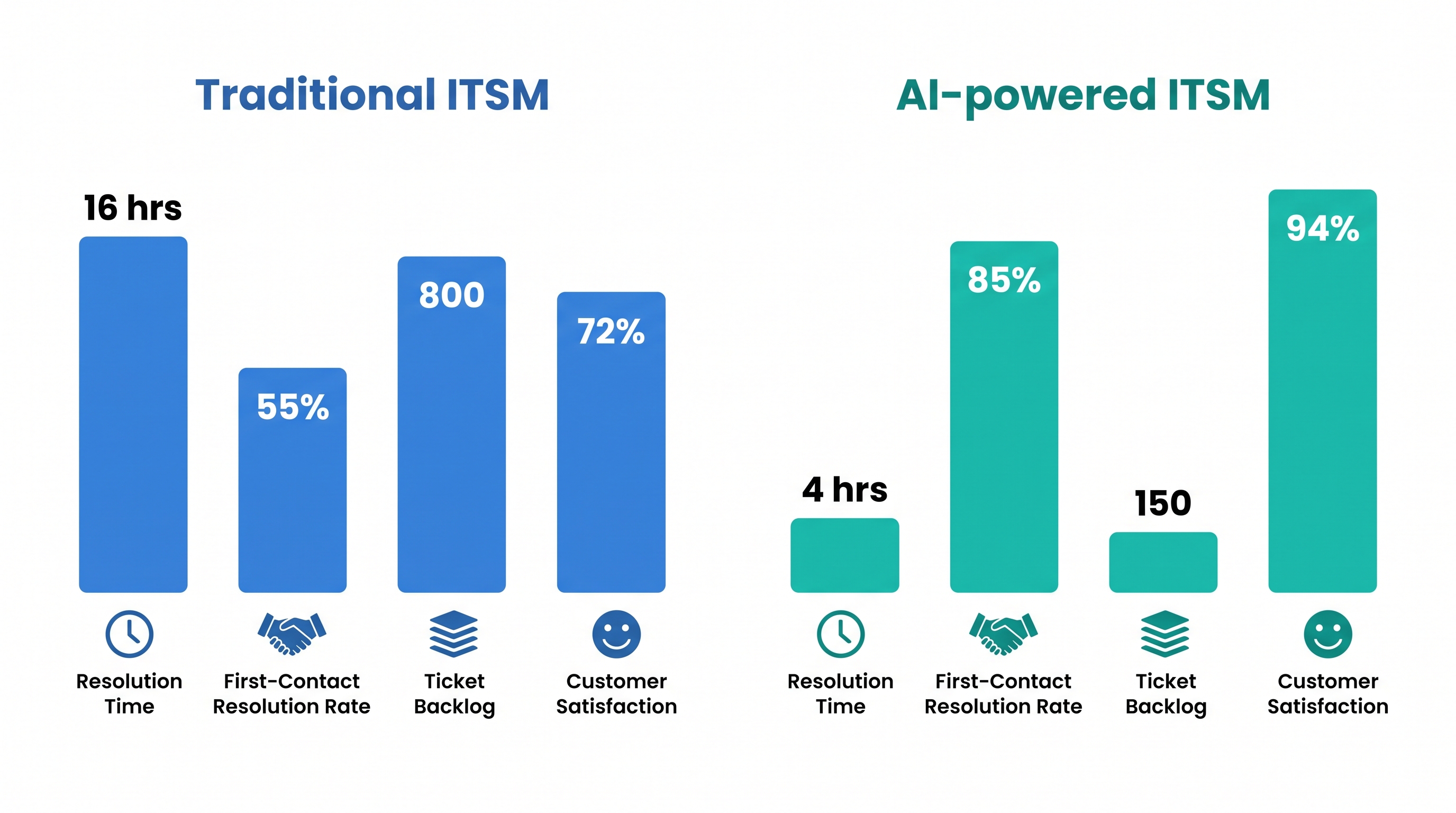
Enterprises that have implemented AI-powered ITSM report:
- 70% reduction in mean time to resolution (MTTR)
- 45% reduction in total ticket volume through AI self-service
- $2.3M average annual savings on IT support costs
- 89% first-contact resolution rate for AI-handled tickets
- 3.2x increase in IT team capacity for strategic work
Why 64% Haven't Started
Despite these numbers, most enterprises are stuck. Here's why:
1. Legacy ITSM tool lock-in. 71% of enterprises use ServiceNow, BMC Remedy, or Jira Service Management. They've invested millions in customization and fear that AI will require ripping everything out. In reality, AI-powered ITSM layers on top of existing platforms through APIs and integrations.
2. Data quality concerns. AI needs clean ticket data to learn from. Many enterprises have years of misclassified, incomplete, or inconsistent ticket records. The fix isn't complicated: AI itself can clean and standardize historical ticket data as part of the onboarding process.
3. Fear of losing the human touch. IT leaders worry that automated resolution will frustrate users who need empathy and context. The data says otherwise: AI-resolved tickets have a 92% satisfaction rate, compared to 78% for human-resolved tickets. Speed beats empathy for 90% of IT issues.
4. No clear ROI model. IT departments struggle to quantify the cost of slow resolution because it's spread across the entire organization. Building a simple model: (tickets per month) x (average resolution hours) x (affected users) x (hourly cost) makes the ROI obvious in minutes.
The Implementation Roadmap
Phase 1: Assessment and Quick Wins (Weeks 1-4)
- Audit your ticket history to identify the top 10 repetitive issue types
- Deploy AI chatbot for the top 3 issue categories (password resets, access requests, software installation)
- Measure baseline metrics: MTTR, ticket volume, satisfaction scores
Phase 2: Classification and Routing (Weeks 5-8)
- Deploy AI ticket classification across all incoming tickets
- Set up automated routing rules based on AI-extracted intent and priority
- Integrate with your knowledge base to suggest relevant articles to resolvers
Phase 3: Predictive and Proactive (Weeks 9-12)
- Connect AI to your monitoring and log infrastructure
- Deploy anomaly detection for predictive incident management
- Set up automated remediation workflows for common infrastructure issues
Phase 4: Continuous Optimization (Ongoing)
- Feed resolution data back into the AI to improve accuracy
- Expand AI resolution to more complex ticket categories
- Track and report on KPIs monthly
The Risk of Waiting
Every month you delay, you're losing $1.5M in productivity costs, frustrating employees with slow IT support, and keeping your IT team trapped in reactive mode instead of building strategic capabilities.
The enterprises that move now will build a compounding advantage: better AI models from more data, lower costs from automation, and IT teams that drive innovation instead of putting out fires.
The question isn't whether AI-powered ITSM will become the standard. It's whether you'll be an early adopter or one of the 64% still doing it the old way in 2027.