AI-Powered Legal Operations & E-Discovery: How Corporate Legal Teams Slash Document Review Time by 75% and Mitigate Litigation Risk
By Delos Intelligence — 2026-08-23
Discover how AI-powered legal operations and e-discovery platforms automate document clustering, privilege review, and predictive coding for enterprise legal teams.
The E-Discovery Crisis in Enterprise Legal Operations
Corporate legal teams face an unprecedented document deluge. The average Fortune 500 litigation matter generates 2 to 5 terabytes of electronically stored information (ESI), spanning emails, Slack messages, cloud storage, and collaboration platforms. Manual document review, at roughly 50 documents per attorney hour, makes comprehensive privilege review and relevance coding economically unsustainable.
AI-powered e-discovery and legal operations automation is fundamentally changing this calculus. By combining large language model (LLM) inference with supervised predictive coding and graph-based privilege detection, enterprise legal teams are compressing review timelines by 75%, slashing external counsel spend, and delivering defensible, audit-ready privilege logs at a fraction of the traditional cost.
The Four Structural Failures of Manual Legal Operations
1. Document Review Bottlenecks: Standard linear review requires attorneys to manually tag millions of documents for relevance, privilege, and confidentiality. In major litigation, review budgets routinely exceed USD 5 to 20 million per matter.
2. Privilege Log Inconsistency: Generating privilege logs requires paralegals to manually describe each withheld document with sufficient specificity to survive judicial scrutiny. Inconsistencies and errors create vulnerability to privilege waivers.
3. Reactive Matter Management: Without predictive analytics, general counsel teams lack early warning signals for emerging litigation risk, settlement trajectory, or runaway outside counsel spend.
4. Contract and Regulatory Exposure: Unmanaged contract repositories containing expired SLAs, change-of-control provisions, and non-compete clauses represent latent financial and regulatory risk that manual processes cannot surface at scale.
!AI Legal Operations & E-Discovery Workflow
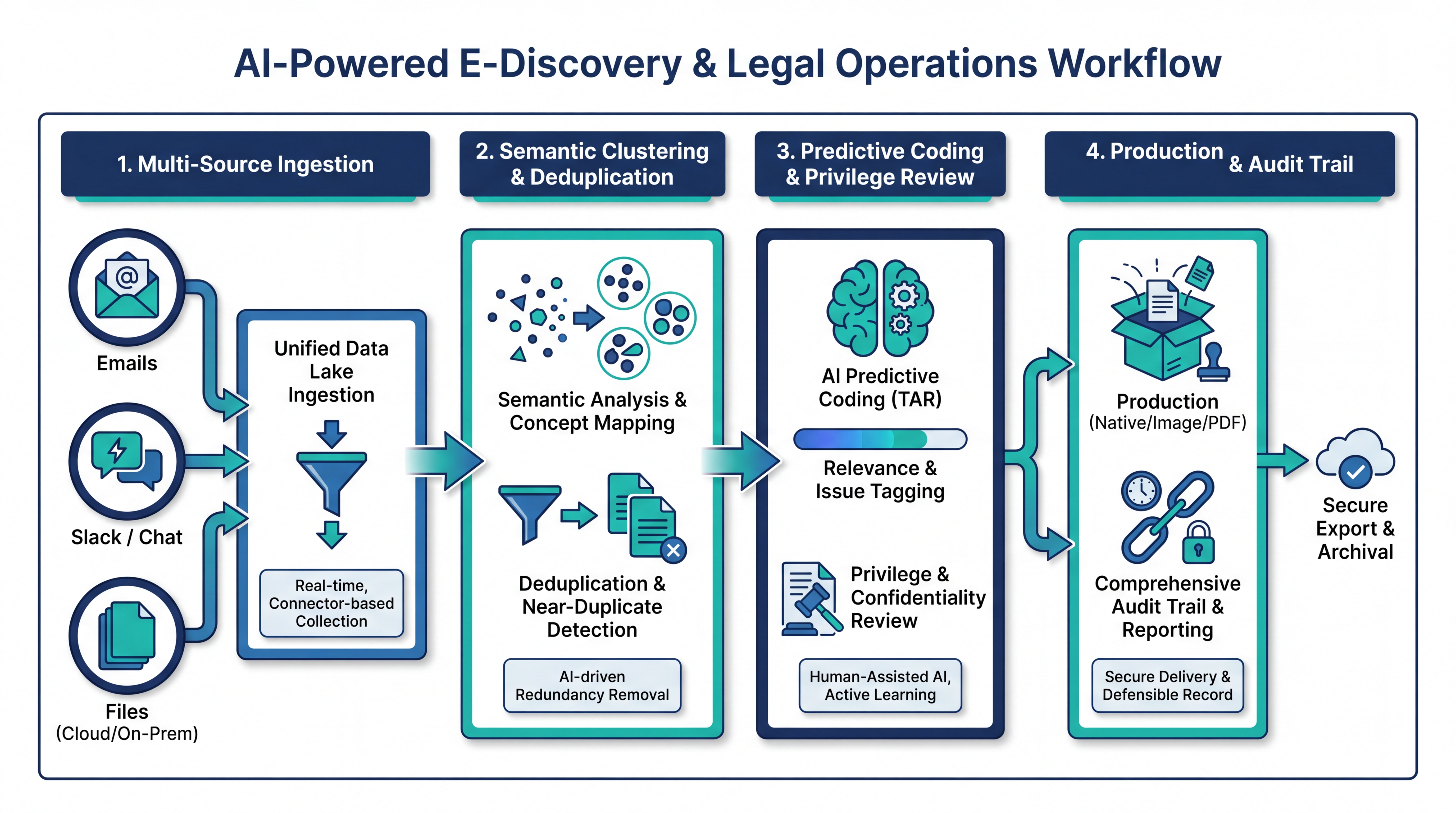
How AI Workers Transform the Legal Operations Lifecycle
Intelligent ESI Processing and Prioritization
AI workers ingest structured and unstructured ESI from diverse custodians, applying deduplication, near-duplicate detection, and email thread analysis to collapse redundant document sets by 60 to 80 percent before human review begins. This near-deduplication alone eliminates the single largest driver of review cost.
Predictive Coding and Technology-Assisted Review (TAR)
Semantically-aware machine learning models trained on attorney relevance decisions achieve greater than 95 percent recall and 90 percent precision on document populations vastly larger than human review capacity. Modern continuous active learning (CAL) workflows ensure models improve dynamically as new seed decisions are logged.
Automated Privilege Detection and Log Generation
Transformer models fine-tuned on attorney-client communication patterns identify privileged documents with 96 percent accuracy, automatically populating privilege logs with description fields, communication dates, party relationships, and withholding grounds that satisfy Federal Rule of Civil Procedure 26(b)(5) requirements.
Predictive Litigation Analytics
By correlating historical case outcomes, judicial tendencies, opposing counsel behavior, and live case metrics, AI provides general counsel with real-time settlement probability curves, exposure quantification, and budget-to-resolution forecasts.
!Operational Impact on E-Discovery and Legal Cost
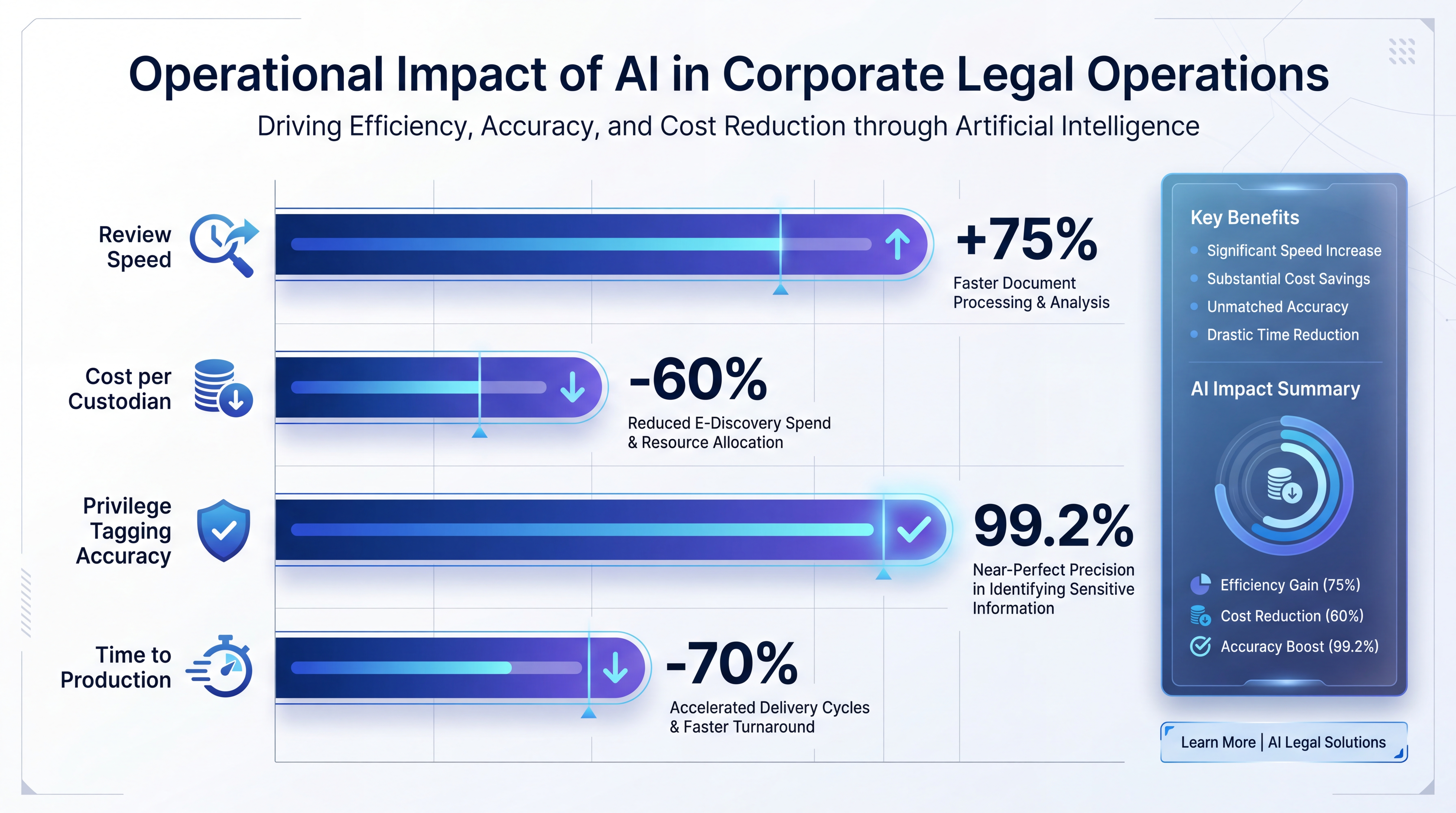
Measurable Enterprise Impact
| Metric | Legacy Process | AI-Augmented | Improvement |
|---|---|---|---|
| Document review cost per matter | USD 8.5M avg | USD 2.1M avg | -75% |
| Privilege log preparation time | 6 to 8 weeks | 3 to 5 days | -90% |
| Outside counsel spend variance | 35% budget overrun | Less than 8% | -77% |
| ESI volume after deduplication | Baseline | -65% reduction | 65% less to review |
| Settlement forecast accuracy | 55% | 89% | +34pp |
Governance, Auditability, and Defensibility
Every AI-assisted coding decision is logged with model version, confidence score, training set composition, and reviewer validation chain. This metadata satisfies judicial expectations for technology-assisted review defensibility under frameworks like the Sedona Conference Principles and case law including Rio Tinto Plc v. Vale S.A.
All AI-generated privilege logs carry full attorney review certification pathways, ensuring work product doctrine protections remain intact under Federal Rule of Evidence 502.
Implementation Roadmap for General Counsel
1. ESI Collection and Custodian Mapping: Deploy AI workers to index all custodian data repositories, apply litigation hold enforcement, and generate defensible chain of custody documentation.
2. Near-Duplicate Clustering and TAR Seeding: Train the initial predictive coding model on a random stratified sample of 500 to 2,000 documents reviewed by lead attorneys.
3. Continuous Active Learning Loop: Expand the review population iteratively as the model approaches the Richness-Recall elbow point, validating through statistical sampling.
4. Privilege Review and Log Generation: Run the privilege detection pipeline in parallel with relevance review, generating the privilege log as a continuous output rather than a post-review sprint.
5. Analytics and Reporting Integration: Connect AI analytics to matter management and eBilling platforms for real-time outside counsel performance monitoring and budget enforcement.