AI-Powered M&A Due Diligence: How Private Equity and Corporate M&A Teams Accelerate Deal Velocity by 4x
By Delos Intelligence — 2026-08-16
Top private equity funds and corporate M&A teams use autonomous AI workers to ingest 10,000+ VDR files, detect hidden contract risks, and compress diligence from weeks to hours.
The Modern M&A Paradox: Deal Velocity vs. Due Diligence Depth
The mergers and acquisitions market is defined by a fundamental tension: competitive deal processes demand speed, while sound investment discipline demands thoroughness. When a private equity fund or corporate acquirer bids on a high-priority target, they often have 3-6 weeks to complete comprehensive legal, financial, commercial, and operational due diligence across virtual data rooms (VDRs) containing 10,000 to 100,000 documents.
Traditional due diligence relies on armies of associates, paralegals, and junior bankers manually reviewing contracts, financial statements, HR records, and IP documentation around the clock. This approach is expensive, error-prone under time pressure, and constrained by human bandwidth. Critical risks, buried change-of-control clauses, undisclosed tax liabilities, and non-compete conflicts, are routinely missed in rushed processes.
AI-powered due diligence is fundamentally reordering this calculus, compressing weeks of manual review into hours while simultaneously increasing the depth and accuracy of risk identification.
How Autonomous AI Workers Transform the Due Diligence Workflow
Intelligent VDR Ingestion and Classification
!Autonomous AI M&A Due Diligence Engine Architecture
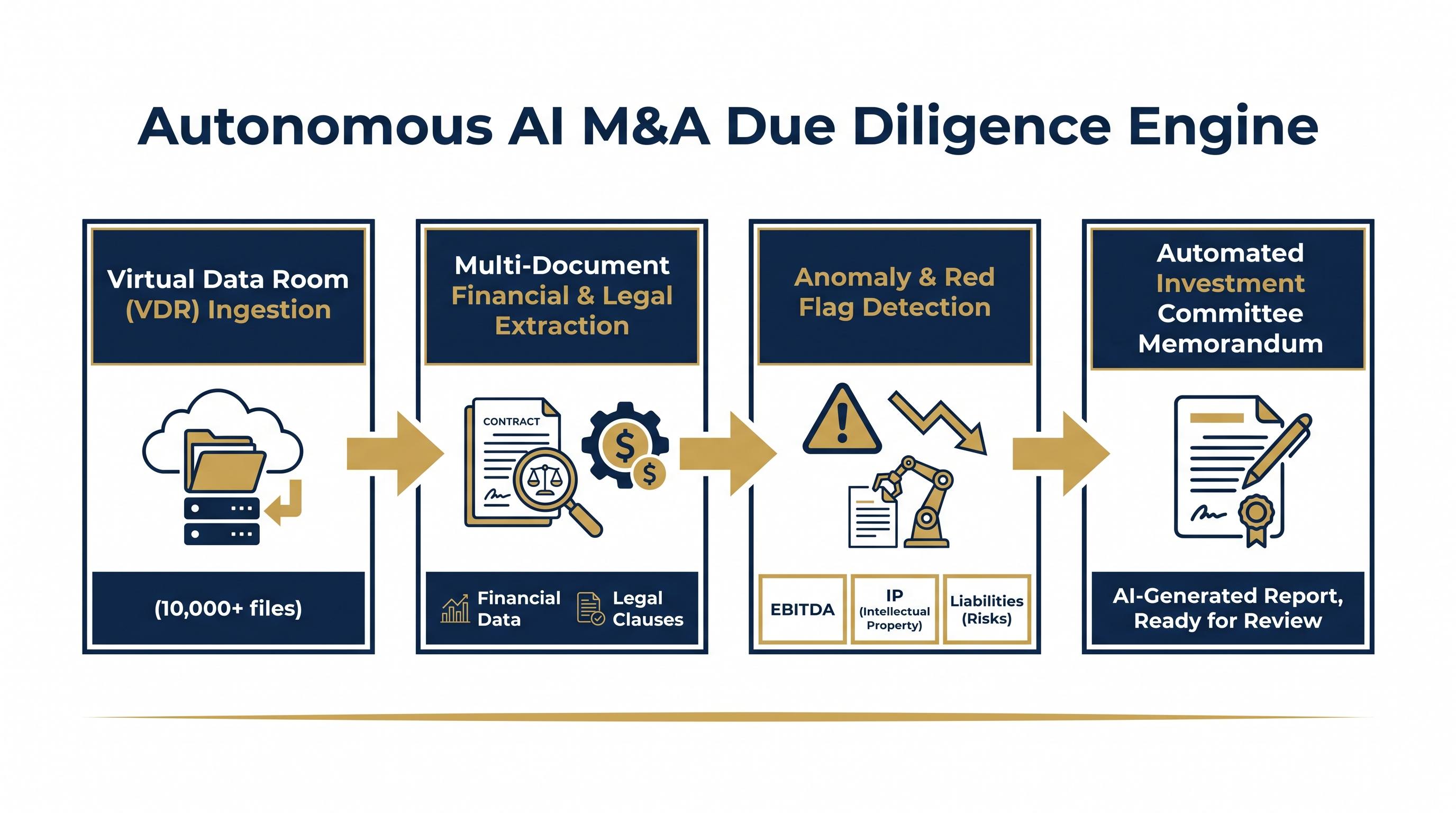
AI workers deployed against a virtual data room immediately begin ingesting and classifying documents across all legal, financial, HR, and operational workstreams. Using document classification models fine-tuned on M&A documentation patterns, the AI categorizes material contracts (customer, supplier, employment, IP licensing), financial statements, regulatory filings, insurance policies, and environmental reports without requiring manual file organization.
Multi-tenant confidentiality protocols ensure that each deal team accesses only their authorized scope, with complete logging of all AI activities for legal privilege and audit purposes.
Automated Extraction of Material Contract Risks
For legal due diligence, the AI worker extracts and analyzes the most commercially consequential contract provisions at scale:
- Change-of-control clauses: Identifying which customer, supplier, and financing agreements include CIC triggers that could result in consent requirements, termination rights, or accelerated payment obligations
- Revenue recognition anomalies: Flagging non-standard revenue recognition practices, deferred revenue obligations, or multi-element arrangement complexities that affect normalized EBITDA calculations
- Non-compete and non-solicitation provisions: Mapping the geographic scope, duration, and enforceability of restrictive covenants affecting key management retention
- Hidden tax liabilities: Cross-referencing transfer pricing structures, intercompany agreements, and tax sharing arrangements against current regulatory positions
- IP ownership and licensing risks: Identifying gaps in IP assignment chains, problematic open-source software licenses, and third-party IP dependencies that could affect post-acquisition commercialization
Investment Committee Memorandum Synthesis
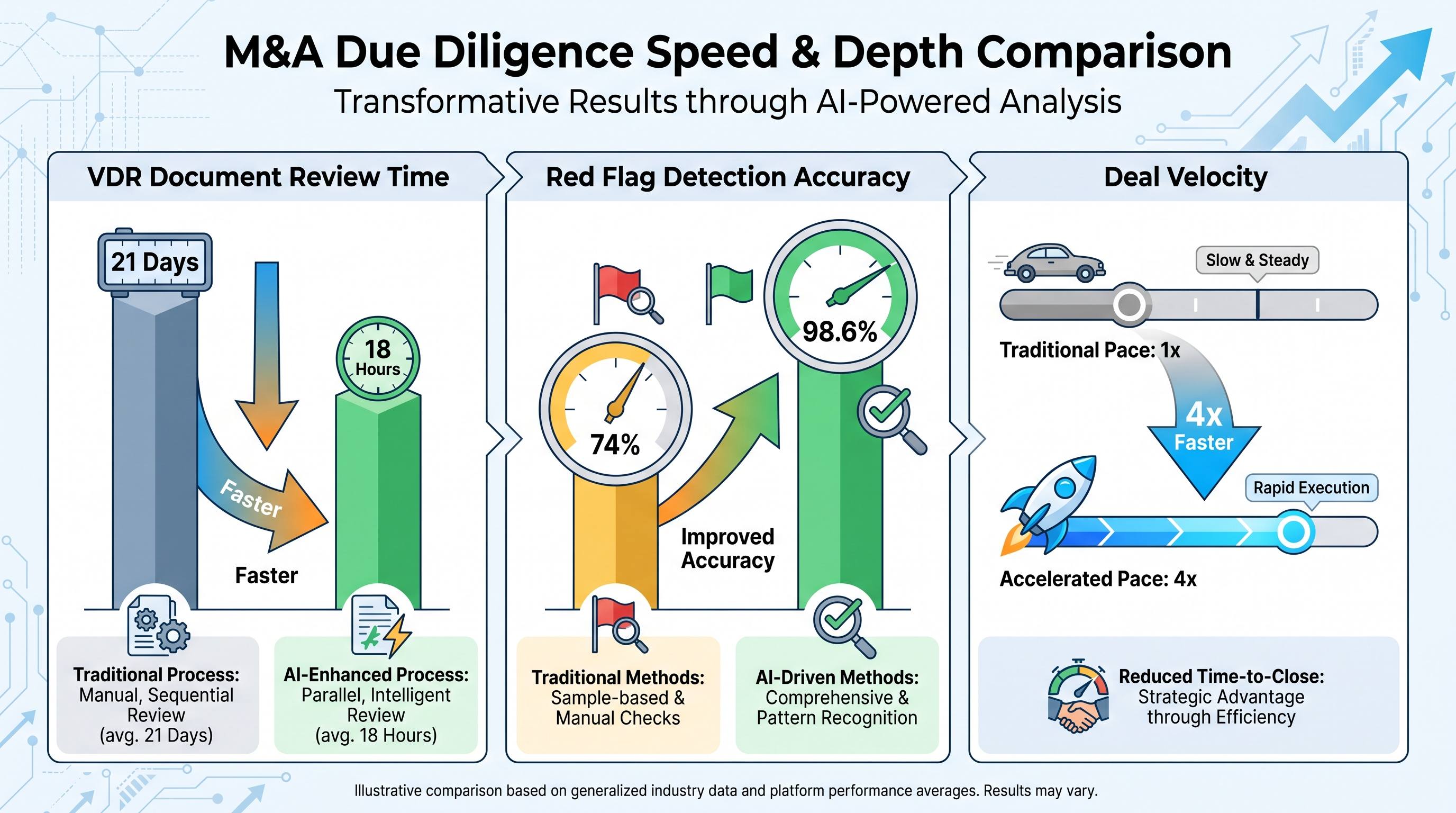
!M&A Due Diligence Review Speed & Accuracy Comparison
Beyond individual risk extraction, AI workers synthesize findings across all workstreams into structured Investment Committee memoranda aligned to standard PE and corporate M&A templates. The IC memo includes risk heat maps by category and severity, quantified financial exposure estimates for identified risks, comparison against industry benchmarks and deal comps, and prioritized negotiation points for purchase price adjustments or representations and warranties insurance coverage.
This synthesis capability is where AI delivers its most transformative value to senior deal professionals: instead of spending 80% of their time reviewing documents, deal partners can review AI-synthesised risk summaries and focus their expertise on commercial valuation and negotiation strategy.
Deal Velocity and Quality Outcomes
Private equity funds and corporate M&A teams deploying AI-powered due diligence report significant competitive and financial advantages:
- 4x acceleration in diligence completion: Comprehensive review of 50,000+ documents in 5 days vs. 3-4 weeks manually
- 95% contract coverage: Complete analysis of all material agreements rather than statistical sampling
- 60% reduction in post-acquisition surprises: More comprehensive pre-close risk identification directly reduces integration disruptions
- 30% reduction in external legal fees: AI handles document review work previously charged at senior associate and junior partner rates
- Higher bid confidence: Quantified risk visibility enables more precise pricing and more competitive bid strategies
Enterprise Deployment with Delos
Delos AI Workers deploy within secure, deal-specific environments with strict data isolation between concurrent transactions. All AI-generated analysis is clearly attributed and maintained with full provenance trails, satisfying both internal governance requirements and the legal privilege considerations essential in contested deal situations.
For deal teams competing against AI-enabled counterparties, the question is no longer whether to deploy AI-powered due diligence, but whether the competitive disadvantage of not deploying it is acceptable.
This article was written with AI assistance in accordance with EU AI Act Article 50.