AI-Powered Meeting Intelligence: How AI Is Killing the Post-Meeting Productivity Tax
By Delos Intelligence — 2026-07-11
Bad meetings cost US businesses $37 billion weekly. AI meeting intelligence eliminates the post-meeting productivity tax with real-time transcription, summarization, action item extraction, and follow-up automation.
The $37 Billion Productivity Tax
Bad meetings are the most expensive habit in enterprise work. US businesses waste an estimated $37 billion per week on unproductive meetings — meetings with no clear agenda, no decisions made, no action items captured, and no follow-up. The average knowledge worker spends 15 hours per week in meetings, and roughly half of those are rated as ineffective by participants themselves.
The real cost isn't just the meeting time. It's the post-meeting productivity tax: the 30 minutes spent writing notes, the 15 minutes reconstructing what was decided, the follow-up emails clarifying action items, and the inevitable "wait, what did we agree on?" Slack thread. For a 500-person organization running 200 meetings per day, this tax compounds into thousands of hours of lost productivity every week.
AI meeting intelligence is killing this tax — not by eliminating meetings, but by making them count.
What Is AI Meeting Intelligence?
AI meeting intelligence is the real-time capture, analysis, and distribution of meeting content using artificial intelligence. It goes far beyond simple transcription. A modern AI meeting assistant performs five functions simultaneously:
!AI Meeting Intelligence Pipeline
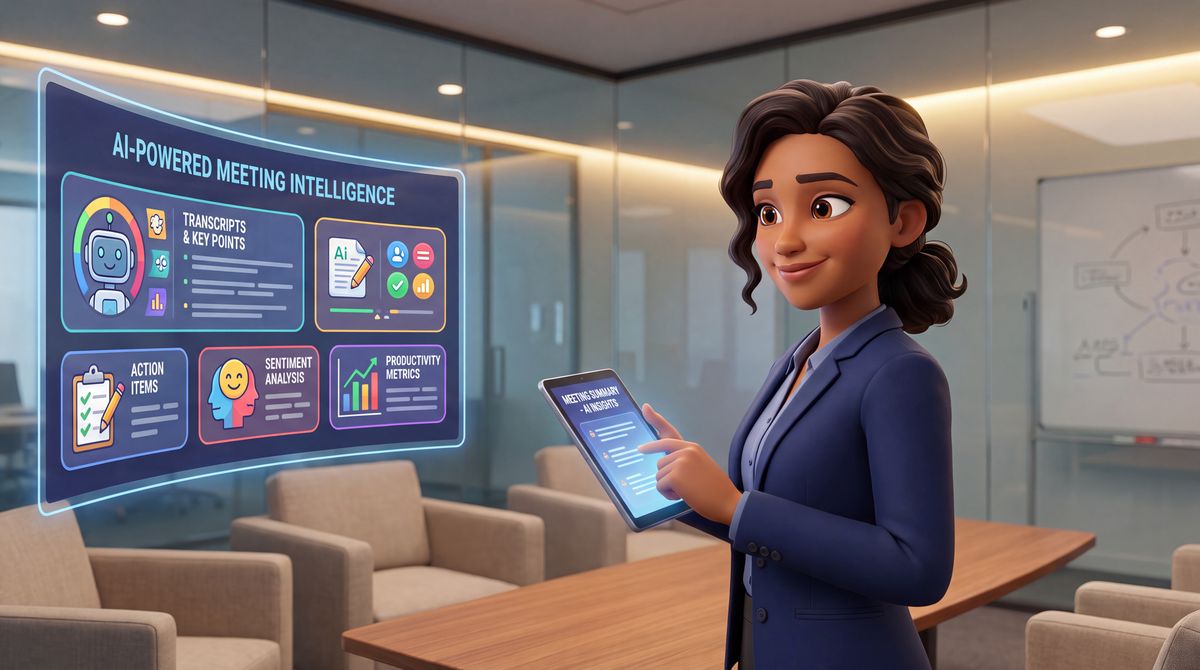
1. Capture and Transcription
The AI joins the meeting as a silent participant — through platform integrations (Zoom, Teams, Meet) or dedicated hardware in conference rooms. It captures audio, identifies speakers through voice biometrics, and transcribes the conversation in real time with 95%+ accuracy, even with accents, overlapping speech, and technical jargon.
2. Summarization
Instead of a raw transcript, the AI generates a structured summary: key decisions, discussion points, and context. The summary is formatted for skimming — typically under 300 words — so participants and non-attendees alike can grasp the outcome in under a minute.
3. Action Item Extraction
This is where the ROI lives. The AI identifies every commitment made during the meeting: who said they'd do what, by when. It extracts these as structured action items with assignees, deadlines, and context — and pushes them directly into your project management tool (Jira, Asana, Monday.com, or Linear).
4. Sentiment Analysis
The AI analyzes tone, word choice, and participation patterns to surface meeting health metrics: Did one person dominate? Were key stakeholders silent? Was there disagreement that wasn't explicitly voiced? These insights help leaders identify dysfunctional meeting patterns before they become cultural problems.
5. Distribution and Follow-up
Within seconds of the meeting ending, the AI distributes the summary and action items to all participants — and optionally to stakeholders who couldn't attend. It integrates with your CRM, project tracker, and knowledge base, ensuring that meeting outputs become organizational memory rather than disappearing into someone's notebook.
The ROI: What Enterprises Actually Save
The measurable impact of AI meeting intelligence is substantial:
- 7 hours saved per week per employee — the combination of eliminated note-taking, faster follow-ups, and reduced "recap" meetings
- 50% reduction in follow-up meetings — when action items and decisions are captured automatically, the "let's meet to discuss what we decided" meeting disappears
- 40% faster decision execution — because action items are assigned and tracked immediately, not rediscovered a week later
- $15,000+ saved annually per 100 employees — in recovered productivity hours, based on average knowledge worker fully-loaded cost
A mid-sized consulting firm (400 employees) deployed AI meeting intelligence across all client-facing teams. Within 90 days, they measured: 11,200 hours of recovered productivity per quarter, a 60% reduction in internal follow-up meetings, and a 35% improvement in action item completion rates. The annual ROI: €1.8 million in recovered time.
Implementation Best Practices
Start with High-Volume Teams
Don't deploy company-wide on day one. Start with teams that have the most meetings per week — sales, project management, and customer success are ideal. These teams see immediate ROI and become internal advocates.
Integrate, Don't Isolate
The biggest mistake is deploying an AI meeting tool as a standalone app. The value comes from integration: action items flow into your project tracker, meeting summaries flow into your knowledge base, customer meeting notes flow into your CRM. Without integration, you've just created another silo.
Address Privacy Head-On
Employees worry about being recorded and analyzed. Be transparent about what's captured, who has access, and how long data is retained. Let individuals opt out of transcription for sensitive discussions. Privacy fears kill adoption faster than any technical limitation.
Measure What Matters
Track these metrics from day one: hours saved per employee, action item completion rate, follow-up meeting reduction, and employee satisfaction with meetings. Without baseline metrics, you can't prove ROI — and without ROI, the tool won't survive the next budget cycle.
The Future: Predictive Meeting Intelligence
The next generation of AI meeting tools won't just capture what happened — they'll improve what happens. Pre-meeting briefings that surface relevant past decisions and documents. Real-time coaching that flags when a discussion is going in circles. Post-meeting analytics that identify which meeting formats produce the best decisions. The meeting itself becomes a data-rich, AI-enhanced workflow — not a time sink to survive.
The post-meeting productivity tax has been accepted as inevitable for decades. It isn't. AI meeting intelligence eliminates it — and the organizations that adopt it first will recover thousands of hours of their most expensive resource: human attention.