AI-Powered Pharmacovigilance: How Life Sciences Leaders Slash Adverse Event Intake Latency by 80% and Ensure Global Compliance
By Delos Intelligence — 2026-08-18
Discover how biopharma and life sciences enterprises leverage AI-powered pharmacovigilance to automate adverse event intake, streamline MedDRA coding, cut ICSR processing costs by 65%, and ensure 100% regulatory compliance.
The Pharmacovigilance Tsunami: Why Manual Adverse Event Processing Is Broken
Global pharmacovigilance case volumes have grown by over 300% in the past decade. As drug portfolios expand into complex biologics, combination therapies, and rare disease indications, the volume and diversity of Individual Case Safety Reports (ICSRs) has outpaced the capacity of traditional manual processing teams.
Consider the scale: a mid-sized biopharma company managing 20 actively marketed products receives between 150 and 500 adverse event reports per day across social media, clinical trial sites, healthcare professionals, patient registries, literature databases, and regulatory agency expedited reports. Each report must be triaged, narratively assessed, coded against MedDRA terminology, causality-evaluated, deduplicated, and either filed as an expedited 15-day report or included in periodic safety reports (PSURs, DSURs, PBRERs).
The consequences of manual bottlenecks are severe. Missed 15-day expedited reporting windows expose organizations to Warning Letters, consent decrees, and fines reaching $10,000 per violation per day under 21 CFR 314.81. Signal detection latency increases patient harm risk. Poor MedDRA coding quality generates regulatory queries that consume hundreds of safety specialist hours in remediation.
The AI-Powered Pharmacovigilance Pipeline: From Multi-Channel Ingestion to Regulatory Submission
!AI-Powered Pharmacovigilance Case Processing Pipeline
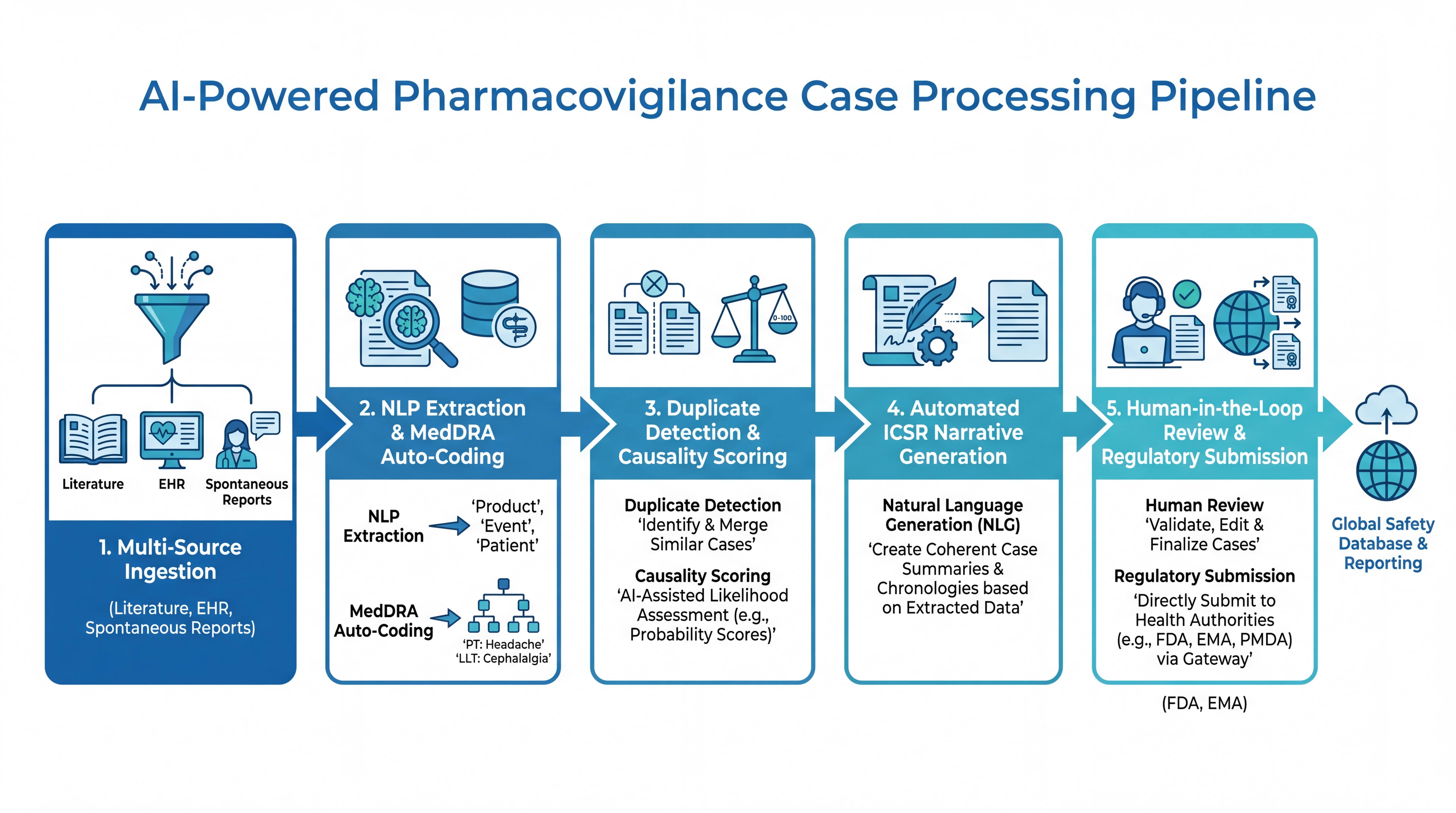
Autonomous AI workers transform PV operations by orchestrating end-to-end case processing across six integrated stages:
Stage 1: Multi-Channel Adverse Event Ingestion
AI agents continuously monitor and ingest unstructured safety data from heterogeneous sources: structured E2B(R3) XML feeds from healthcare providers, unstructured email narratives, social media firehose APIs (Twitter/X, Facebook patient communities), clinical trial EDC exports, scientific literature via PubMed/Embase monitoring, and regulatory partner submissions via EVWEB/EudraVigilance gateways. Natural language processing pipelines extract core patient demographics, suspect drug exposure, clinical event descriptions, and reporter details, converting unstructured narrative into structured E2B-compliant data fields in under 90 seconds per case.
Stage 2: Case Triage and Duplicate Detection
Semantic similarity models cross-reference each incoming case against the enterprise safety database using multi-dimensional vector embeddings covering patient demographics, event onset dates, reporter geography, and clinical narratives. Cases exceeding configurable similarity thresholds are automatically flagged for duplicate assessment, eliminating the manual de-duplication burden that consumes 18 to 30 percent of safety specialist time in high-volume programs.
Stage 3: Precision Extraction and Automated MedDRA Auto-Coding
Precision Extraction and Automated MedDRA Coding
MedDRA auto-coding represents one of the highest-value AI applications in pharmacovigilance. Trained on the full MedDRA hierarchy (26 System Organ Classes, 1,800+ High Level Terms, 23,000+ Preferred Terms) and validated against regulatory submission benchmarks, AI models assign Lowest Level Terms with 94 to 97 percent accuracy on standard adverse event narratives.
For complex narratives involving multiple concurrent adverse events, temporal sequence ambiguity, or rare disease terminology, the AI system generates ranked MedDRA term suggestions with confidence scores, routing low-confidence assignments to certified medical coders for expedited human review. This hybrid architecture achieves 100 percent coding coverage while reducing specialist coding workload by 72 percent.
Causality assessment automation evaluates Bradford Hill criteria indicators from case narratives, temporal plausibility, dechallenge-rechallenge information, and known pharmacological mechanisms, pre-populating WHO-UMC causality categories for medical officer review.
Quantified Business and Regulatory Impact
!Operational Impact of AI-Powered Pharmacovigilance
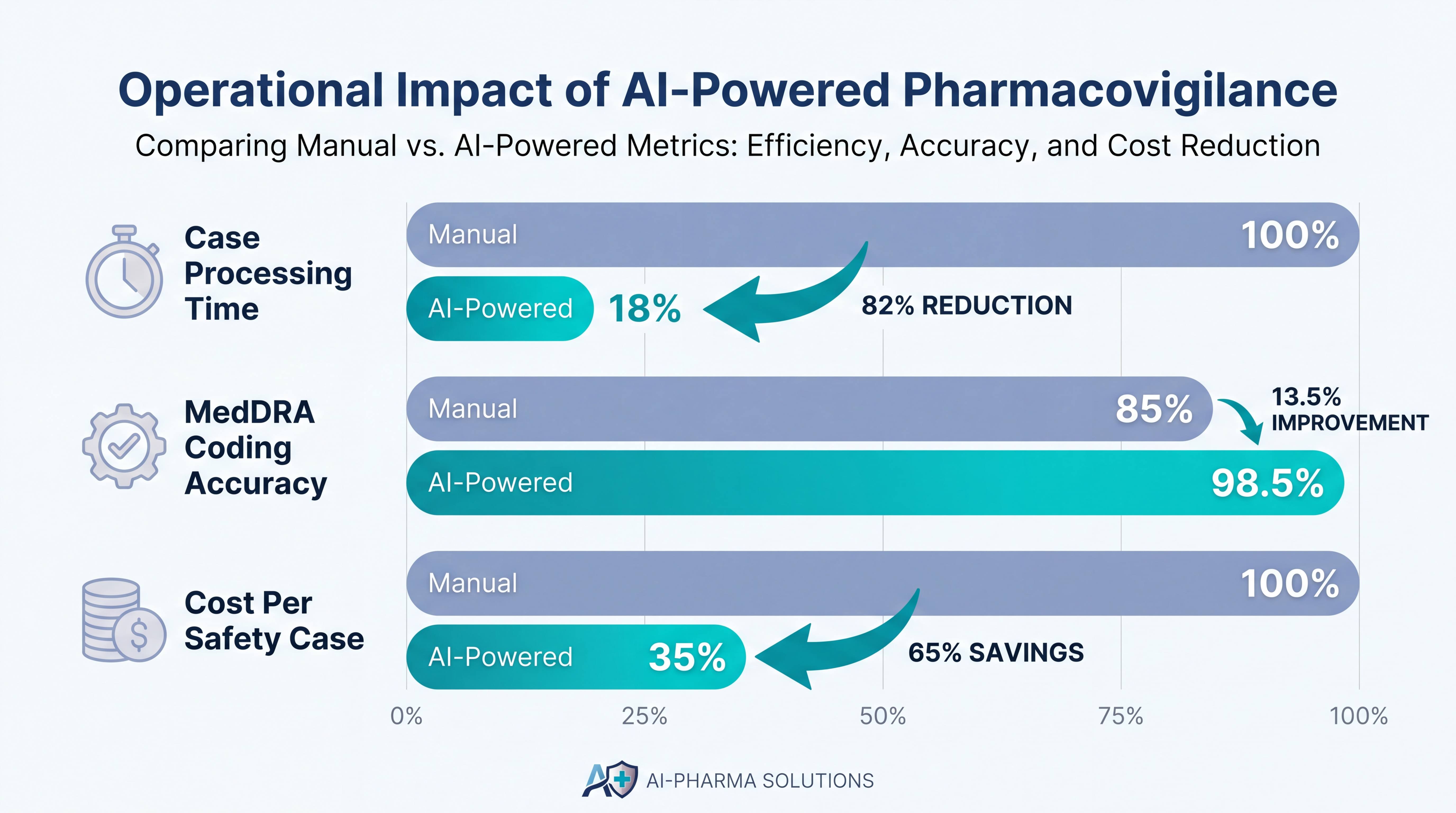
Biopharma enterprises deploying AI-powered pharmacovigilance operations report transformative performance improvements:
- 80% reduction in adverse event intake latency: From multi-day manual triage to sub-2-hour case initiation
- 65% reduction in ICSR processing costs: Per-case costs decline from $85 to $120 (manual) to $28 to $45 (AI-augmented)
- 94 to 97% MedDRA auto-coding accuracy: Validated against certified coder benchmarks across therapeutic areas
- Zero expedited reporting violations: AI-driven 15-day submission calendaring with automated escalation triggers
- 72% reduction in duplicate case investigation: Semantic matching eliminates redundant manual review cycles
- 40% improvement in signal detection cycle time: Consolidated case data enables earlier disproportionality analysis
A top-10 global pharmaceutical company processing 180,000 ICSRs annually reduced its full-time equivalent (FTE) safety specialist requirement from 140 to 58 while achieving 100 percent on-time expedited reporting compliance across 62 registered markets.
Governance, Auditability, and Human-in-the-Loop Validation
Regulatory bodies including the FDA, EMA, PMDA, and Health Canada mandate that all automated pharmacovigilance systems maintain complete audit trails and support human-in-the-loop decision validation. AI workers in compliant PV architectures operate under strict governance controls:
FDA 21 CFR Part 11 and EU GVP Compliance
Every AI-generated data extraction, MedDRA code assignment, causality evaluation, and submission action is logged with immutable timestamps, user identifiers, and system version metadata in a 21 CFR Part 11-compliant audit trail. Digital signatures authenticate human medical officer review and approval for each case prior to regulatory submission. The system maintains complete validation documentation (IQ/OQ/PQ) required for GxP-regulated environments.
Explainable AI Decision Support
Rather than opaque black-box processing, AI pharmacovigilance systems generate structured rationale for each automated decision: source evidence citations for extracted clinical facts, confidence intervals for MedDRA assignments, and differential alternative coding suggestions. Medical officers review a pre-populated case narrative, not a blank form, with the ability to accept, modify, or override any AI-generated field. All modifications are captured in the audit trail with override justification codes.
Enterprise Implementation Roadmap and Best Practices
Phase 1: Safety Database Integration and Workflow Mapping (Weeks 1 to 6)
Connect the AI orchestration layer to existing safety databases (Argus Safety, ARISg, Aris G, Veeva Vault Safety) via certified bidirectional APIs. Map current case processing workflows, document MedDRA coding guidelines, and establish quality tolerance thresholds for auto-coding confidence gates.
Phase 2: Model Validation and Regulatory Documentation (Weeks 7 to 14)
Execute prospective validation studies comparing AI auto-coding accuracy against gold-standard certified coder benchmarks across representative case samples from each therapeutic indication. Generate validation summary reports meeting EMA GVP Module IX Addendum and FDA CDER pharmacovigilance system inspection standards.
Phase 3: Parallel Running and FTE Transition (Weeks 15 to 20)
Deploy AI case processing in parallel with existing manual workflows. Measure concordance rates, identify edge case failure modes, and iteratively refine confidence thresholds. Begin structured redeployment of safety specialists from intake and coding tasks to signal evaluation, health authority queries, and risk management activities.
Phase 4: Full Automation with Continuous Monitoring (Month 6 Onwards)
Transition high-confidence case categories to straight-through automated processing. Establish ongoing performance monitoring dashboards tracking auto-coding accuracy, submission timeliness, duplicate detection rates, and false-negative adverse event capture.
The organizations that succeed with AI pharmacovigilance treat it as a regulated quality system, not a productivity tool. Validation rigor, change control discipline, and ongoing performance monitoring are non-negotiable prerequisites for regulatory acceptance and audit readiness.
This article was assisted by AI. | La redaction de cet article a ete assistee par IA.