AI-Powered Procurement: How Enterprises Save 22% on Spend (And Why 58% Still Use Spreadsheets)
By Delos Intelligence — 2026-07-19
Discover how AI-powered procurement helps enterprises save 22% on total spend, automate supplier discovery, and why 58% still manage procurement in spreadsheets.
The Procurement Paradox
Procurement is the second-largest cost center in most enterprises, yet it runs on tools that belong in a museum.
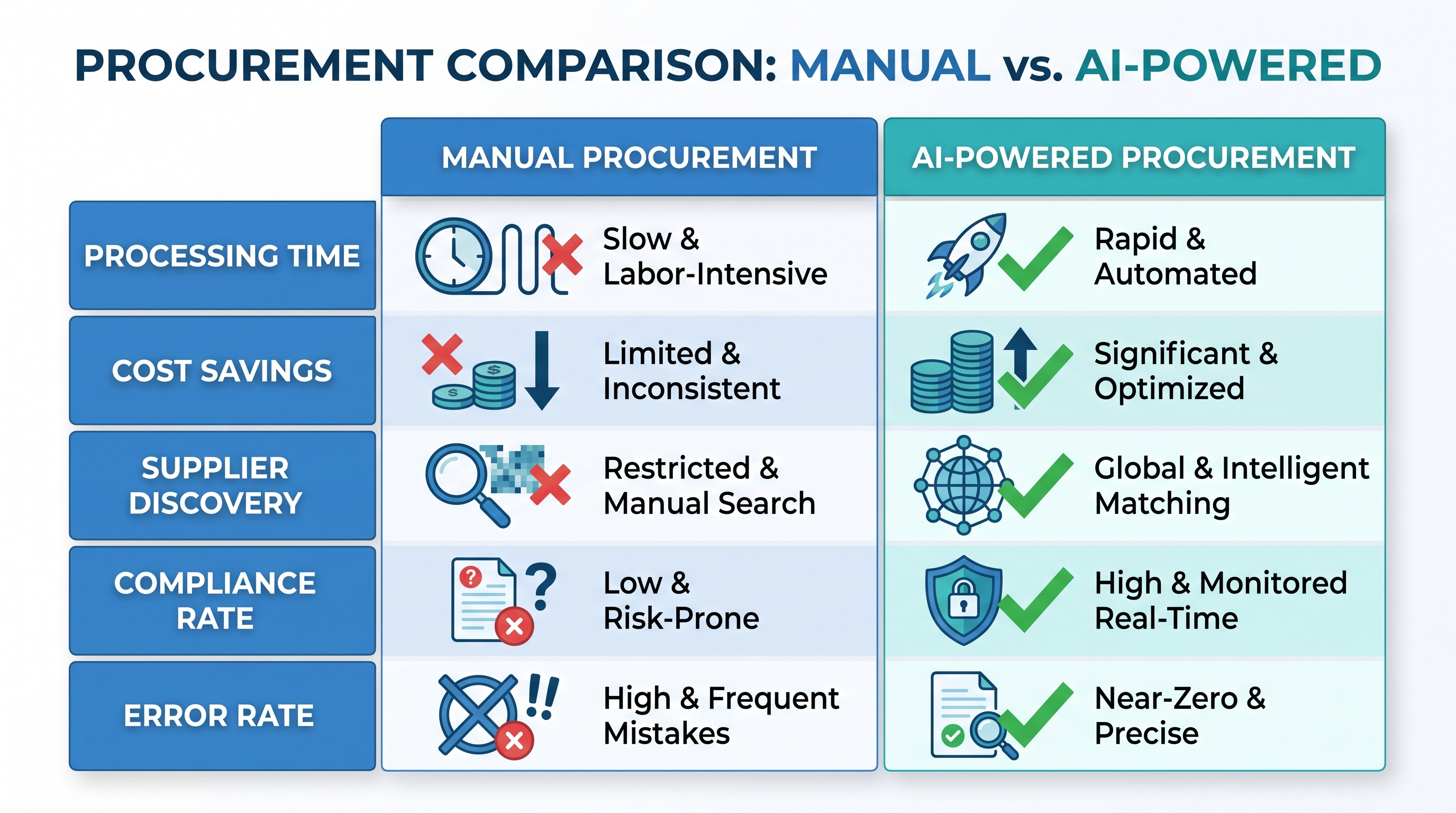
58% of enterprises still manage procurement primarily through spreadsheets and email. The average purchase order takes 7 days to process. Supplier comparison happens through manual research and vendor presentations. Contract negotiation relies on a procurement officer's personal experience and gut feeling.
The result: enterprises overspend by an average of 22% on goods and services because they lack visibility into market pricing, miss volume discount opportunities, and fail to consolidate spend across departments.
AI-powered procurement is changing this. Early adopters are achieving 22% average savings on total addressable spend, cutting PO processing time from 7 days to 4 hours, and discovering qualified suppliers in minutes instead of weeks.
What AI-Powered Procurement Actually Does
Intelligent Spend Analysis
The average enterprise has 40,000+ line items of procurement data spread across ERP systems, expense reports, P-cards, and invoice management tools. Nobody has a complete picture of what's being bought, from whom, at what price, and whether it's competitive.
AI-powered procurement ingests all of this data, normalizes it, and creates a unified spend dashboard. It identifies:
- Maverick spend: Purchases made outside preferred supplier contracts (typically 23% of total spend)
- Price variance: Same item purchased at different prices across departments (average variance: 18%)
- Consolidation opportunities: Multiple suppliers for the same category that could be consolidated for volume discounts
- Contract compliance gaps: Suppliers charging above contracted rates
!Manual procurement vs AI-powered procurement: key differences
Automated Supplier Discovery and Evaluation
Finding the right supplier for a new requirement traditionally takes 2-4 weeks: research, RFP creation, vendor outreach, proposal evaluation, reference checks. AI compresses this to hours.
AI-powered procurement platforms scan supplier databases, industry registries, and market data to identify qualified suppliers matching your requirements. They evaluate suppliers on:
- Financial stability (credit ratings, revenue trends, payment history)
- Performance metrics (on-time delivery rate, quality scores, complaint history)
- Compliance status (certifications, regulatory standing, ESG ratings)
- Pricing competitiveness (benchmark against market rates and your existing contracts)
The AI presents a ranked shortlist of 3-5 suppliers with detailed comparison data, reducing the evaluation cycle from weeks to days.
Smart Contract Negotiation
AI doesn't just find suppliers. It helps you negotiate better deals. By analyzing thousands of contracts in your industry, AI-powered procurement tools can:
- Benchmark proposed pricing against market rates and historical contracts
- Identify non-standard terms and clauses that increase risk
- Suggest alternative payment terms that improve cash flow
- Flag auto-renewal clauses and price escalation terms that lock you in
One enterprise discovered that 34% of their supplier contracts had auto-renewal clauses they didn't know about, costing $1.2M annually in unwanted renewals.
Purchase Order Automation
Once a supplier is selected, AI-powered procurement automates the PO workflow:
- Generate PO from approved requisitions with correct coding and approvals
- Validate against contract terms (price, quantity, delivery date)
- Route for approval based on value and category rules
- Send to supplier and track acknowledgment
Average PO processing time drops from 7 days to 4 hours. Approval bottlenecks disappear because the AI routes approvals to the right person based on availability and authority level.
The Savings by Category
!Cost savings from AI-powered procurement across spend categories
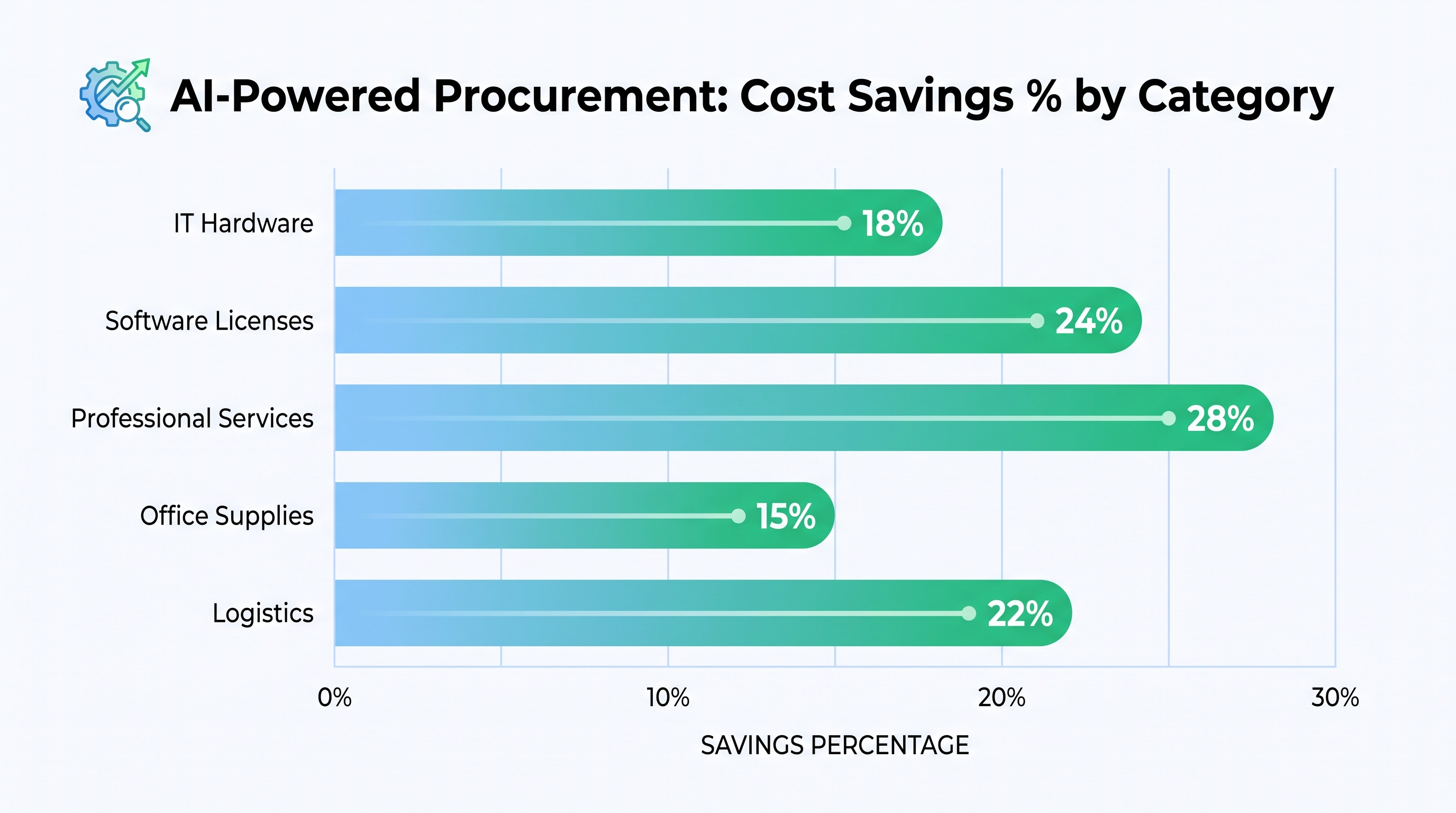
Enterprises implementing AI-powered procurement see different savings rates by category:
- IT Hardware: 18% (better benchmarking against market prices)
- Software Licenses: 28% (identifying unused licenses and consolidating vendors)
- Professional Services: 15% (rate benchmarking and scope optimization)
- Office Supplies: 22% (consolidation and contract compliance)
- Logistics: 19% (route optimization and carrier comparison)
The weighted average across all categories: 22% savings on total addressable spend.
Why 58% Still Use Spreadsheets
1. Procurement is seen as a back-office function. Most executives don't think of procurement as a strategic lever. It's a cost center that processes POs. The idea that procurement could generate 22% savings doesn't register because nobody's measuring the opportunity cost.
2. Integration complexity. Procurement touches ERP, finance, legal, and every business unit. Integrating AI across these systems feels daunting. In practice, modern AI procurement tools connect through APIs and can be deployed in 60-90 days.
3. Change resistance from procurement teams. Procurement officers worry that AI will replace them. The reality is different: AI handles the data-heavy, repetitive work (spend analysis, supplier research, PO processing) so procurement teams can focus on strategic supplier relationships and negotiation.
4. "Our spend isn't big enough." Enterprises with $10M+ in annual procurement spend can justify the investment. Below that, the ROI is thinner but still positive. The break-even point is typically around $5M in annual addressable spend.
The 60-Day Implementation Plan
Days 1-20: Spend Visibility
- Integrate procurement data sources (ERP, expense, invoices, P-cards)
- Deploy AI spend classification and normalization
- Generate baseline spend dashboard and identify top savings opportunities
Days 21-40: Supplier Intelligence
- Deploy AI supplier discovery and evaluation for top 5 spend categories
- Benchmark existing supplier pricing against market rates
- Identify consolidation and renegotiation opportunities
Days 41-60: Process Automation
- Automate PO generation and approval workflows
- Deploy contract analysis for auto-renewal and price escalation risks
- Set up ongoing spend monitoring and alert system
The Bottom Line
An enterprise spending $50M annually on procurement is overspending by $11M. AI-powered procurement can recover $5-7M of that within 12 months.
The enterprises that move now will build a procurement function that's a competitive advantage, not a cost center. They'll have real-time visibility into spend, automated supplier evaluation, and the ability to redirect savings into growth initiatives.
The question isn't whether AI will transform procurement. It's whether you'll be among the enterprises capturing the savings or among the 58% still managing it in spreadsheets.