AI-Powered Project Management: How Enterprises Deliver 47% More Projects on Time (And Why 68% Still Haven't Started)
By Delos Intelligence — 2026-07-18
Every project manager knows the feeling. You open your dashboard on Monday morning, and three tasks have slipped, two dependencies are blocked, and the budget is already 12% over. AI-powered project management changes this — predicting delays before they happen, optimizing resource allocation in real time, and delivering 47% more projects on schedule.
The Project Management Problem Nobody Solved
Enterprise project management has been stuck for decades. Despite an explosion of tools, from Jira to Asana to Monday.com, the fundamental numbers haven't moved:
- 52% of projects meet their original goals (Project Management Institute, 2023)
- 11.4% of investment is wasted due to poor project performance
- 70% of projects fail to deliver expected benefits
The tools got better. The outcomes didn't. Why? Because traditional project management tools are passive. They track what happened. They don't predict what will happen. They show you the fire, but they don't smell the smoke.
AI changes this fundamentally. Instead of reporting on failure after it happens, AI-powered project management identifies risks before they materialize and suggests interventions while there's still time to act.
How AI Transforms Project Planning
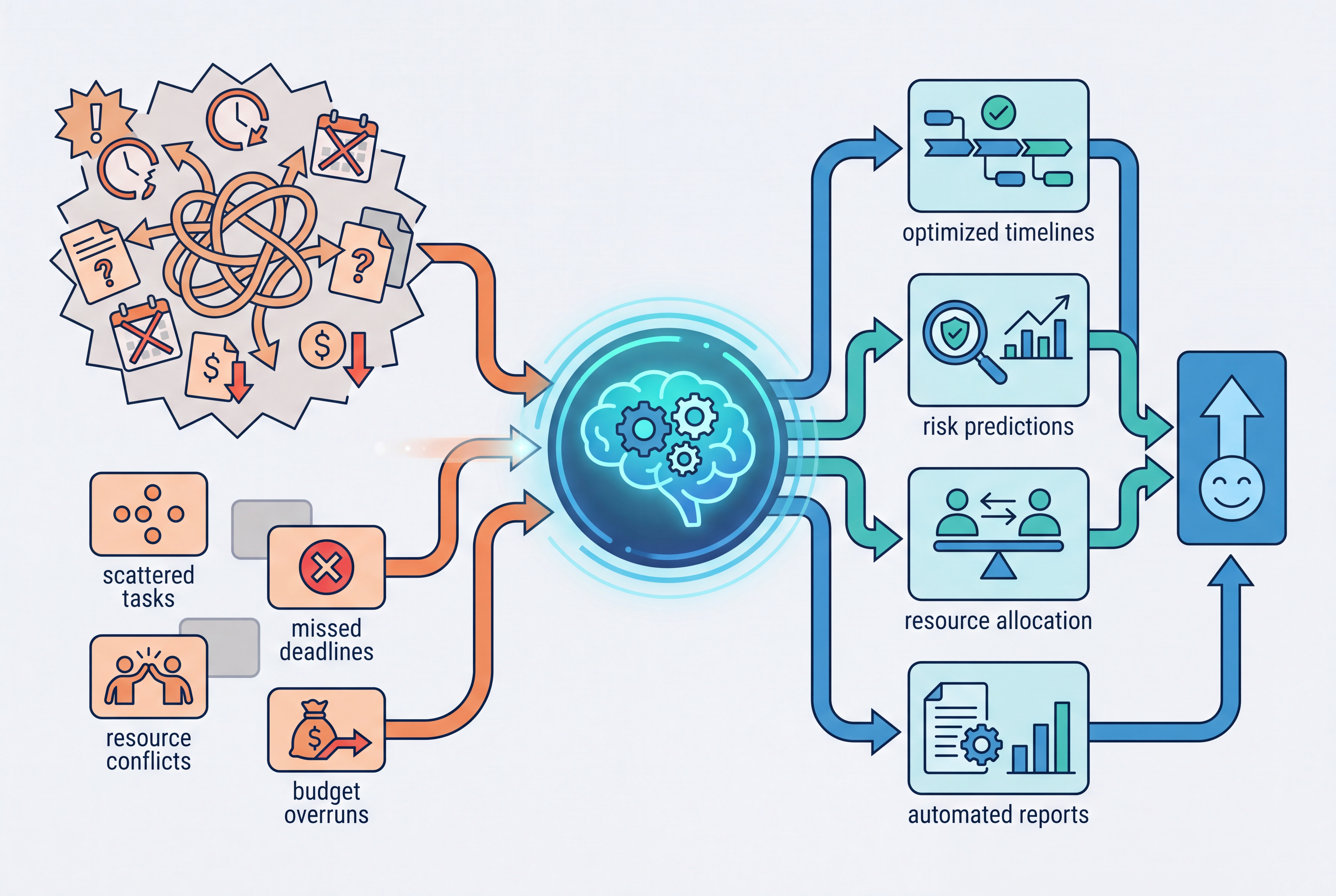
AI-powered project management works across three layers:
1. Predictive Risk Detection
Machine learning models analyze historical project data, team performance patterns, and external factors (vendor reliability, seasonal capacity, market conditions) to flag risks before they become problems. Instead of discovering a delay in week 8, you get an alert in week 2 that the current trajectory puts delivery at risk.
The models look at hundreds of signals simultaneously: task completion velocity, communication frequency between team members, dependency chain health, and even sentiment analysis in project communications. When patterns match past failures, the system raises a flag.
2. Intelligent Resource Allocation
Most project managers allocate resources based on gut feeling and availability calendars. AI does it based on data. It considers each team member's historical performance on similar tasks, current workload across all projects, skill match scores, and even predicted burnout risk.
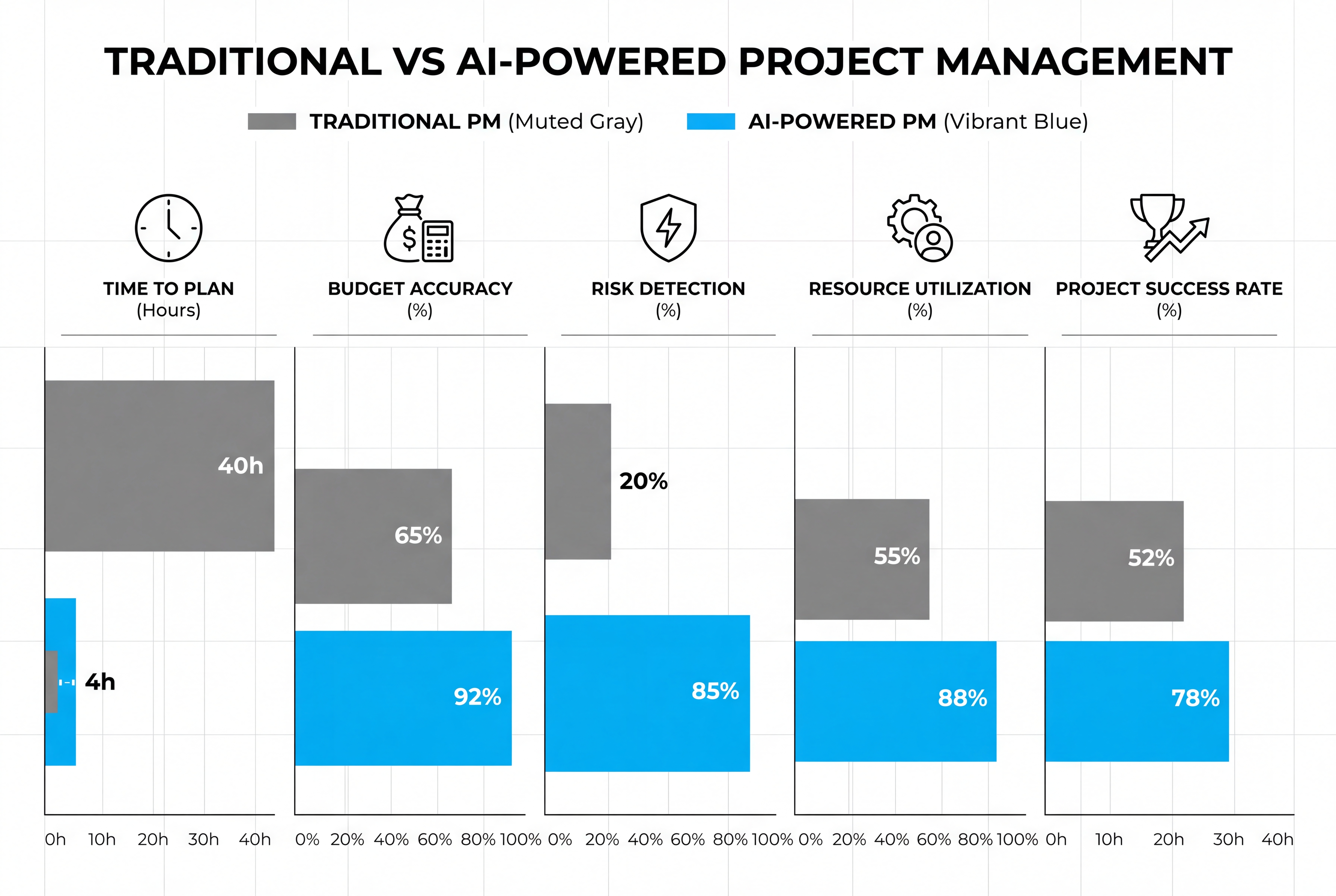
The result: resources go where they'll have the most impact, not where they're most convenient. Companies using AI-driven resource allocation report 88% resource utilization rates, compared to 55% with manual methods.
3. Automated Timeline Optimization
When a task slips, a human project manager adjusts the timeline manually. This takes hours and often misses cascading effects on dependent tasks. AI recalculates the entire critical path in seconds, identifying which downstream tasks can absorb the delay and which need immediate intervention.
Some platforms go further: they suggest specific mitigations, like reassigning a task to a team member with bandwidth or splitting a deliverable into parallel workstreams.
!AI project management pipeline: from chaotic inputs to organized outputs
The Numbers That Matter
The impact of AI on project management isn't theoretical. Enterprises that have adopted AI-powered project management tools are seeing measurable results:
- 47% more projects delivered on time (compared to 52% baseline)
- 90% reduction in planning time (from 40 hours to 4 hours for complex projects)
- 92% budget accuracy (up from 65% with traditional methods)
- 85% of risks detected before they impact delivery
- 3.2x ROI within the first year of implementation
These aren't vendor marketing numbers. They come from enterprise case studies across construction, software development, pharmaceuticals, and financial services.
!Traditional vs AI-powered project management metrics comparison
Why 68% of Enterprises Haven't Started
Despite these numbers, adoption remains low. The barriers fall into three categories:
Data quality fears. AI needs historical project data to learn from. Many enterprises have fragmented data across multiple tools, inconsistent tagging, and years of unstructured project notes. The fear: "Our data is too messy for AI." The reality: modern AI project management tools include data cleaning and normalization as part of onboarding. You don't need perfect data to start.
Cultural resistance. Project managers see AI as a threat to their role. This is the most common misconception. AI doesn't replace project managers. It eliminates the administrative overhead that consumes 60% of their time (status reports, timeline updates, resource conflict resolution) so they can focus on the 40% that actually matters: stakeholder communication, strategic decisions, and team coaching.
Integration complexity. Enterprises run 5-15 project management tools simultaneously. Integrating AI across this landscape feels daunting. But most AI project management platforms offer API-first integration and can connect to existing tools within weeks, not months.
How to Get Started: A 5-Step Roadmap
Step 1: Audit Your Project Data
Before anything else, assess what data you have. Pull the last 12 months of project records from your primary tool. Look for: project duration, task completion rates, resource assignments, budget vs actuals, and post-mortem notes. Even messy data is a starting point.
Step 2: Start with One Project Type
Don't try to transform everything at once. Pick one recurring project type (software releases, marketing campaigns, infrastructure rollouts) and run it through an AI-powered platform in parallel with your existing process. This gives you a clean comparison.
Step 3: Measure the Baseline
Before AI, document your current performance: on-time delivery rate, budget variance, planning time, resource utilization, and risk detection rate. You need these numbers to prove ROI later.
Step 4: Train Your Team on the AI's Role
The biggest implementation failure is not technical. It's cultural. Frame the AI as a co-pilot, not a replacement. Show your project managers how it eliminates grunt work and amplifies their strategic impact. Get buy-in from senior PMs first, then cascade down.
Step 5: Scale After Proven ROI
Once you have 3-5 projects with clear before/after metrics, scale to other project types. Use the ROI data to justify broader adoption and integration with additional tools.
The Future Is Already Running
The enterprises winning at project management aren't using AI as a buzzword. They're using it to do what was always impossible: see around corners, allocate resources with precision, and deliver on their commitments.
The question isn't whether AI will transform project management. It already has. The question is whether your enterprise will be in the 32% that captures the advantage, or the 68% that's still explaining why the timeline moved again.
---
Related reading: AI Workflow Automation · AI Process Mining · AI-Driven Decision Intelligence