AI-Powered Revenue Management: How Enterprises Boost Margins by 25% with Dynamic Pricing Intelligence
By Delos Intelligence — 2026-08-12
Most enterprises still rely on static pricing models that leave billions on the table. AI-powered revenue management delivers 2-5 percent revenue lift, with top performers reaching 10 percent or more, through dynamic pricing intelligence that updates in real time.
Why Traditional Revenue Management Is Breaking Down
Most enterprises still rely on static pricing models built in spreadsheets, updated quarterly, and disconnected from real-time market signals. In a world where demand shifts by the hour, competitors adjust prices by the minute, and customer expectations evolve continuously, this approach leaves money on the table.
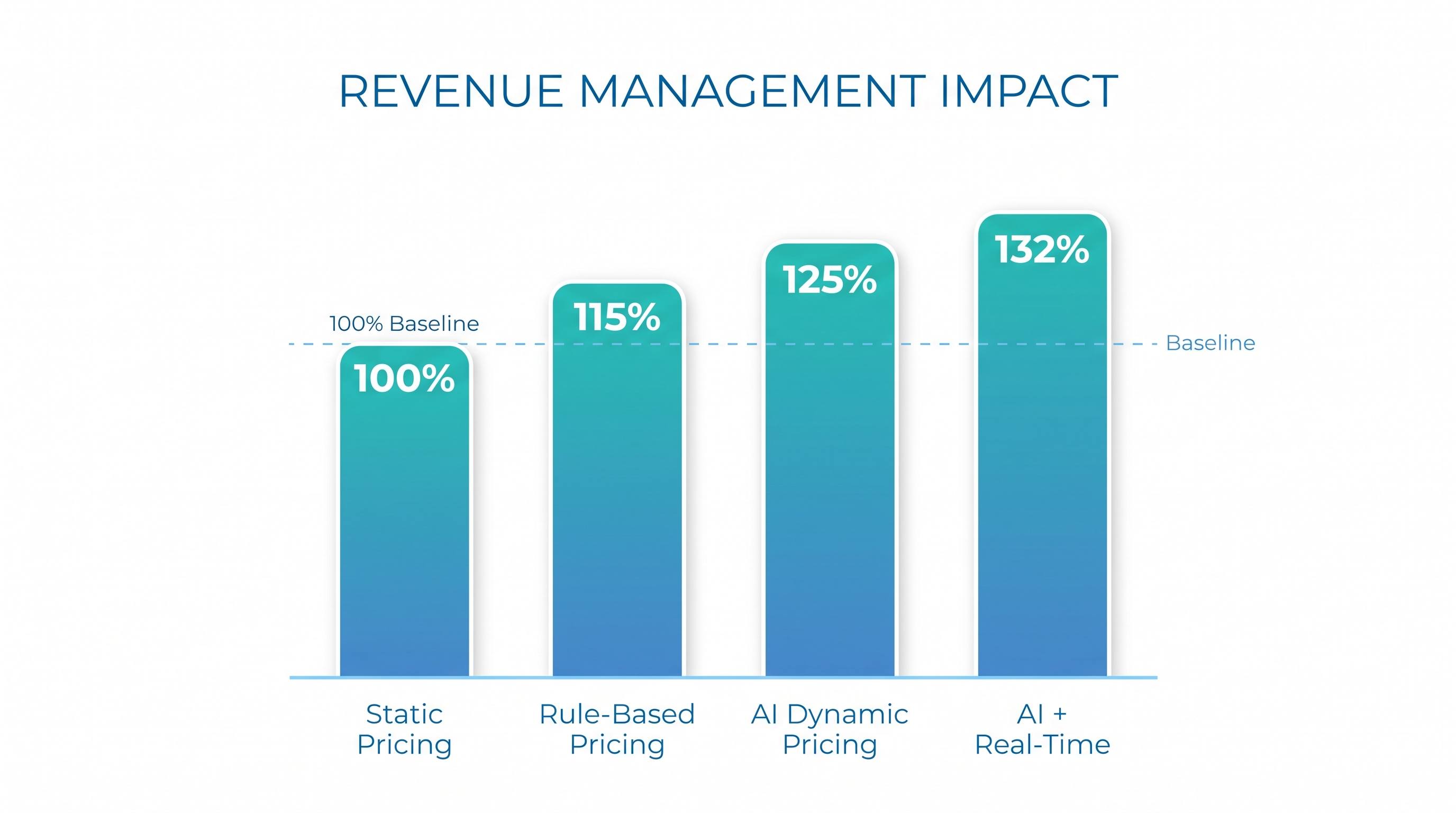
McKinsey estimates that enterprises using AI-driven pricing capture 2-5% additional revenue annually. For a company with $2B in revenue, that is $40-100M per year. The gap between static and dynamic pricing is no longer a competitive advantage. It is a survival requirement.
!Revenue Management Impact: AI dynamic pricing delivers 32% revenue uplift vs static pricing
What AI-Powered Revenue Management Actually Does
AI-powered revenue management replaces gut-feel pricing and rigid rule engines with machine learning models that process thousands of variables simultaneously. These systems analyze historical sales data, competitor pricing, market demand signals, seasonality, inventory levels, customer segments, and macroeconomic indicators to recommend optimal prices in real time.
The core capability is not just setting a price. It is continuously learning from outcomes and adjusting. Every transaction becomes a training data point. Every price change generates new signal. Over time, the system gets sharper.
The Five-Step AI Revenue Engine
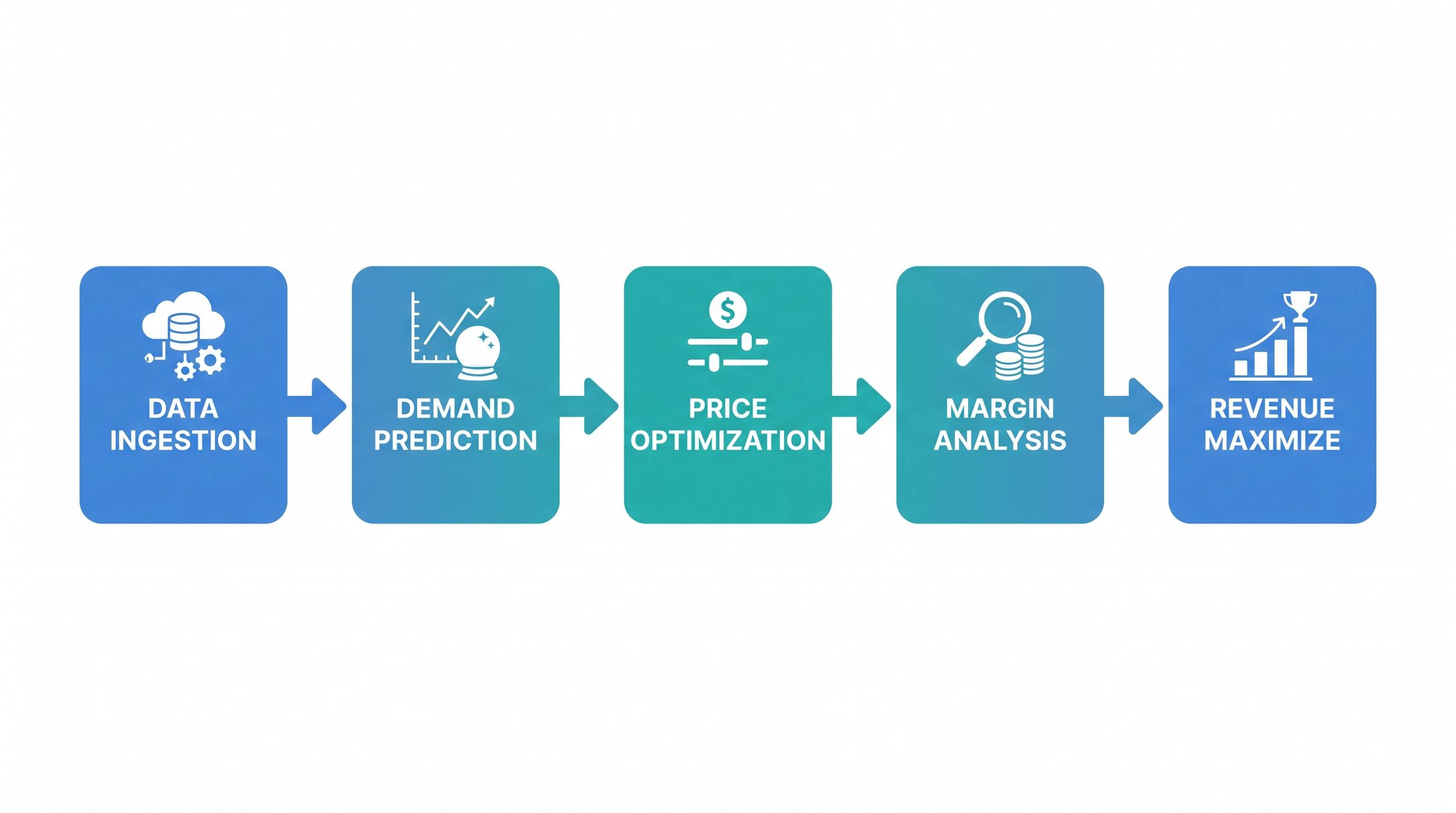
1. Data Ingestion: The system pulls from ERP, CRM, POS, web analytics, competitor feeds, weather data, and economic indicators.
2. Demand Prediction: Machine learning forecasts demand at a granular level, by product, segment, channel, and time window. These forecasts update continuously as new data arrives.
3. Price Optimization: The engine calculates the price that maximizes revenue or margin for each SKU, segment, and channel, accounting for constraints like minimum margins, competitive positioning, and customer price sensitivity.
4. Margin Analysis: Real-time margin tracking ensures every price change protects profitability. The system flags margin erosion before it hits the P&L.
5. Revenue Maximization: The loop closes with continuous A/B testing of pricing strategies, measuring actual revenue impact and feeding results back into the model.
Real-World Impact: What Enterprises Are Seeing
Companies across industries are reporting measurable results:
- Retail: A global retailer implemented AI dynamic pricing across 50,000 SKUs and saw a 4.1% revenue lift in six months, with no measurable impact on customer satisfaction scores.
- Travel & Hospitality: A hotel chain using AI-driven room pricing increased RevPAR by 18% year-over-year, outperforming the market by 12 points.
- Manufacturing: An industrial parts manufacturer deployed AI pricing for 200,000 product-customer combinations and recovered $23M in margin previously lost to inconsistent discounting.
- SaaS: A B2B software company used AI to optimize subscription pricing tiers and increased average contract value by 22% while reducing churn by 8%.
According to McKinsey pricing research, companies that adopt AI-driven pricing see 2-5% margin improvement on average, with top performers reaching 10% or more.
The Technology Stack Behind AI Revenue Management
Data Layer
Modern data platforms (Snowflake, Databricks, BigQuery) consolidate transactional, behavioral, and external data into a single source of truth. The key is real-time or near-real-time data pipelines, not batch updates.
Model Layer
Machine learning models for demand forecasting and price optimization are available as managed services. Commercial platforms like Pricefx, Zilliant, and Vendavo offer enterprise-grade pricing optimization out of the box.
Decision Layer
This is where AI meets business rules. The system applies guardrails: minimum margins, competitive ceilings, customer-specific overrides, and regulatory constraints. AI recommends, humans approve or automate within thresholds.
Execution Layer
Prices flow back into ERP, e-commerce, and POS systems via APIs. The execution layer closes the loop by capturing transaction outcomes and feeding them back into the model.
Overcoming the Three Biggest Barriers
1. Data Quality and Integration
The number one reason AI pricing projects stall is poor data. Product hierarchies are inconsistent, customer records are duplicated, and historical pricing data is incomplete. The fix is data cleansing, master data management, and governance.
2. Organizational Resistance
Sales teams often resist AI-driven pricing because it challenges their autonomy. Start with pilot categories, show the revenue lift, and let the results speak.
3. Model Trust and Explainability
Modern AI pricing platforms provide explainability features: showing the key drivers behind each recommendation. This transparency builds trust and accelerates adoption.
Getting Started: A Practical Roadmap
1. Audit your pricing data: Assess data completeness, accuracy, and granularity across products, customers, and channels. Fix gaps before building models.
2. Start with one segment: Pick a product category or customer segment with high transaction volume and clear margin opportunity. Prove the concept before scaling.
3. Choose build vs buy: Evaluate commercial pricing platforms against custom builds. For most enterprises, a commercial platform with customization delivers faster ROI.
4. Set guardrails: Define minimum margins, maximum price changes, and competitive positioning rules. AI optimizes within these boundaries.
5. Measure relentlessly: Track revenue lift, margin improvement, customer retention, and competitive positioning. A/B test AI recommendations against control groups.
6. Scale gradually: Once the pilot proves value, expand to adjacent categories. Each expansion benefits from the model's accumulated learning.
The Future: From Pricing to Revenue Intelligence
AI-powered revenue management is evolving beyond pricing. The next generation of systems will optimize across the entire revenue lifecycle: pricing, promotions, discounts, channel mix, and customer lifetime value.
Enterprises that build this capability now will compound their advantage. Each year of data makes the models smarter. Each iteration closes the gap between decision and action.
Key Takeaways
- AI-powered revenue management delivers 2-5% revenue lift on average, with top performers reaching 10%+
- The technology stack has matured: managed platforms, open-source libraries, and cloud data infrastructure make implementation feasible
- Data quality is the foundation: invest in cleansing and governance before building models
- Start with a pilot, prove value, then scale
- The future is revenue intelligence: optimizing across the entire revenue lifecycle
For more on how AI is transforming enterprise operations, see our articles on AI-Powered Demand Forecasting and AI-Powered Treasury Management. For broader context, the Harvard Business Review provides excellent analysis on pricing transformation.
La rédaction de cet article a été assistée par IA.