AI-Powered Supplier Risk Intelligence: How Global Supply Chains Predict Vendor Disruptions and Build Operational Resilience
By Delos Intelligence — 2026-08-17
How Fortune 500 enterprises use AI-powered supplier risk intelligence to continuously monitor Tier-1 to Tier-N vendor vulnerabilities, financial health, and ESG compliance.
The Blind Spot Beyond Tier 1: Why Supply Chains Break
Most enterprise supply chain risk programs focus exclusively on Tier 1 suppliers. But the most catastrophic disruptions rarely originate at the top of the supply pyramid. They cascade upward from Tier 2, Tier 3, and beyond. The 2021 semiconductor shortage exposed automakers not because their direct suppliers failed, but because a Taiwanese wafer fabricator deep in the supply chain — invisible to most OEM risk dashboards — was capacity-constrained. The result: $210B in lost automotive revenue globally.
Traditional supply chain risk management is reactive and manually intensive. Quarterly supplier scorecards, annual audits, and manually curated watchlists cannot provide the continuous multi-tier visibility required to detect and respond to modern supply chain threats.
!Multi-Tier AI Supplier Risk Intelligence Pipeline
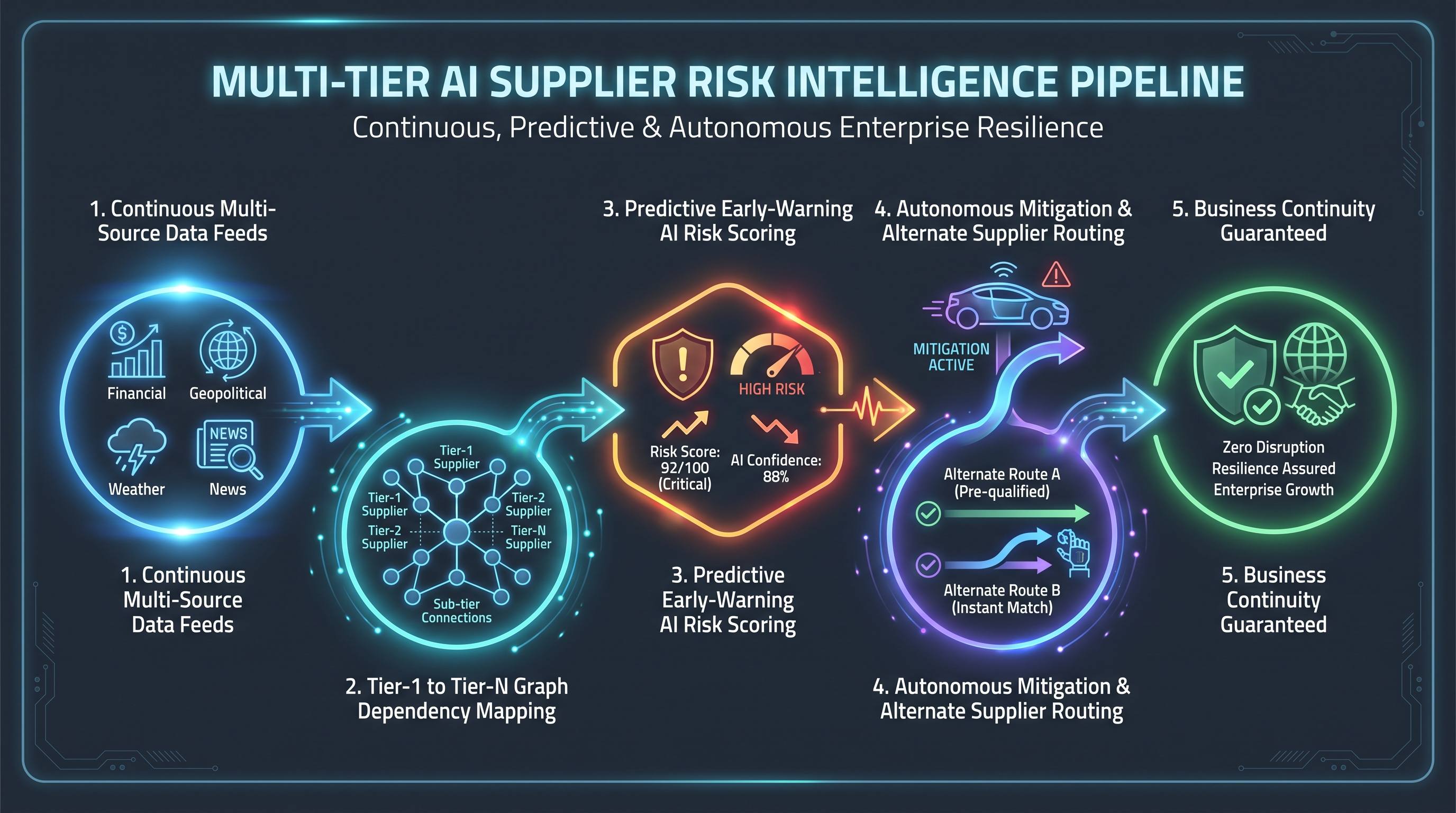
How AI Powers Multi-Tier Supplier Intelligence
Multimodal Signal Ingestion
AI supplier risk agents continuously ingest and correlate signals across multiple dimensions:
- Financial health indicators: credit agency feeds, bond yield spreads, payment default databases, SEC/Companies House filings, and cash flow trend modeling
- Geopolitical and trade signals: export control regulation changes, tariff schedule updates, port congestion indices, sanctions list modifications, and regional instability indices
- Environmental and climate signals: extreme weather event forecasts, flood zone proximity of manufacturing facilities, drought impact on agricultural input suppliers
- Operational signals: job posting activity (sudden drops in hiring indicate distress), logistics carrier performance, lead time elongation from public freight data
Predictive Bankruptcy and Default Modeling
AI models trained on historical supplier distress events predict the probability of bankruptcy or critical operational disruption within a rolling 90-day window. By combining Altman Z-score variants with machine learning models trained on payment behavior, credit event patterns, and industry-specific stress indicators, the AI identifies supplier financial deterioration on average 28 days before traditional risk management frameworks detect the same signal.
This 28-day advance warning window is the difference between activating an alternative supplier before a shortage occurs and scrambling to source replacements after production has already halted.
Autonomous Alternate Vendor Onboarding Protocols
When a supplier risk score crosses a critical threshold, the AI doesn't just alert the procurement team — it initiates autonomous preparatory actions: identifying pre-qualified alternative suppliers from the vendor master, running preliminary capability and compliance screening against qualification criteria, flagging capacity availability windows, and preparing draft outreach communication for procurement manager review.
!Impact of Predictive AI on Supplier Risk Management
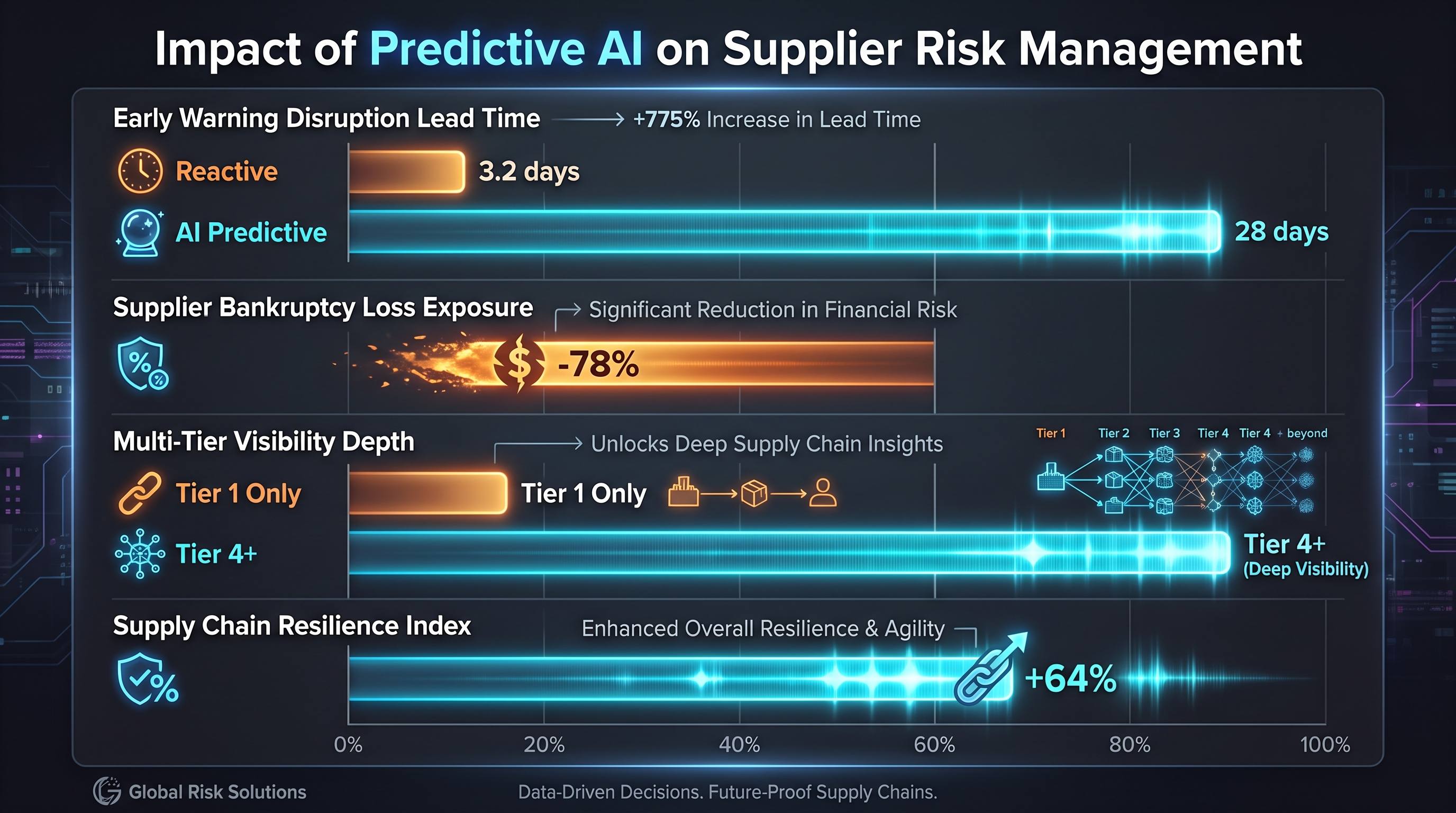
Quantified Business Impact
Fortune 500 enterprises deploying AI-powered supplier risk intelligence platforms report:
- 28-day average advance warning: versus 2-3 day reactive detection with legacy scorecards
- 62% reduction in supply disruption events: through proactive mitigation before events materialize
- 91% multi-tier supplier visibility: up from an average of 34% Tier 1-only coverage
- $14M average annual risk exposure reduction: for a manufacturer with $1.5B in direct materials spend
Implementation Framework
Phase 1 (Weeks 1-8): Map the full Tier 1-N supply chain graph. Integrate financial data feeds and ERP supplier master data. Deploy baseline risk scoring.
Phase 2 (Weeks 9-16): Activate continuous monitoring with configurable alert thresholds. Begin enriching supplier profiles with geopolitical and environmental signal layers.
Phase 3 (Months 5-9): Enable predictive default modeling and autonomous alternate vendor qualification workflows. Integrate risk signals into procurement decision workflows.
Building Operational Resilience as a Competitive Moat
Supply chain resilience is increasingly a competitive differentiator. Organizations that can absorb disruptions — continuing production while competitors halt — capture market share, strengthen customer relationships, and avoid the punishing spot-market costs that follow supply shortages.
AI-powered supplier risk intelligence transforms supply chain visibility from a retrospective audit function into a continuous forward-looking intelligence capability that compounds in value as the model learns from each disruption event — predicted or realized.
This article was written with AI assistance. [EU AI Act Article 50 transparency notice]