AI-Powered Supply Chain Demand Forecasting: How Global Enterprises Slash Forecast Errors by 40% and Prevent Inventory Stockouts
By Delos Intelligence — 2026-08-20
Learn how AI demand sensing and predictive multi-echelon inventory optimization reduce forecast errors by 40% and eliminate stockouts.
The Forecasting Gap That Costs Enterprises Billions
Supply chain disruption is the new normal. Between post-pandemic demand volatility, geopolitical trade friction, and accelerating product lifecycle compression, traditional statistical forecasting methods are failing at scale. The average enterprise using legacy ARIMA or ETS models reports forecast accuracy in the 60-70% range, with MAPE errors exceeding 30% during demand spikes or supply shocks.
The financial consequences are twofold. Overstock ties up working capital, drives warehousing costs, and generates markdown pressure on slow-moving SKUs. Understock causes stockouts, lost sales, emergency air freight, and customer churn. Industry research estimates that the combined cost of over- and under-stocking represents 8-12% of annual revenues for consumer goods and industrial manufacturers.
!AI Demand Forecasting Engine Workflow
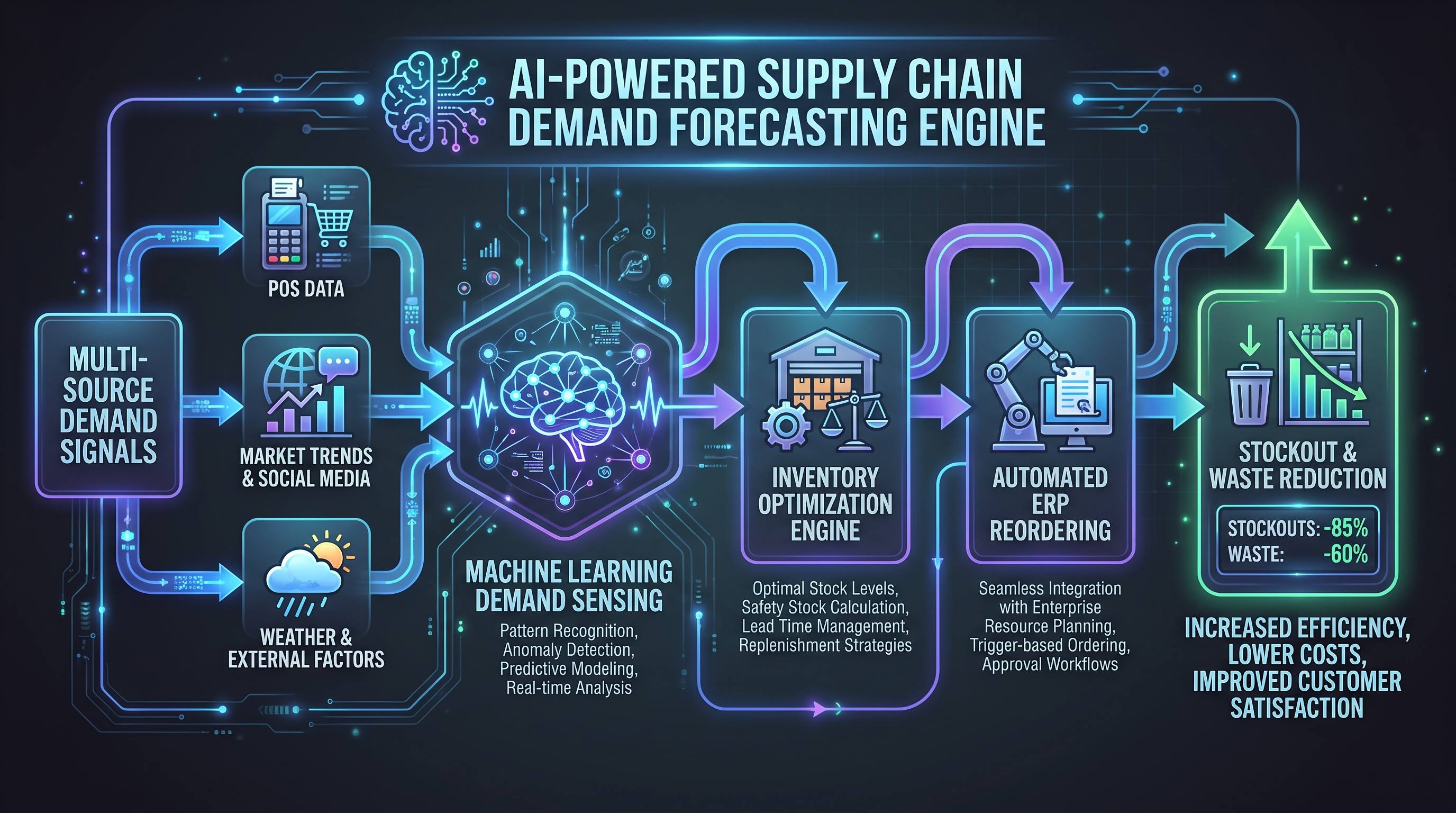
How AI Demand Sensing Transforms Forecasting Accuracy
Multi-Signal Real-Time Data Ingestion
AI demand sensing platforms ingest dozens of external and internal signals simultaneously: point-of-sale data, distributor sell-through rates, weather forecasts, social media sentiment, macroeconomic leading indicators, commodity price indices, and competitor promotional calendars. This multi-signal approach captures demand inflections 4-6 weeks earlier than shipment-based history alone.
Hierarchical Machine Learning Models
Modern AI forecasting engines deploy ensemble architectures combining gradient boosting, LSTM neural networks, and Bayesian probabilistic models. Forecasts are generated at multiple hierarchy levels, from SKU-level to category to total business, with automated reconciliation to ensure consistency across planning horizons.
Multi-Echelon Inventory Balancing
AI workers translate demand forecasts into optimal inventory positioning decisions across the supply network. Rather than setting static safety stock at each node, AI models continuously rebalance inventory between regional DCs, in-transit inventory, and supplier kanban buffers based on real-time lead time variability and service level targets.
!AI Demand Forecasting Performance Impact
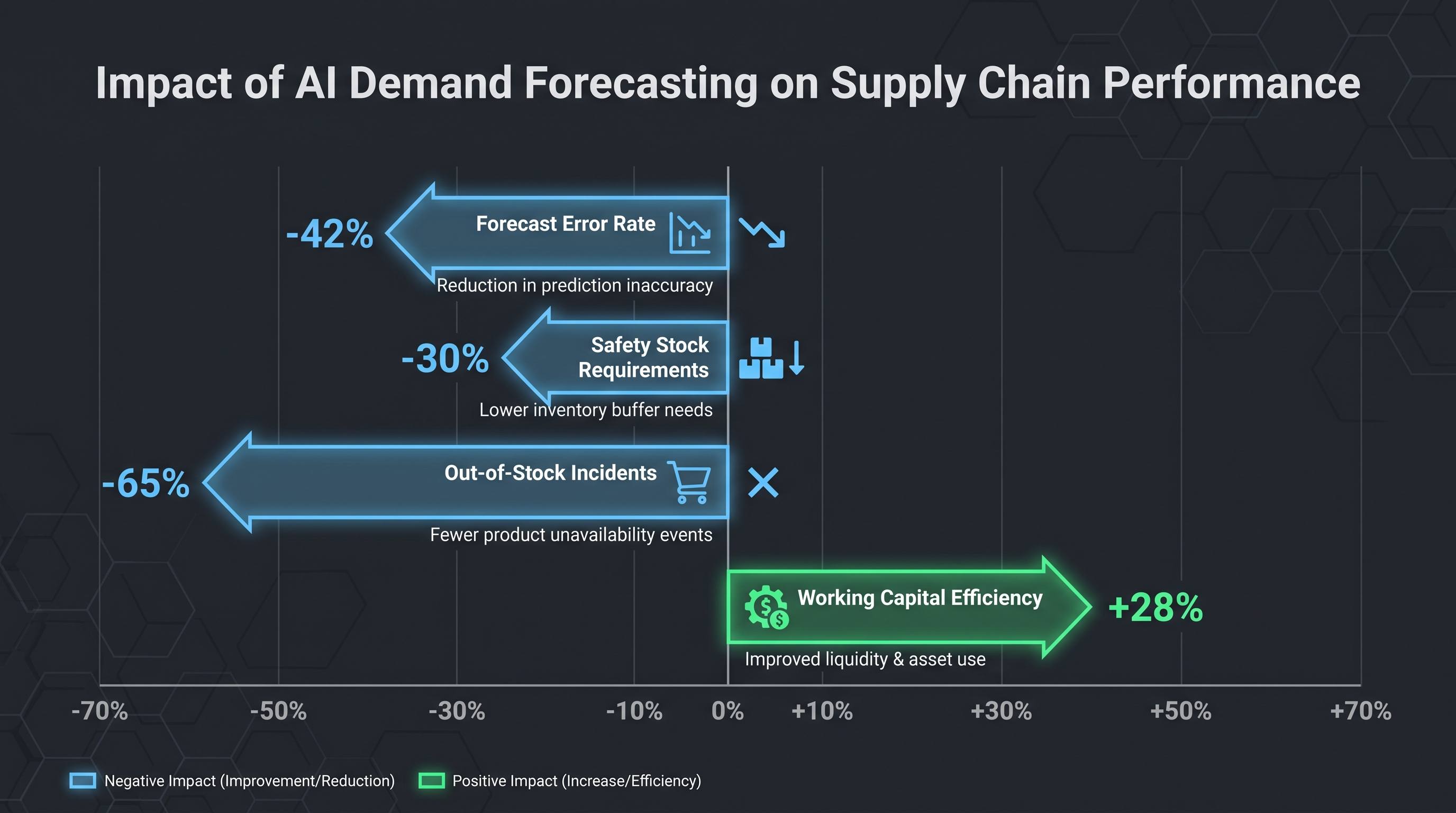
Quantified Performance Improvements
| Forecasting Metric | Legacy Statistical | AI-Powered | Delta |
| :--- | :--- | :--- | :--- |
| Forecast MAPE (12-week horizon) | 28-35% | 16-20% | -40% error reduction |
| Stockout frequency | 8-12% of SKUs | 2-3% of SKUs | -75% stockout events |
| Excess inventory value | 18-22% of revenue | 8-10% of revenue | -55% working capital trapped |
| Demand sensing lead time | Lagging (shipments) | 4-6 weeks forward | Proactive vs reactive |
Automated ERP Replenishment Integration
AI demand forecasts flow directly into ERP replenishment modules (SAP IBP, Oracle ASCP, Microsoft Supply Chain Center), automatically generating purchase orders, production schedules, and transfer orders when inventory positions breach AI-calculated reorder points. This closed-loop automation eliminates the weekly planning cycle and reduces planner intervention by 70%.
Implementation Best Practices
1. Establish a demand data lake: Centralize POS, distributor, and promotional data into a unified forecasting feed.
2. Start with your top 20% of SKUs by revenue: These drive 80% of forecast error impact and provide the fastest ROI.
3. Build a forecast accuracy KPI dashboard: Track MAPE, bias, and stockout rate weekly to measure improvement.
4. Integrate with S&OP: Feed AI forecasts into monthly Sales and Operations Planning processes to align commercial and supply decisions.
Conclusion
AI-powered demand forecasting is the single highest-ROI investment in supply chain technology. Enterprises that deploy multi-signal demand sensing with automated ERP integration consistently achieve 40%+ forecast error reductions within two planning cycles. In volatile markets, this capability is not a competitive advantage. It is a survival requirement.
This article was created with AI assistance. | La redaction de cet article a ete assistee par IA.