AI-Powered Warranty Management: How Manufacturers Eliminate Warranty Leakage, Detect Defects Early, and Cut Claim Costs by 45%
By Delos Intelligence — 2026-08-16
For global manufacturers, warranty claims consume 2.5-4.8% of annual revenues. Autonomous AI workers cut adjudication time by 85%, eliminate leakage, and feed real-time quality intelligence to engineering teams.
The Hidden Warranty Cost Crisis
For global manufacturers in automotive, aerospace, and industrial machinery, warranty claims consume 2.5-4.8% of annual revenues. Despite massive ERP/CRM investments, claims adjudication remains stubbornly manual. Service centers submit unstructured invoices, scanned work orders, and technician narratives across fragmented dealer management systems. Human adjusters are inundated, leading to high backlog, inconsistent policy enforcement, and undetected fraudulent claims.
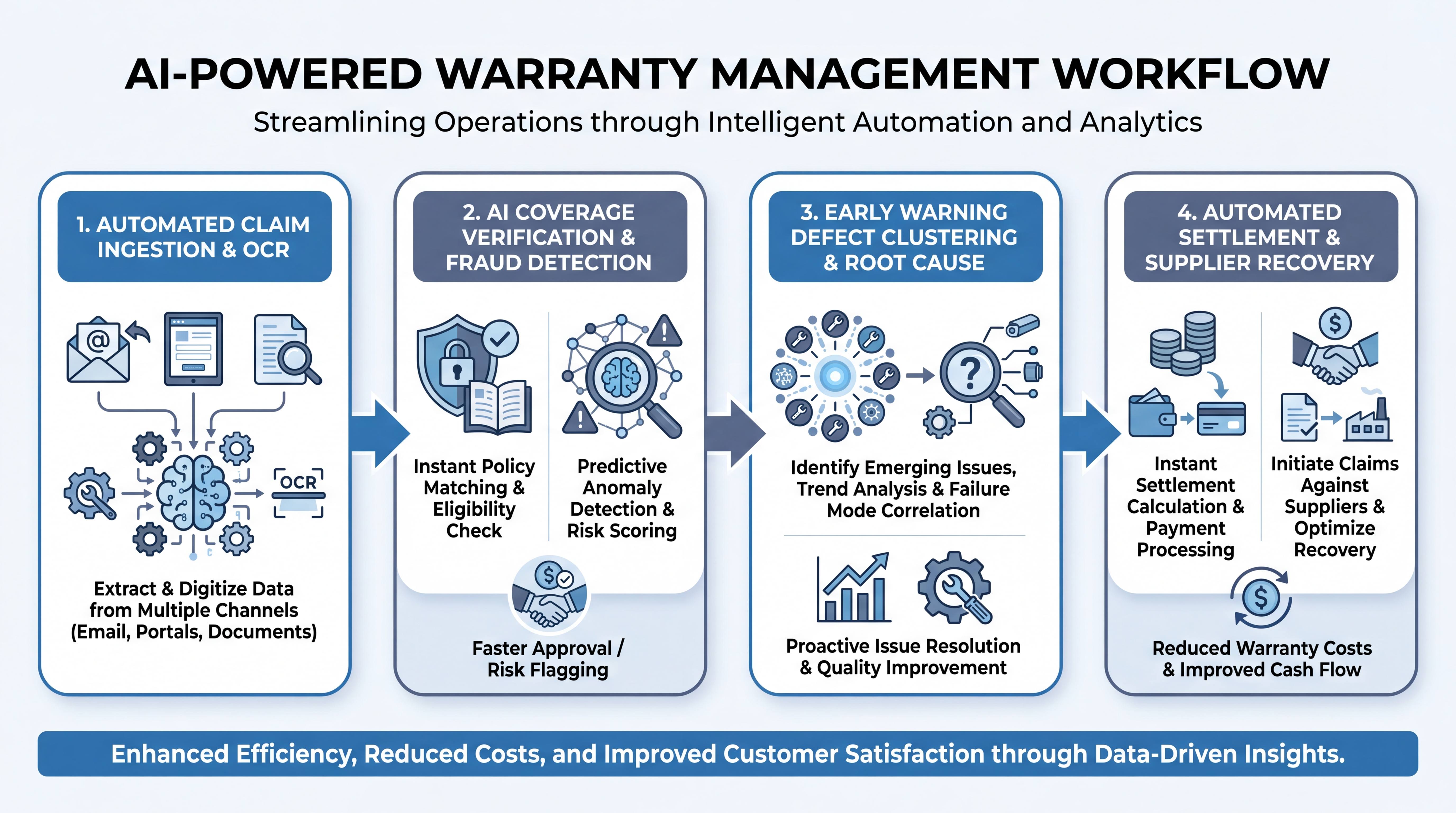
Autonomous AI workers are transforming this paradigm. By deploying intelligent multi-agent workflows across ingestion, validation, fraud detection, and engineering feedback loops, enterprise manufacturers are cutting adjudication time from weeks to minutes, reducing administrative overhead by 45%, and uncovering recurring defect clusters before they trigger multi-million dollar recalls.
!AI-Powered Warranty Management Workflow
The Four Structural Failures of Legacy Warranty Systems
1. High Administrative Overhead
Every claim requires an adjuster to manually cross-reference VIN/serial numbers, verify warranty coverage periods, and approve part replacement pricing. The average cost to process a single complex warranty claim ranges from $65 to $120, with turnaround times stretching past 14 business days.
2. Pervasive Warranty Leakage and Fraud
Warranty leakage accounts for 8-15% of all warranty expenditures. Common leakage vectors include unwarranted part replacements where simple calibrations were sufficient, duplicate claims across dealer locations, manipulated labor rates, and expired warranty terms disguised by altered repair dates.
3. Disconnected Upstream Supplier Recovery
When a component fails due to a supplier manufacturing defect, the OEM is entitled to supplier recovery chargebacks. Because claim narratives are rarely reconciled with supplier master service agreements, OEMs recover less than 35% of eligible supplier warranty costs.
4. Delayed Early Warning and Quality Feedback
Quality engineering teams typically discover systemic defects 3-6 months after parts begin failing in the field. By the time analysts identify an anomaly, thousands of defective units have shipped, multiplying potential recall liabilities tenfold.
How AI Workers Automate the Full Warranty Lifecycle
Autonomous AI workers operate as 24/7 intelligent claims specialists integrated directly between dealer portals, ERP systems (SAP, Oracle, Microsoft Dynamics), and PLM repositories.
Automated Ingestion and Multi-Modal Document Parsing
When a dealer submits a claim, AI workers extract structured fields from heterogeneous source documents: scanned PDF repair orders, photos of damaged components, ECU error logs, and unstructured technician notes. The AI parses standard labor codes, matches replaced part SKUs with BOM trees, and checks warranty registration dates in real time.
Intelligent Policy Adjudication and Straight-Through Processing
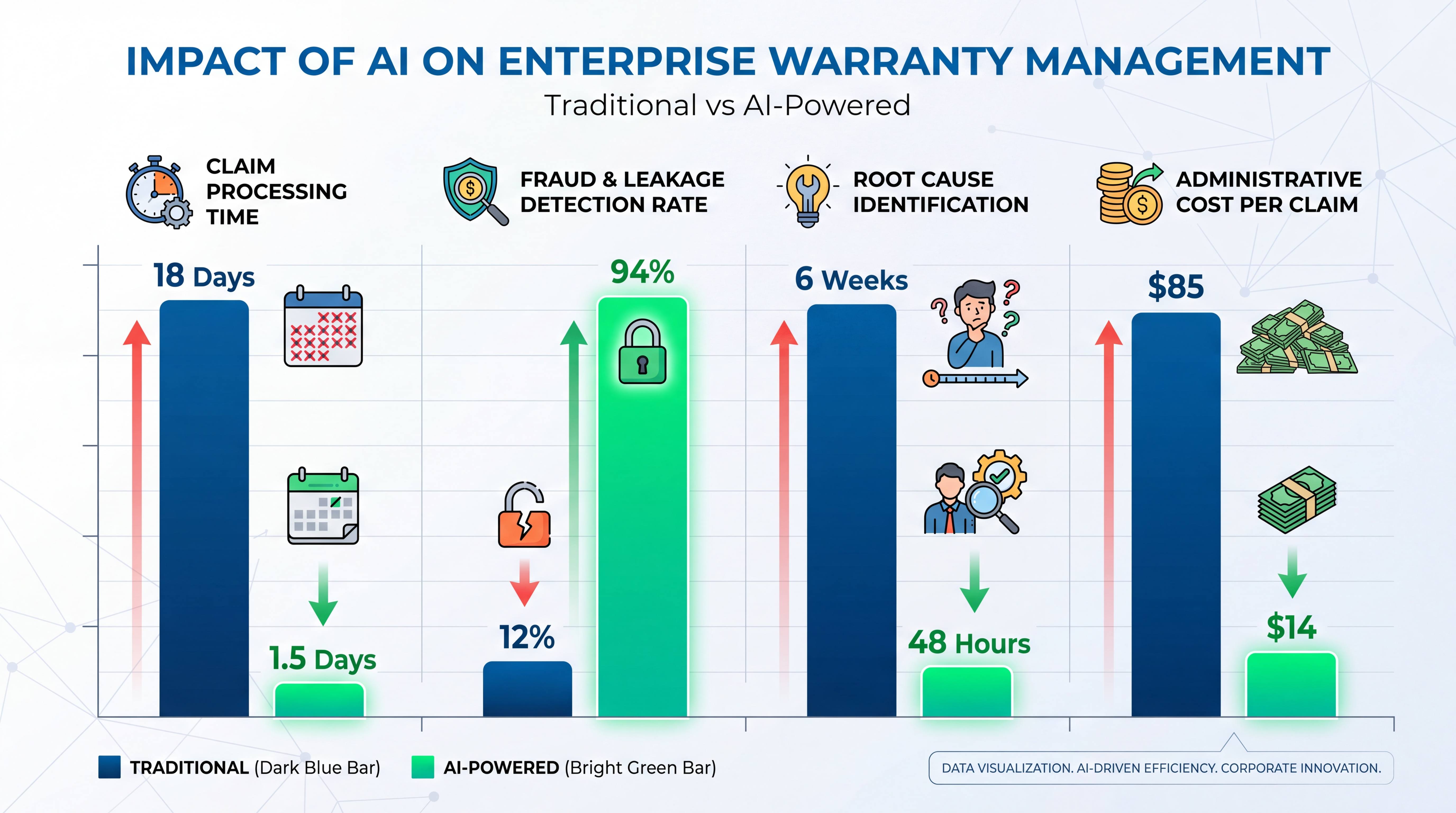
The AI worker evaluates the claim against dozens of validation rules: Is the product within warranty limits? Does the reported failure align with the replaced component? Do billed labor hours exceed standard repair time allowances? Claims meeting all criteria are approved autonomously through Straight-Through Processing (STP), cutting adjudication cycle times from 18 days to under 30 minutes.
Graph-Based Anomaly and Fraud Detection
AI models evaluate claims across a relational knowledge graph, flagging outliers such as repair shops with abnormally high warranty-to-service ratios, repeated part replacements on the same asset within short intervals, or statistical anomalies in labor hours claimed across geographic clusters.
!Impact of AI on Enterprise Warranty Management
Key Business Outcomes
Enterprises deploying AI-powered warranty management achieve measurable results:
- 85% reduction in claim processing time: From 18 days to under 30 minutes for straight-through claims
- 45% reduction in administrative overhead: Per-claim costs drop from $65-120 to $12-18
- $4.2M saved per $100M warranty spend: Through continuous fraud detection vs 10% manual sample audits
- 160% increase in supplier recovery: From 25-35% to 85-92% of eligible chargebacks tracked automatically
- 75% faster defect detection: Mean time to detect critical engineering flaws drops from 90-180 days to 48-72 hours
Early Warning Quality Intelligence
Beyond processing transactions, AI warranty intelligence bridges field service and design engineering. NLP models continuously analyze unstructured technician comments, customer verbatims, and telemetry data to cluster emerging defect patterns.
When an abnormal frequency of failures is detected across 15 disparate service centers, the AI worker: groups related claim narratives using semantic embeddings; correlates failures with specific manufacturing batch numbers; automatically opens a corrective action request in the engineering PLM system with pre-compiled technical evidence; and quantifies the projected warranty exposure if unaddressed.
Implementation Steps
1. Connect Historical Claims and ERP Repositories: Ingest past 3-5 years of settled claims, rejected claims, part catalogs, and supplier master agreements.
2. Benchmark Straight-Through Processing Thresholds: Start with low-dollar, high-frequency claim categories to calibrate confidence scores.
3. Automate Supplier Recovery Chargebacks: Integrate supplier warranty liability matrices to trigger instant debit memos.
4. Implement Real-Time Telemetry Dashboards: Provide quality assurance, finance, and procurement leaders with continuous visibility into defect trends and reserve adequacy.
Conclusion
Warranty management should no longer be treated as an inevitable cost of doing business. By deploying autonomous AI workers, enterprise manufacturers turn reactive claims processing into a high-precision operational defense, eliminating leakage, accelerating dealer settlements, and feeding real-time quality intelligence back to engineering teams.
This article was written with AI assistance.