AI-Powered Wealth Management Onboarding: How Private Banks Automate KYC, Suitability Scoring, and Client Intake
By Delos Intelligence — 2026-08-23
Learn how private banks and wealth managers use AI to automate client onboarding, KYC verification, MiFID II suitability scoring, and account provisioning.
The Private Banking Onboarding Bottleneck
For private banks, family offices, and wealth management platforms, client onboarding is a perpetual tension between regulatory rigor and competitive speed-to-value. A high-net-worth client expecting frictionless digital onboarding encounters a weeks-long gauntlet of duplicated document requests, manual KYC analyst reviews, and paper-based suitability questionnaires.
The average private banking onboarding cycle takes 21 to 45 days for new clients. During this window, assets sit undeployed, advisory relationships are strained, and competitors with faster digital workflows capture first-mover advantage. In wealth management, where relationship inertia is the primary retention mechanism, the onboarding experience is often the most consequential first impression a firm can make.
AI workers are collapsing this timeline to under 72 hours for standard account types while maintaining full compliance with AML Directives, MiFID II suitability requirements, CRS/FATCA obligations, and domestic KYC standards.
The Regulatory Complexity Driving Onboarding Delays
Private banks operate under a compounding stack of regulatory obligations that affect client intake:
- KYC and Enhanced Due Diligence (EDD): PEP screening, adverse media monitoring, beneficial ownership mapping (FATF Rec. 10), and source of wealth verification for ultra-high-net-worth clients.
- MiFID II and FCA COBS Suitability: Documented assessment of client knowledge and experience, financial situation, risk tolerance, investment objectives, and sustainability preferences (SFDR Article 8/9).
- CRS/FATCA Tax Residency Reporting: Self-certification forms, US Indicia screening, and reportable account identification across multiple jurisdictions.
- FinCEN 314(a) and OFAC Screening: Real-time denied-party screening against OFAC SDN lists, EU consolidated list, and INTERPOL databases.
!AI-Powered Wealth Management Onboarding Pipeline
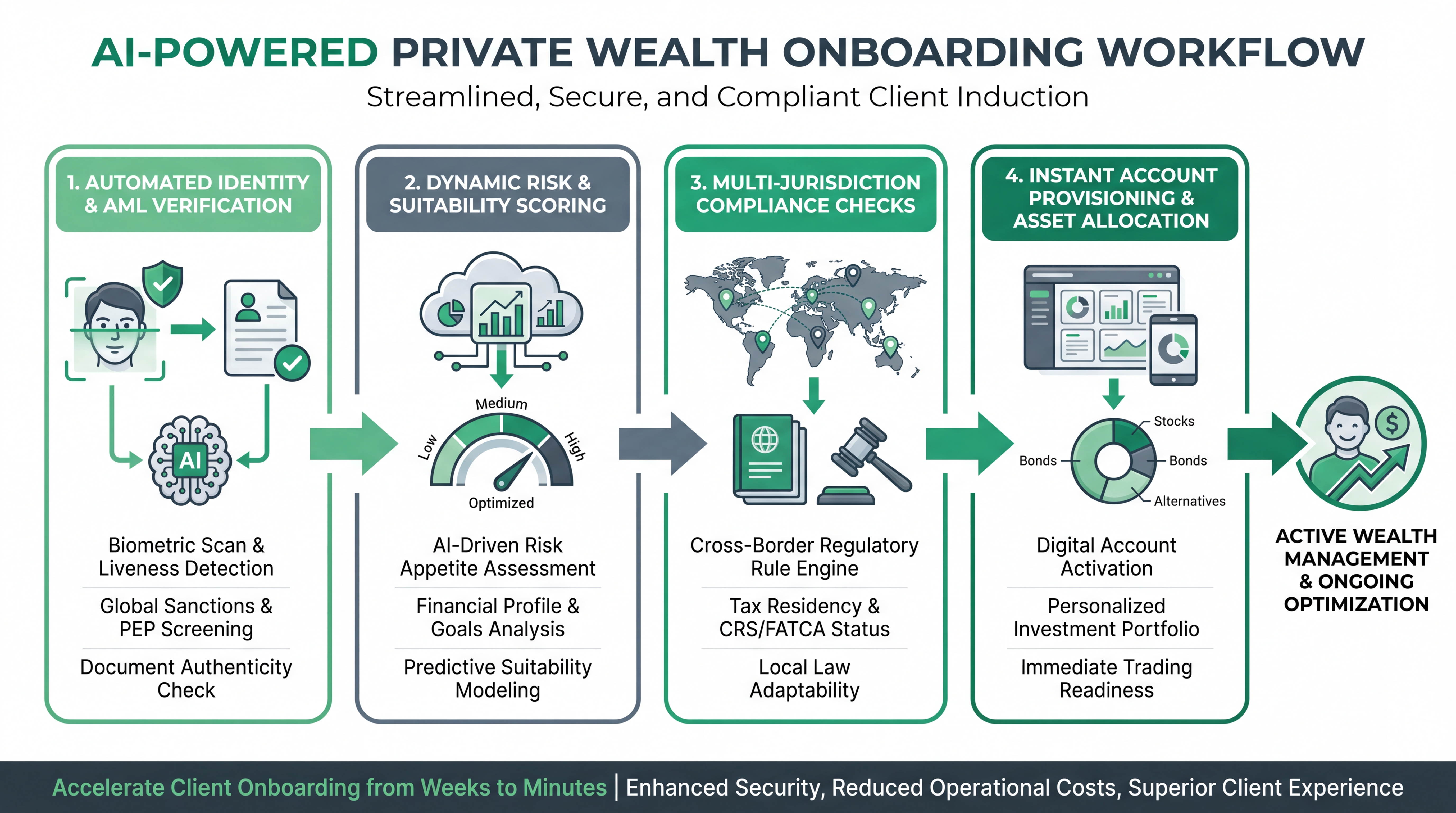
How AI Workers Automate the Wealth Management Onboarding Lifecycle
Intelligent Document Ingestion and Extraction
Clients upload passports, utility bills, corporate registry extracts, and source-of-wealth documentation via secure digital portals. AI workers apply computer vision OCR and multi-language NLP to extract structured data fields, cross-reference against identity verification databases, and auto-populate client profiles in the core banking system.
Document authenticity checks, including hologram detection, font consistency analysis, and national registry API verification, execute in under 30 seconds per document.
Automated KYC and Risk Tier Classification
AI models evaluate the extracted client profile against a configurable risk scoring matrix encompassing:
- PEP Status and Close Associates: Graph-traversal models map political exposure through first, second, and third-degree relationship networks.
- Adverse Media Monitoring: NLP models continuously scan over 100,000 news sources in 50 languages, flagging sanctions exposure, regulatory actions, and reputational risk signals.
- Source of Wealth Plausibility Scoring: Machine learning models compare declared wealth origins against employment history, corporate directorships, and publicly available financial disclosures.
Clients are automatically stratified into Standard, Enhanced, and Restrictive due diligence tiers, with EDD workflow triggers dispatched to compliance analysts only for genuinely ambiguous cases.
MiFID II Suitability Scoring and Investment Policy Statement Generation
AI workers administer dynamic digital suitability questionnaires that adapt based on prior client responses and real-time market conditions. Completed questionnaires are automatically scored against the firm proprietary suitability matrix, generating a recommended investment policy statement (IPS) and asset allocation proposal.
!Onboarding Cycle Time and Compliance Impact
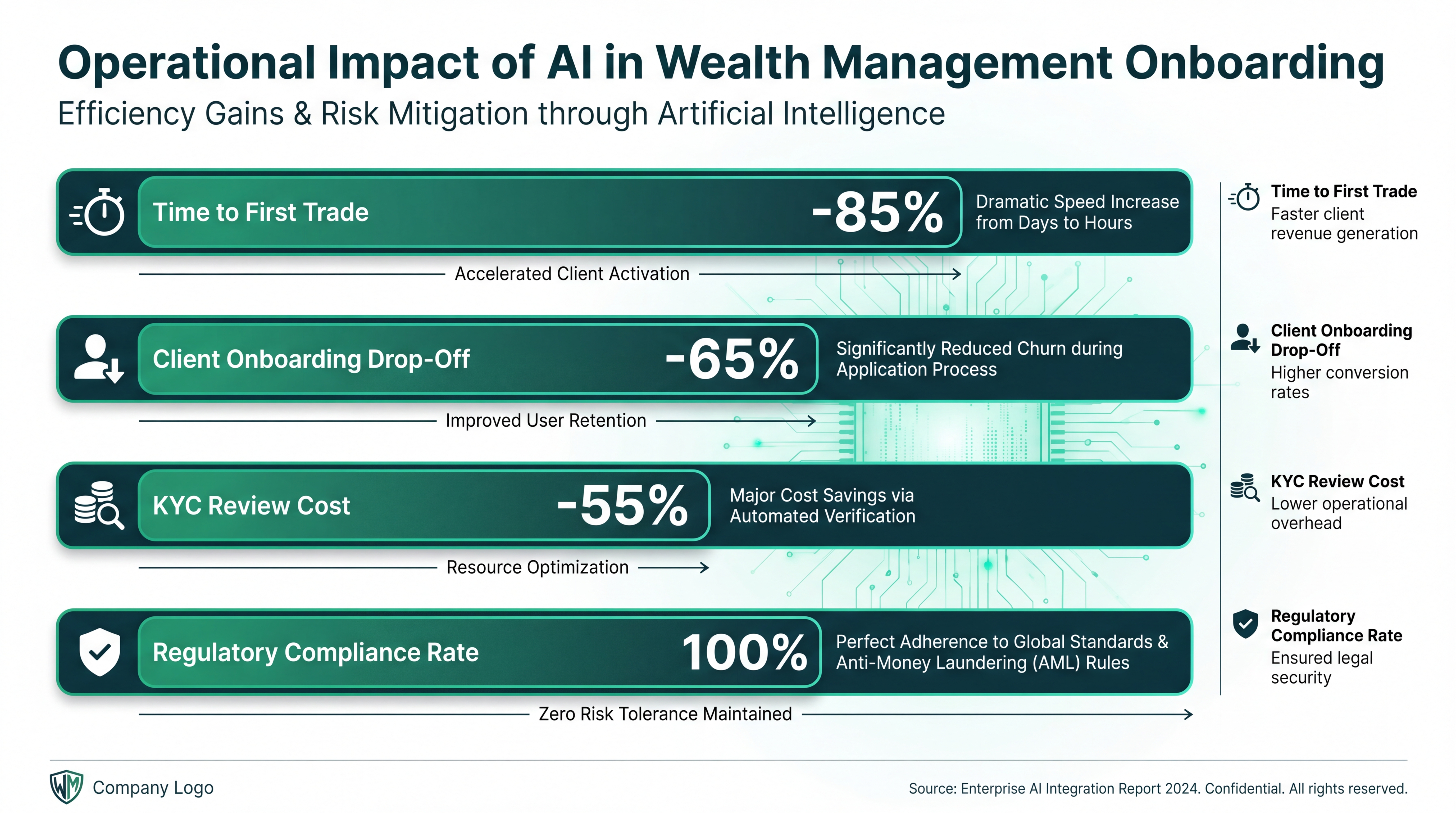
Measurable Impact for Private Banking Operations
| Operational Metric | Manual Process | AI-Powered | Delta |
|---|---|---|---|
| End-to-end onboarding cycle | 21 to 45 days | 1 to 3 days | -90% |
| KYC analyst review volume | 100% of cases | 8% of cases | -92% |
| Document re-request rate | 42% of onboardings | Less than 5% | -88% |
| Suitability questionnaire completion | 65% digital | 98% digital | +33pp |
| False positive PEP/sanctions alerts | 87% false positive | 14% false positive | -73pp |
Implementation Roadmap for Wealth Management Leaders
1. Digital Portal Integration: Deploy a branded secure document portal with AI-powered extraction connected to core banking and CRM.
2. KYC Risk Model Calibration: Customize risk scoring thresholds to firm-specific risk appetite and regulatory jurisdiction.
3. Compliance Analyst Workflow Integration: Route only genuine EDD cases to analysts, complete with pre-populated risk dossiers and suggested investigation pathways.
4. Suitability Engine Deployment: Integrate AI suitability scoring with portfolio management systems for real-time IPS generation and ongoing suitability monitoring.
5. Continuous Monitoring Activation: Enable post-onboarding perpetual KYC monitoring for watchlist changes, adverse media signals, and account behavior anomalies.