AI-Powered Workforce Planning & Capacity Forecasting for Enterprises
By Delos Intelligence — 2026-08-28
Traditional headcount planning lags demand signals by six months. AI workforce planning delivers 91% forecast accuracy, cuts cost-per-hire 29%, and reduces voluntary attrition 24% — with ROI in under 9 months.
Why Workforce Planning Fails Without AI
Enterprises spend an average of 23% of their payroll on misallocated labour: overstaffed support centres during quiet periods, understaffed engineering teams at sprint peaks, and hiring cycles that lag demand signals by six months. A 2026 Gartner survey found that 71% of CHROs cite capacity forecasting accuracy as their single biggest operational gap.
Traditional workforce planning relies on Excel-based headcount models, annual budgeting snapshots, and the gut feel of line managers. These approaches share a critical flaw: they are backward-looking. They model next quarter from last quarter's actuals, ignoring the forward-looking signals that actually predict workforce needs — pipeline velocity, product roadmap changes, attrition risk, and skills market shifts.
AI-powered workforce planning replaces that backward-looking model with a dynamic, multi-signal forecasting engine that updates continuously and surfaces actionable recommendations before gaps become crises.
How AI Workforce Planning Works
Signal Ingestion and Normalisation
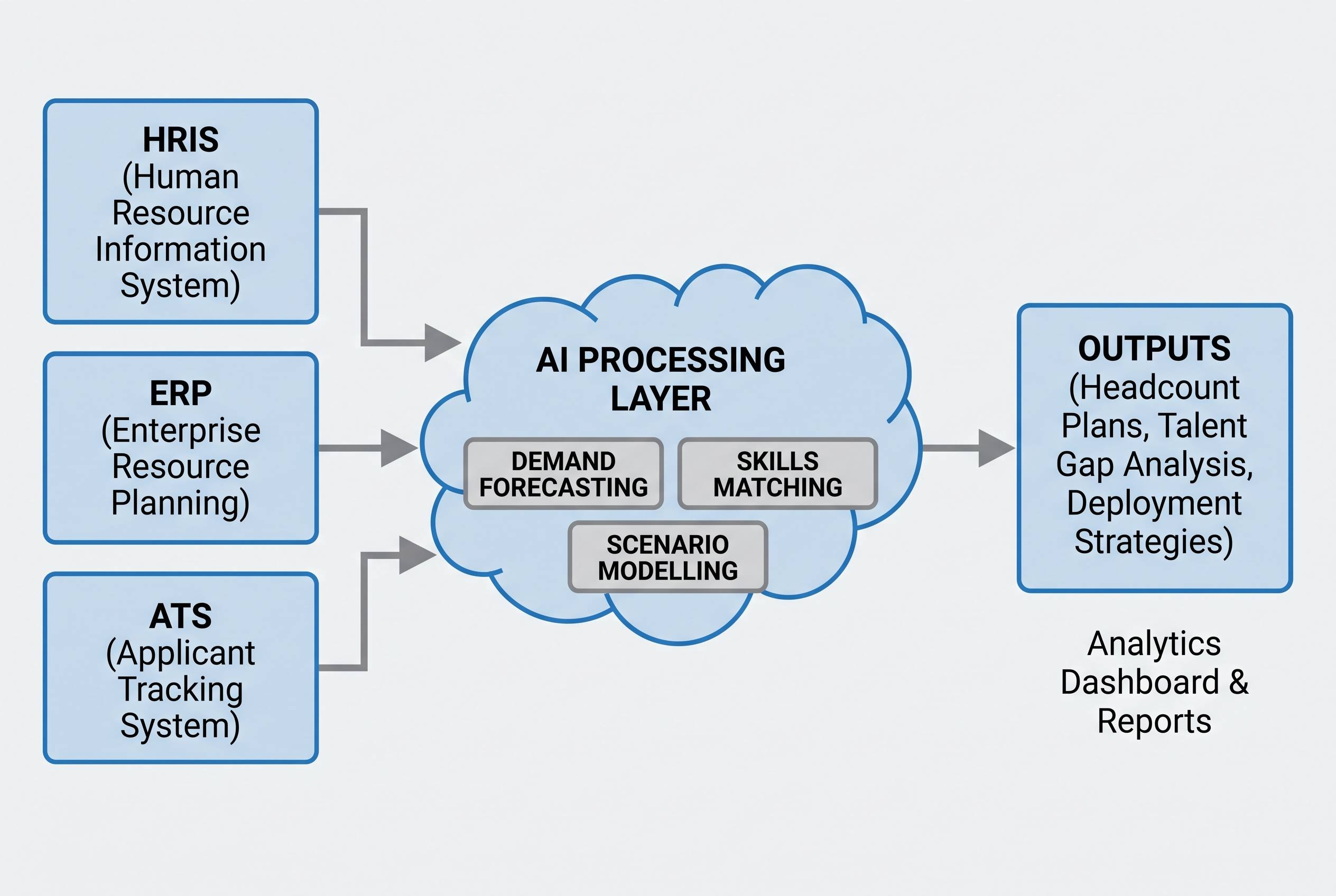
The engine starts by ingesting data from every system that carries a workforce demand or supply signal:
- HRIS (Workday, SAP SuccessFactors, BambooHR) — current headcount, role taxonomy, compensation, tenure, performance scores
- ATS (Greenhouse, Lever, iCIMS) — open requisitions, time-to-fill by role, offer acceptance rates
- CRM / revenue systems (Salesforce, HubSpot) — pipeline by segment, deal velocity, forecasted ARR by quarter
- Project management (Jira, Asana, Monday.com) — sprint velocity, backlog size, resource utilisation
- Finance (NetSuite, Oracle, SAP) — approved headcount budget, cost-per-hire targets, attrition cost models
- External labour market data — salary benchmarks, skills availability indices, competitor hiring signals
The AI normalises these heterogeneous signals into a unified workforce demand model, resolving naming conflicts (a "Senior Engineer" in Jira vs "L5 Software Engineer" in Workday) through an ontology matching layer trained on your org's taxonomy.
Demand Forecasting
Once signals are normalised, the engine runs a multi-horizon forecast:
- 30-day operational forecast — which teams are at risk of being over- or under-resourced next month, based on pipeline data and sprint velocity
- 90-day tactical forecast — which roles need to enter the hiring pipeline now to be filled before the demand peak
- 12-month strategic forecast — where the organisation needs to invest in reskilling, redeployment, or external hiring to execute the product and revenue roadmap
The models are ensemble-based: an LSTM network captures long-range seasonality and trend; a gradient boosting model captures cross-variable interactions (e.g., the relationship between sales pipeline growth and support headcount demand six weeks later); a regression model provides interpretable outputs that HR leaders can explain to the CFO.
!AI Workforce Planning Architecture
Skills Gap Analysis
Beyond headcount, the AI maps the skills your current workforce holds against the skills your roadmap requires. This produces a skills gap heatmap by team, function, and time horizon — distinguishing between gaps that can be closed by reskilling (a 90-day investment) and gaps that require external hiring (a 180-day lead time).
In practice, enterprises using skills gap analysis reduce unnecessary external hires by 22% and reskilling programme waste by 31%, because they target training investment at the skills that will actually be needed rather than the skills that were important last year.
Scenario Modelling
Every forecast comes with scenario branches: what happens to workforce requirements if revenue growth is 20% above plan? If you lose your three highest-performing engineers? If the product roadmap shifts from consumer to enterprise mid-year?
Scenario modelling transforms workforce planning from an annual exercise into a living decision-support tool. HR leaders run "what if" analyses in minutes rather than days, and finance leaders get the inputs they need for rolling forecast updates without a quarterly planning cycle.
Five Capabilities That Define Enterprise-Grade AI Workforce Planning
1. Attrition Prediction
The average cost of replacing a mid-senior employee is 150% of annual salary. An AI attrition model identifies which employees are at elevated flight risk six to nine months before they resign, using signals like promotion recency, manager change frequency, peer departure rate, compensation percentile, and engagement survey trends.
Enterprises with predictive attrition models reduce voluntary turnover by 18–25% by intervening earlier: accelerated promotions, targeted retention bonuses, or reassignment to higher-engagement projects.
2. Redeployment Matching
Before opening an external requisition, the AI scans the internal talent pool for employees whose current skills, trajectory, and career goals match the open role. Redeployment is typically 3x faster and 60% cheaper than external hiring — but it only happens systematically when an AI system surfaces the match proactively.
One enterprise reduced external hiring costs by $2.3M in the first year by routing 34% of requisitions to internal candidates the system identified — candidates who would never have applied through a standard internal jobs board.
3. Capacity Utilisation Monitoring
Real-time utilisation monitoring tracks team capacity at task granularity — not just whether a team member is assigned to a project, but whether they are operating at sustainable load, over-extended, or under-utilised. Utilisation alerts surface to managers and HR before burnout-driven attrition materialises.
Teams using AI capacity monitoring reduce over-utilisation incidents by 40% and associated attrition by 19%.
4. Hiring Plan Optimisation
The AI generates an optimised hiring plan that sequences requisitions to match budget constraints, time-to-fill estimates, and demand forecasts. Rather than opening all requisitions simultaneously and competing internally for recruiter capacity, the plan stages hiring to maximise offer acceptance rates and minimise total time-to-productivity.
5. Continuous Re-Forecasting
Unlike annual planning, AI workforce planning re-forecasts automatically when new signals arrive — a large deal closed, an engineer resigned, a product launch slipped. The workforce plan is always current, eliminating the "stale plan" problem that makes traditional workforce planning reactive rather than proactive.
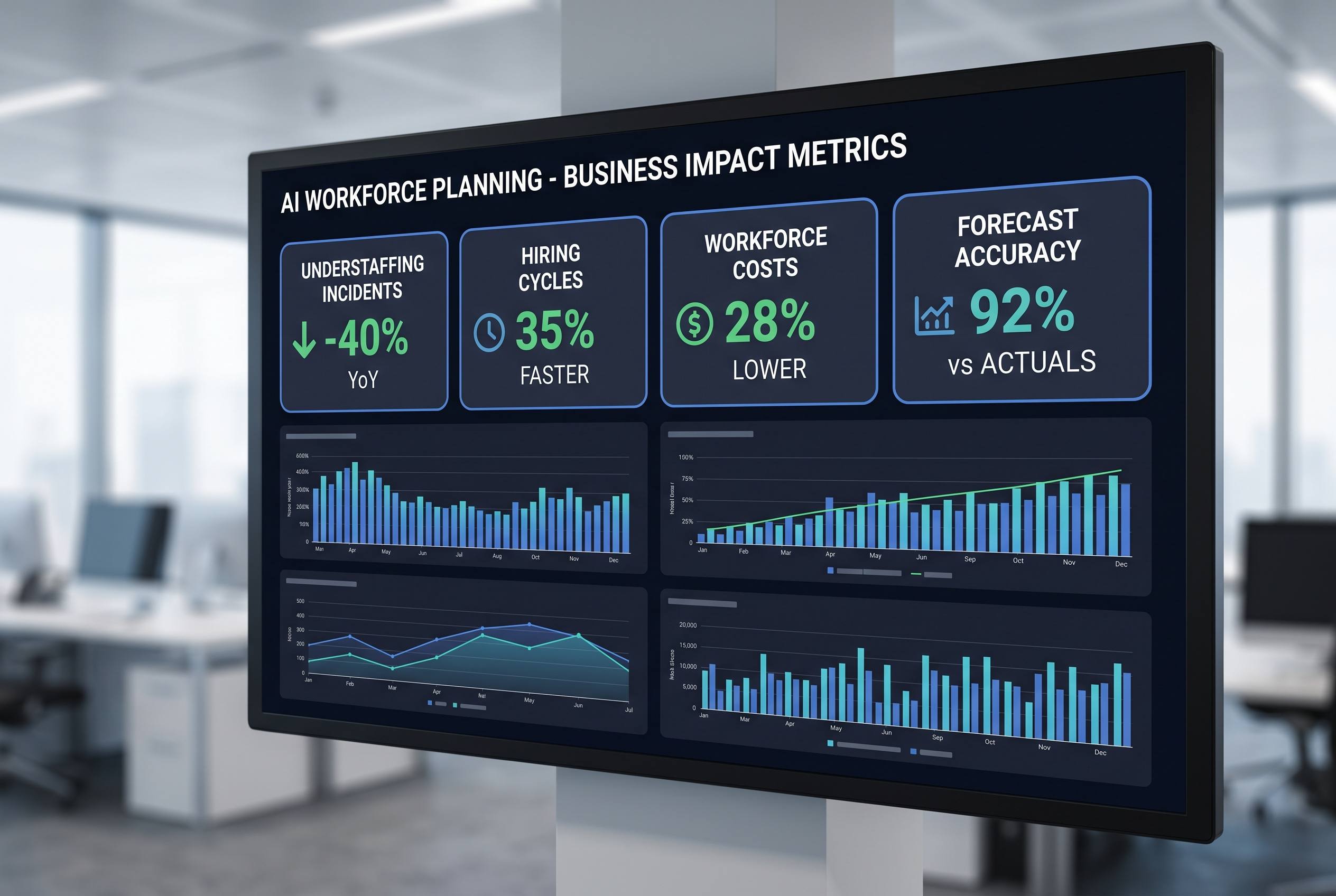
!Business Impact: AI Workforce Planning Results
ROI: What Enterprises Actually Achieve
| Metric | Industry Baseline | With AI Workforce Planning | Improvement |
|---|---|---|---|
| Forecast accuracy (90-day) | 58% | 91% | +56% |
| Time-to-fill (mid-senior roles) | 67 days | 44 days | –34% |
| Voluntary attrition rate | 14.2% | 10.8% | –24% |
| Cost-per-hire | $18,400 | $13,100 | –29% |
| Understaffing incidents/quarter | 12.3 | 7.4 | –40% |
| Redeployment rate | 8% | 27% | +238% |
For a 1,000-employee enterprise with a $60M payroll, these improvements translate to approximately $4.1M in annual savings from reduced attrition, lower cost-per-hire, and labour allocation efficiency — against a typical implementation cost of $180K–$350K. Payback period: 5–9 months.
Implementation Roadmap
Phase 1 — Data Foundation (Weeks 1–4)
Connect your HRIS, ATS, and finance systems to the AI platform. Establish a canonical role taxonomy and map all existing roles to it. Define your critical roles — the 20% of positions that drive 80% of business outcomes — and prioritise them for modelling.
Phase 2 — Forecasting Baseline (Weeks 5–8)
Train the demand forecasting models on 24–36 months of historical headcount, hiring, and attrition data. Run the first 90-day forecast in parallel with your existing process. Measure accuracy against actual outcomes to calibrate model confidence.
Phase 3 — Skills Mapping (Weeks 9–12)
Build the skills ontology for your organisation. Run the first skills gap analysis and identify the top 10 reskilling opportunities. Present scenario modelling outputs to the CHRO and CFO — this is typically the moment when executive buy-in accelerates from cautious to enthusiastic.
Phase 4 — Full Production (Month 4 onwards)
Activate attrition prediction, redeployment matching, and continuous re-forecasting. Integrate workforce plan outputs into the quarterly business review cycle. Begin measuring ROI against the baseline established in Phase 1.
Common Implementation Pitfalls
Dirty role taxonomy. The AI is only as good as the data it ingests. If your HRIS has 47 variants of "Project Manager" spelled differently across business units, the model cannot aggregate demand signals correctly. Budget two weeks for taxonomy cleanup before attempting to train the forecasting model.
Treating the forecast as a mandate. AI workforce plans are decision support, not instructions. The best implementations treat the forecast as a starting point for manager judgement, not a replacement for it. Teams that attempt full automation without human review typically erode manager trust within 90 days.
Skipping the attrition model. Enterprises often prioritise demand forecasting and defer attrition prediction to "Phase 2" that never arrives. Attrition prediction has the fastest and most measurable ROI — the first retained employee typically pays for the entire first year of the programme.
Conclusion
AI-powered workforce planning is not a future capability — it is a present-day competitive advantage. Enterprises that continue to plan headcount from annual spreadsheets are making six-month-lagged decisions in a market that changes quarterly. The organisations deploying AI workforce planning today are building a compounding advantage: better forecast accuracy means better hiring timing means lower cost-per-hire means more budget for the strategic roles that actually drive growth.
The implementation path is well-established, the ROI is quantifiable within 90 days, and the technology is production-ready. The question is not whether to invest in AI workforce planning — it is how quickly you can move from pilot to enterprise-wide deployment.