AI-Driven Pricing Optimization: How Enterprises Increase Margins by 12% (And Why 58% Still Price Manually)
By Delos Intelligence — 2026-07-19
Pricing is the single most powerful profit lever in business. A 1% price improvement translates to an average 11% increase in operating profit. AI-driven pricing optimization helps enterprises increase margins by 12%. Yet 58% still price manually.
The Problem with Manual Pricing
Manual pricing has three structural weaknesses that AI addresses directly.
Slow response to market changes: When a competitor drops prices, a raw material cost shifts, or demand spikes unexpectedly, manual pricing teams need days or weeks to react. AI pricing engines adjust in minutes.
Limited data processing: A pricing analyst can track maybe 20-30 competitors across 50 products. AI systems track thousands of competitors, millions of transactions, and dozens of market signals simultaneously.
Human bias in price setting: Anchoring bias, round-number preference, and emotional attachment to historical prices all distort manual pricing decisions. AI models optimize for revenue and margin without these cognitive blind spots.
!Manual pricing vs AI-driven pricing comparison
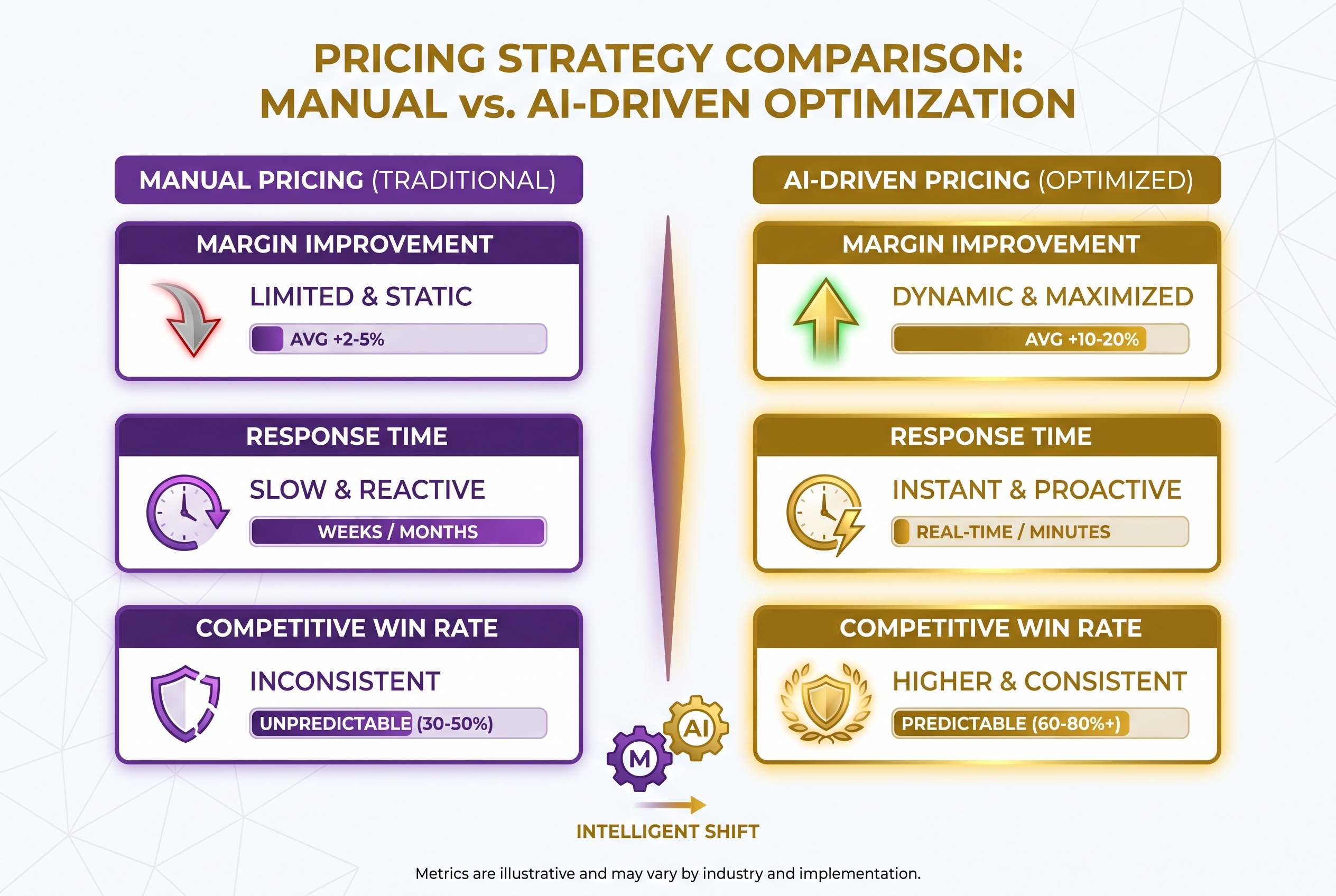
The result: enterprises using AI pricing optimization report an average margin improvement of 12%, compared to 2-3% for those using traditional methods.
How AI Pricing Optimization Works
Data Ingestion
AI pricing platforms aggregate data from multiple sources: historical transaction data, competitor pricing (via web scraping and API integrations), market demand signals, inventory levels, seasonality patterns, and macroeconomic indicators.
Demand Modeling
The core of the system is a demand elasticity model that predicts how changes in price will affect sales volume for each product. This model is continuously refined using actual transaction data, so it learns from every sale and every lost deal.
Optimization Engine
The optimization engine balances multiple objectives: maximize revenue, protect margin, maintain market share, and respect business constraints (minimum margins, competitive positioning rules, customer-specific pricing agreements).
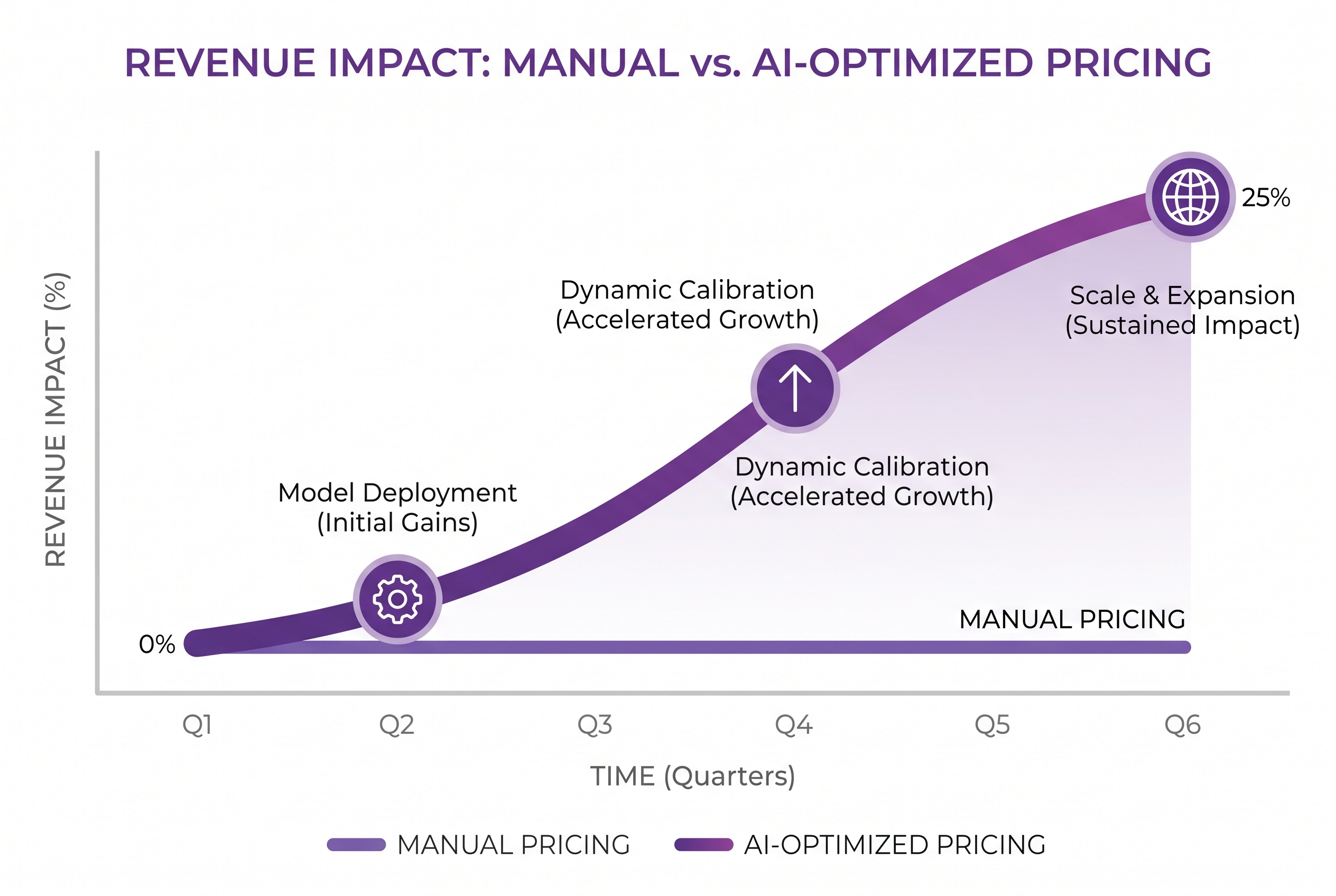
!Revenue impact: manual vs AI-optimized pricing over time
Execution and Monitoring
The system outputs price recommendations that can be automatically deployed or routed for human review. It then monitors the impact of each price change and feeds the results back into the model, creating a continuous learning loop.
Real-World Results
Enterprises across industries are seeing measurable impact:
- Uber uses dynamic pricing (surge pricing) powered by real-time demand prediction, increasing revenue per ride by 20-30% during peak periods
- Amazon adjusts prices every 10 minutes on average, using AI to optimize for both revenue and conversion probability
- A European industrial distributor implemented AI pricing and increased gross margins by 8% within 6 months while maintaining sales volume
- A B2B SaaS company used AI-driven tiered pricing to increase average contract value by 15% and reduce discounting by 30%
The pattern is consistent: enterprises that move from manual to AI-driven pricing see 8-15% margin improvements within the first year.
Why 58% Still Price Manually
Despite the evidence, more than half of enterprises still rely on manual pricing processes. The barriers are familiar:
Data quality issues: AI pricing requires clean, structured transaction data. Many enterprises have fragmented pricing data across ERP systems, CRM platforms, and local spreadsheets. Data consolidation is a prerequisite that many have not completed.
Fear of price volatility: Dynamic pricing can create customer confusion and channel conflict if not managed carefully. Enterprises worry that frequent price changes will erode customer trust.
Organizational resistance: Pricing is often a politically sensitive function. Sales teams want lower prices to win deals, finance wants higher margins, and marketing wants competitive positioning. AI pricing engines that optimize for a single objective can create friction across these stakeholders.
A Practical Implementation Path
1. Clean your pricing data first: Before deploying AI, ensure your transaction data is consolidated, accurate, and accessible. This typically takes 2-3 months and delivers immediate value through better visibility into current pricing performance.
2. Start with a controlled pilot: Choose a product category with high transaction volume and clear competitive dynamics. Run the AI pricing engine in shadow mode for 30 days, comparing its recommendations to actual pricing decisions. This builds confidence and surfaces edge cases.
3. Define your optimization objective: Be explicit about what you are optimizing for. Revenue maximization, margin protection, and market share growth require different model configurations. Trying to optimize for all three simultaneously produces mediocre results.
4. Set guardrails: Define minimum margins, maximum price change velocity, and customer-specific rules. The AI should operate within these boundaries, not override them.
5. Measure and iterate: Track margin impact, conversion rates, customer complaints, and competitive response. Adjust the model and guardrails based on observed outcomes.
The Bottom Line
Every day your enterprise prices manually is a day your competitors with AI pricing are capturing margin you are leaving on the table. The question is not whether AI pricing optimization works, the evidence is overwhelming. The question is how long you can afford to wait.