AI Project Management: How Enterprises Deliver Projects 40\% Faster with Intelligent Planning
By Delos Intelligence — 2026-08-03
Discover how AI-powered project management helps enterprises predict delays, optimize resources, and deliver projects 40\% faster with intelligent planning and real-time risk detection.
Why Traditional Project Management Breaks at Scale
Most enterprise projects miss their deadlines. McKinsey reports that 70% of large-scale transformations fail to meet their stated goals. The traditional playbook of weekly status meetings, manual resource tracking, and Gantt charts was never designed for the complexity of modern enterprise initiatives.
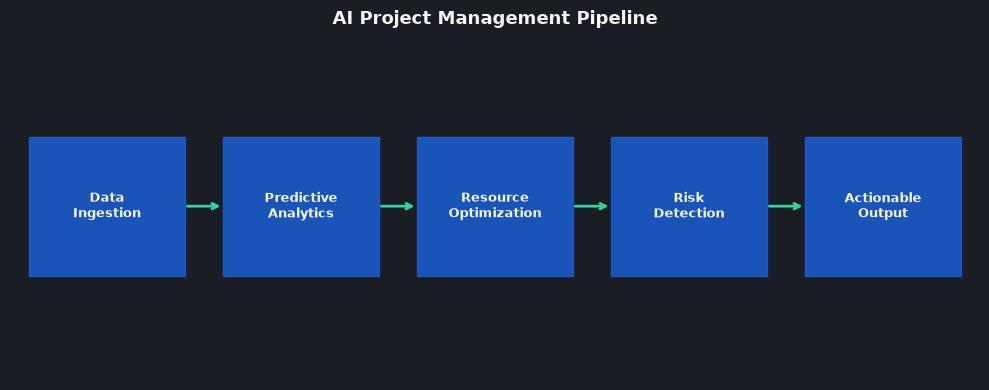
!AI project management pipeline: from data ingestion to actionable output
The Visibility Problem
Project status is reported upward through layers of aggregation. By the time status reaches decision-makers, it is days old, filtered, and often optimistic. Real-time visibility does not exist — what exists is a lagging snapshot that tells you where the project was, not where it is going.
The Resource Allocation Guess
Resource allocation in traditional PM is largely manual. A project manager looks at a spreadsheet, estimates who is available, and assigns tasks based on gut feel and availability calendars. This ignores skill matching, workload saturation, and cross-project dependencies. The result: 30% of enterprise resources are misallocated at any given time, according to PMI data.
The Risk Blind Spot
Risk registers are static documents. When a key vendor delays delivery by two weeks, or a critical team member leaves, the risk register does not automatically flag the cascade effect on downstream tasks. By the time the impact is visible in status reports, the project is already off track.
How AI Transforms Project Management
AI augments project managers with three capabilities humans cannot perform at scale: predictive analytics, real-time resource optimization, and automated risk detection.
1. Predictive Schedule Analytics
AI models analyze historical project data, current progress, and external factors to predict delivery dates with remarkable accuracy. The models train on thousands of completed projects and learn which task patterns tend to slip, which vendor relationships cause delays, and which team compositions deliver fastest.
For example, if the AI detects that integration testing in projects involving more than three vendor systems historically runs 40% over estimate, it flags this risk during planning and recommends buffer allocation or parallel test tracks.
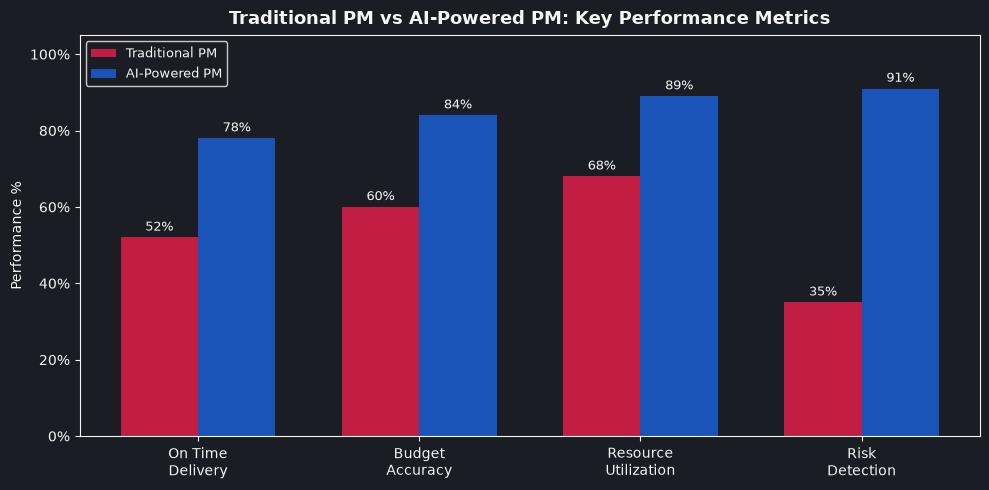
!Traditional PM vs AI-Powered PM: Key Performance Metrics
2. Intelligent Resource Optimization
AI resource optimization works across the entire project portfolio. The system knows which team members have which skills, current workload across all active projects, historical productivity patterns, and dependency chains requiring specific skills at specific times. Organizations using AI-driven resource allocation report a 25% improvement in resource utilization and a 15% reduction in project costs.
3. Real-Time Risk Detection and Mitigation
Unlike static risk registers, AI risk monitoring runs continuously. It ingests signals from task completion rates, communication patterns, resource changes, and external signals. When the AI detects a risk pattern, it recommends specific mitigations based on what worked in similar past situations.
Real-World Results: Three Enterprise Case Studies
Global Manufacturing Company Cuts Time-to-Market by 35%
A Fortune 500 manufacturing company implemented AI project management across 80+ concurrent projects. Within six months: time-to-market decreased by 35%, resource utilization improved from 68% to 84%, and projects delivered on budget increased from 54% to 78%. The AI identified that 40% of delays were caused by the same bottleneck in testing phases.
Financial Services Firm Eliminates 90% of Status Meetings
A global bank replaced weekly status meetings across 200+ projects with AI-driven real-time dashboards: 90% reduction in status meeting time, reclaiming approximately 15,000 person-hours per quarter, with issues flagged and escalated in hours instead of weeks.
Healthcare Provider Reduces Project Overruns by 50%
A regional healthcare provider implemented AI predictive analytics across 60+ IT projects. Results after one year: budget overruns reduced by 50%, projects delivered on time increased from 45% to 72%, and portfolio ROI improved by 20%.
Implementation Roadmap
Phase 1 (Weeks 1-4): Data Foundation. Consolidate project data from existing tools (Jira, Asana, MS Project) into a unified repository. Include historical project data — the AI needs past projects to learn from.
Phase 2 (Weeks 5-12): Predictive Analytics Pilot. Select 5-10 active projects. Deploy AI predictive analytics alongside your current workflow. Compare predictions to actual outcomes to build trust and calibrate the model.
Phase 3 (Weeks 13-20): Resource Optimization Rollout. Extend to resource optimization. Start with new project staffing recommendations. Present recommendations as suggestions with confidence scores and rationale.
Phase 4 (Weeks 21+): Full Portfolio Integration. Roll out across the full project portfolio with real-time dashboards, predictive delivery dates, automated risk alerts, and resource optimization recommendations.
Common Pitfalls to Avoid
Treating AI as a replacement for project managers. The most successful implementations position AI as a decision-support tool. Project managers who see it as eliminating the worst parts of their job become enthusiastic advocates.
Underinvesting in data quality. AI is only as good as the data it learns from. Invest in data cleanup before implementation. 50 well-documented past projects will outperform 500 incomplete ones.
Ignoring change management. Teams need to trust the AI recommendations, which means transparency in how predictions are generated and a feedback loop where project managers can correct the AI when it is wrong.
See also our guides on AI change management, AI cost optimization, and AI workforce planning.
The Bottom Line
AI project management is not a future technology — it is a present-day competitive advantage. Enterprises that have implemented it are delivering projects faster, cheaper, and more reliably than their peers. The 40% improvement in delivery time is the average result among early adopters. Organizations that invest now will compound that advantage as their AI models learn from more projects and become increasingly accurate over time.