AI-Powered Quality Assurance: How Enterprises Cut Defect Rates by 60% (And Why 54% Still Inspect by Hand)
By Delos Intelligence — 2026-07-19
Human inspectors can examine 200-300 parts per hour with 80% accuracy. AI-powered quality assurance inspects 10,000 parts per hour with 99.5% accuracy. Enterprises cut defect rates by 60%. Yet 54% still inspect by hand.
The Limits of Human Inspection
Human visual inspection has well-documented limitations. After 30 minutes of continuous inspection, accuracy drops below 70%. Defects that are subtle, rare, or occur in complex patterns are frequently missed. And every inspector applies slightly different standards, creating inconsistency across shifts and facilities.
The financial impact is significant. The cost of a defect escaping to the customer is typically 10x the cost of catching it in production, and 100x if it reaches the field. For automotive and aerospace components, a single escaped defect can cost millions in recalls and liability.
!Manual inspection vs AI defect detection comparison
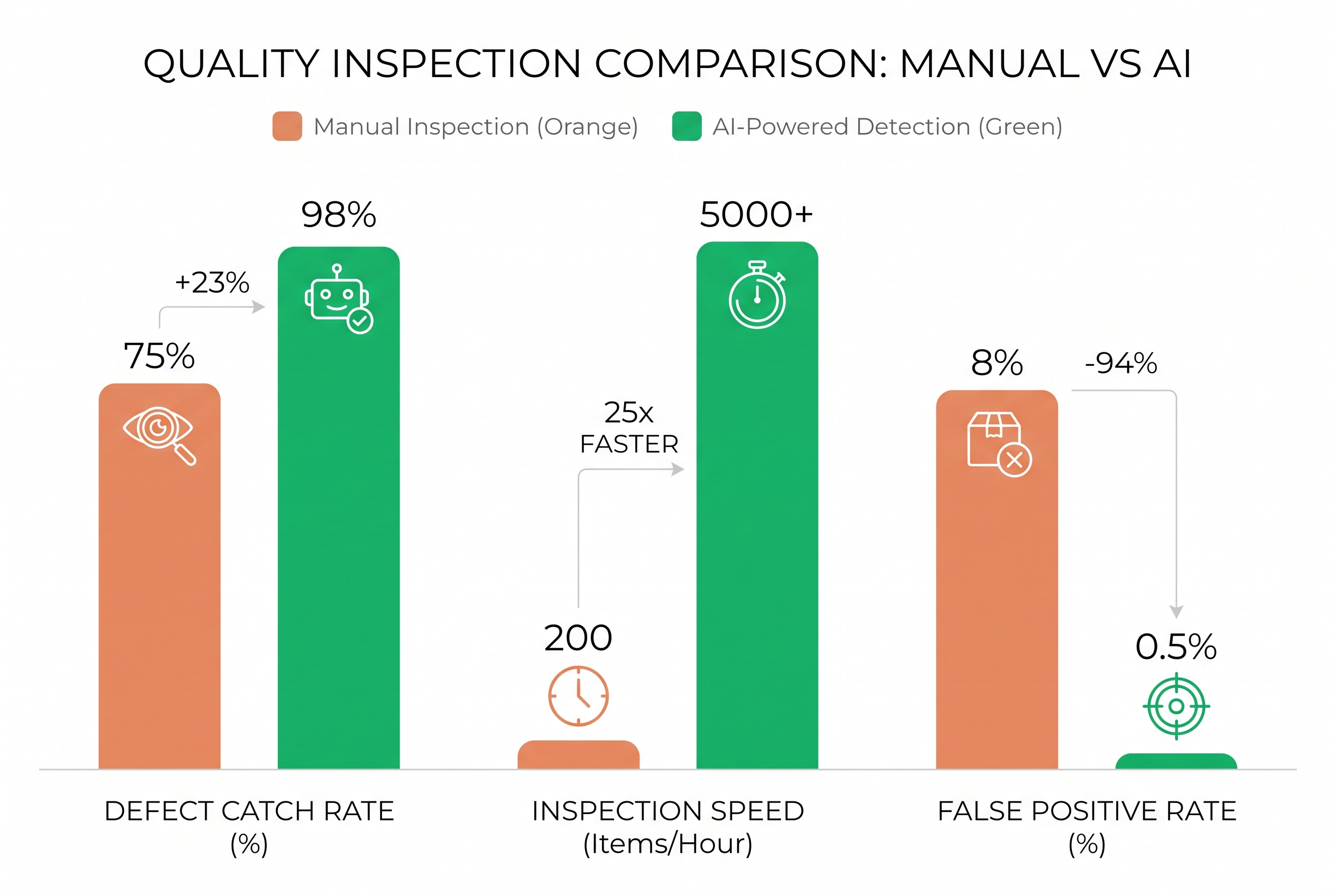
Yet 54% of manufacturing enterprises still rely primarily on human inspectors for quality control. The gap between what is possible and what is practiced represents one of the largest untapped efficiency opportunities in industrial operations.
How AI-Powered Quality Assurance Works
Computer Vision Inspection
AI quality assurance systems use computer vision models trained on thousands of images of both defective and non-defective products. These models can detect surface defects (scratches, dents, discoloration), dimensional deviations, assembly errors, and missing components with superhuman accuracy.
The Inspection Pipeline
!AI-powered quality assurance pipeline diagram
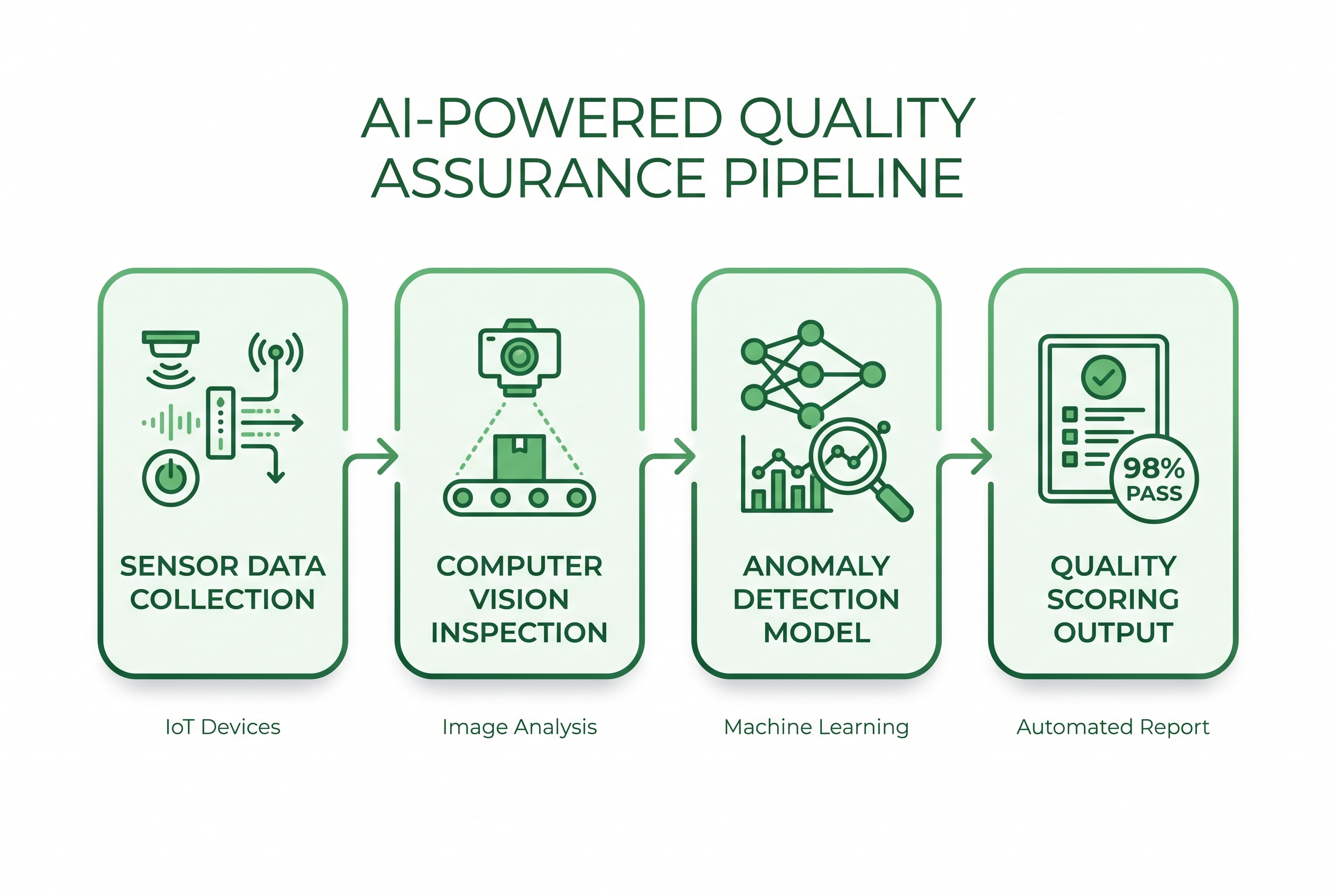
The pipeline works in four stages:
1. Image capture: High-resolution cameras and sensors capture images of each product on the production line. Depending on the application, this may include visible light, infrared, X-ray, or hyperspectral imaging.
2. Preprocessing: Images are normalized, aligned, and enhanced to ensure consistent analysis. This step compensates for varying lighting conditions, product positioning, and camera calibration differences.
3. Anomaly detection: The AI model analyzes each image and assigns a defect probability score. Models can be trained to detect specific defect types (classification) or to flag any deviation from the norm (anomaly detection).
4. Decision and routing: Products above the defect threshold are automatically routed for review, rework, or rejection. The system logs every inspection result for traceability and continuous model improvement.
Continuous Learning
Modern AI QA systems improve over time. Every image, whether flagged as defective or not, is used to refine the model. This means the system gets better the more it runs, unlike human inspectors who degrade over time.
Real-World Impact
Enterprises deploying AI-powered quality assurance report consistent, measurable results:
- BMW uses AI image recognition to inspect car body welds, reducing inspection time by 80% while improving defect detection rates
- Nestle deployed AI vision systems for packaging quality control and reduced customer complaints by 35%
- A semiconductor manufacturer implemented AI defect classification and cut false positive rates from 15% to 2%, saving 8 million euros per year in unnecessary scrap
- A pharmaceutical company uses AI visual inspection for vial quality control and achieved 99.7% accuracy, compared to 94% with human inspectors
The average enterprise sees a 50-70% reduction in escaped defects and a 40-60% reduction in inspection costs within the first year of deployment.
Why 54% Still Inspect by Hand
The barriers to AI QA adoption are practical, not theoretical:
High-volume production requirements: AI vision systems require consistent, high-quality image capture. Production lines with variable lighting, product positioning, or packaging need physical infrastructure upgrades before AI can be deployed.
Training data challenges: Building an effective defect detection model requires thousands of labeled images of defects. For rare defect types, gathering sufficient training data can take months.
Integration with existing systems: Quality data needs to flow from the AI system to MES (Manufacturing Execution Systems), ERP, and quality management platforms. This integration work is often underestimated.
Regulatory validation: In regulated industries like pharmaceuticals and medical devices, AI inspection systems must undergo rigorous validation and approval processes that can take 12-18 months.
A Practical Deployment Roadmap
1. Audit your current inspection process: Document what is inspected, how, by whom, and at what accuracy. Identify the highest-cost defects and the inspection points where AI would have the greatest impact.
2. Start with one line, one defect type: Choose a production line with high volume and a well-defined defect type that has sufficient training images. Deploy the AI system in parallel with human inspection for 60-90 days to build confidence and training data.
3. Invest in image infrastructure: Ensure cameras, lighting, and positioning systems are consistent and reliable. The quality of your AI inspection is fundamentally limited by the quality of your images.
4. Build a continuous improvement loop: Create a process for human inspectors to review AI-flagged defects, confirm or reject the findings, and feed the results back into the model. This human-in-the-loop approach accelerates model improvement and maintains quality standards.
5. Expand incrementally: Once the initial deployment proves its value, expand to additional defect types, production lines, and facilities. Each expansion benefits from the infrastructure and learnings of the previous one.
The Bottom Line
Every product that passes through human inspection carries the risk of human error. AI-powered quality assurance does not just reduce that risk, it transforms quality from a reactive, labor-intensive function into a proactive, data-driven capability. The enterprises that make this shift first will set the quality standard for their industries. The ones that wait will be explaining to their customers why they missed what a machine could have caught.