AI Revenue Operations: How Enterprises Reclaim 12 Hours Per Week (And Why 82% Still Aren't Ready)
By Delos Intelligence — 2026-07-20
Teams using AI in RevOps report 46% productivity increase and reclaim 12 hours per week. But 82% lack the data foundations to scale. Here's what leaders do differently.
The RevOps Paradox
Revenue Operations was supposed to be the great unifier. Marketing, sales, and customer success finally aligned under one data-driven roof. But for most enterprises, RevOps has become another layer of complexity: disconnected CRM fields, manual data entry, and forecasting that still relies on gut feel.
AI is changing that. Fast.
According to ZoomInfo's State of AI in RevOps, teams using AI report a 46% productivity increase and reclaim 12 hours per week from manual data tasks. Gartner predicts that 75% of the highest-growth companies will adopt RevOps by 2026. And 96% of revenue leaders expect their teams to use AI by end of year.
Yet here is the paradox: 82% of RevOps teams agree that clean data and reliable routing are prerequisites for scaling AI, but only one-third actually have those foundations in place. The gap between intent and readiness is where most enterprises are stuck.
This article breaks down what AI-powered Revenue Operations looks like in practice, the three maturity stages, and the concrete steps your team can take to close the readiness gap.
What Is AI Revenue Operations?
AI Revenue Operations is the application of artificial intelligence across the entire revenue lifecycle, from lead generation to customer expansion. It goes beyond dashboards and reporting. AI actively cleanses data, scores leads, predicts deal outcomes, automates CRM updates, and orchestrates workflows across marketing, sales, and customer success.
The core shift: instead of humans pulling reports and updating fields, AI agents monitor signals in real time and take action. A sales call ends, and AI automatically updates the deal stage, logs objections, creates follow-up tasks, and alerts the customer success team if churn signals appear.
This is not a future scenario. Companies like Gong, AskElephant, and ZoomInfo are already delivering these capabilities. The question is not whether AI will transform RevOps, but whether your data infrastructure is ready for it.
The Three Stages of AI RevOps Maturity
!Three stages of AI RevOps maturity
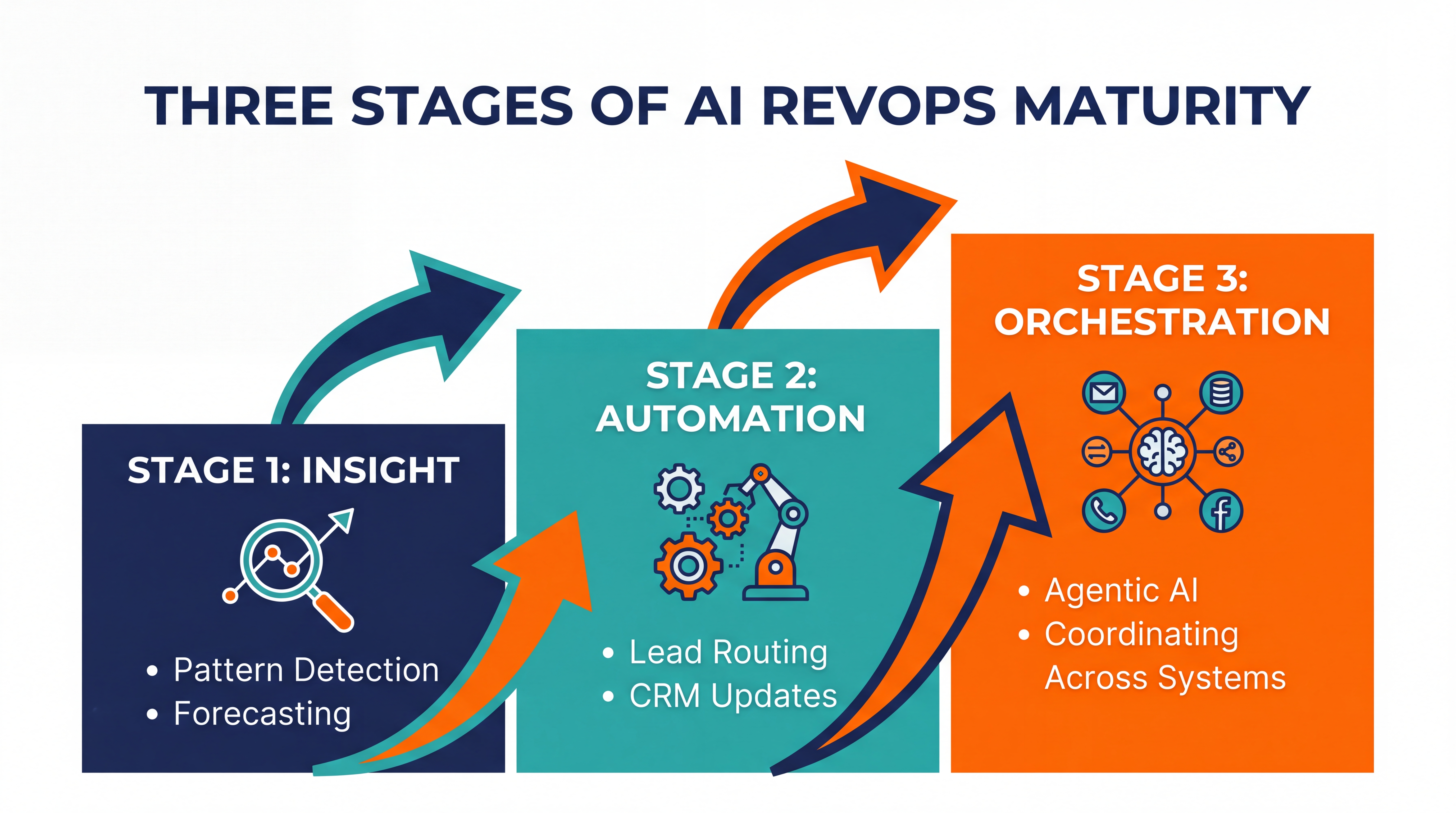
Not every team starts at the same place. AI adoption in RevOps follows a clear maturity curve:
Stage 1: Insight. AI detects patterns, forecasts revenue, identifies churn signals, and scores leads. This is where most enterprises are today. The AI observes and recommends, but humans still execute.
Stage 2: Automation. AI triggers workflows: lead routing, email sequences, territory updates, CRM field updates after calls. The AI acts on predefined rules and reduces manual data entry. Teams at this stage typically see 30 to 50% time savings on operational tasks.
Stage 3: Orchestration. Agentic AI coordinates across multiple systems, reasons across signals, and makes autonomous decisions. It can adjust a forecast based on market data, trigger a retention play when a customer's usage drops, and reassign leads based on real-time rep capacity. Only a small fraction of enterprises have reached this stage.
The jump from Stage 1 to Stage 2 delivers the most immediate ROI. That is where the 12 hours per week get reclaimed.
What Changes When AI Powers RevOps
!Traditional vs AI-powered RevOps comparison
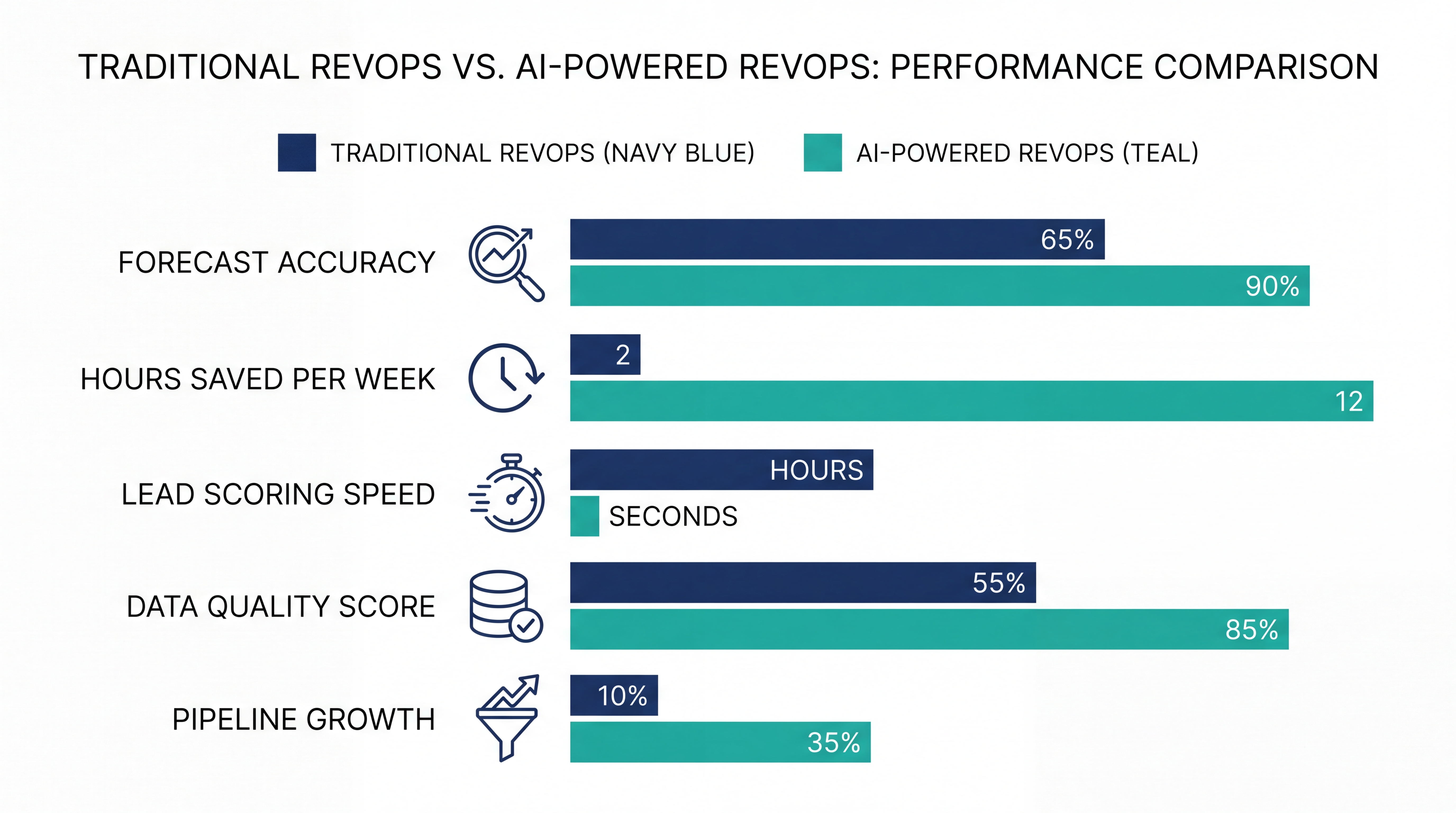
The metrics shift dramatically when AI takes over the operational layer:
- Forecast accuracy jumps from 65% to 90%. AI analyzes historical patterns, deal velocity, and conversation signals to predict outcomes with far higher precision than spreadsheet-based methods.
- Lead scoring goes from hours to seconds. Instead of manual qualification checklists, AI scores every inbound lead against your ideal customer profile in real time.
- Data quality scores rise from 55% to 85%. AI automatically deduplicates records, enriches missing fields, and flags inconsistencies that humans would miss.
- Pipeline growth increases by 35%. With better lead routing, faster follow-up, and more accurate targeting, reps spend more time selling and less time on admin work.
These are not theoretical numbers. They come from RevOps teams that have moved beyond pilot projects and embedded AI into daily workflows.
Why 82% of Teams Are Not Ready Yet
The LeanData 2026 State of MarTech and RevOps report reveals an uncomfortable truth: the majority of teams want AI but have not built the foundation to use it effectively.
Here are the three blockers:
1. Data Fragmentation
32% of teams report duplicate or mismatched lead-to-account records. When your CRM data is unreliable, AI predictions are unreliable. Garbage in, garbage out still applies.
2. Platform Fragmentation
The average RevOps team uses 8 to 12 tools across marketing automation, CRM, sales engagement, and analytics. AI needs a unified data layer to reason across these systems. Most teams do not have one.
3. Skills Gap
55% of RevOps power users use AI weekly, but most teams lack the technical skills to implement and maintain AI workflows. The result: AI adoption stays stuck at low-risk use cases like content creation (46% adoption) while high-impact use cases like AI lead routing remain at just 11%.
A Practical Roadmap to Get Started
You do not need a $200,000 transformation program to begin. Here is a phased approach that delivers value within 90 days:
Phase 1: Data Audit (Weeks 1 to 3)
Run a full audit of your CRM data. Identify duplicate records, missing fields, and broken routing rules. This is unglamorous but essential. Without it, every AI investment downstream will underperform.
Phase 2: Automate the Highest-Friction Task (Weeks 4 to 8)
Pick one workflow that consumes the most manual hours. For most teams, this is CRM data entry after sales calls. Deploy an AI tool that automatically updates deal stages, logs call summaries, and creates follow-up tasks. Measure time saved.
Phase 3: Expand to Lead Scoring and Routing (Weeks 9 to 12)
Once your data is clean and one workflow is automated, extend AI to lead scoring and routing. This is where pipeline growth accelerates. AI scores leads against your ICP in real time and routes them to the right rep based on capacity and territory rules.
Phase 4: Build Toward Orchestration (Months 4+)
With foundations in place, start connecting AI across systems. Let agents monitor customer health signals, trigger retention plays, and adjust forecasts based on external market data. This is where RevOps moves from operational support to strategic advantage.
The Bottom Line
Revenue Operations was built to align teams around data. AI is what finally makes that alignment real.
The enterprises that win in 2026 will not be the ones with the most AI tools. They will be the ones who cleaned their data first, automated the right workflows, and built toward orchestration step by step.
The 12 hours per week are there for the taking. The question is whether your data is ready to give them back.
Further reading: Explore how AI-powered sales enablement transforms lead scoring, and learn why AI agent observability is critical for monitoring autonomous RevOps workflows.