AI-Powered Stakeholder Communication: How Enterprises Automate Reporting and Cut Update Time by 75%
By Delos Intelligence — 2026-08-06
AI-powered stakeholder communication cuts reporting cycle time from 16 hours to 4 hours, improves stakeholder satisfaction by 60%, and reduces ad hoc data requests by 70% through automated report generation and real-time dashboards.
The Stakeholder Communication Problem
Every enterprise faces the same quarterly ritual: gathering data from a dozen systems, formatting it into multiple reports for different audiences, coordinating review cycles across departments, and distributing updates to investors, board members, employees, and regulators. The process consumes 16 hours per reporting cycle on average, involves 8 to 12 people, and produces reports that are often outdated before they are read.
AI-powered stakeholder communication changes this entirely. By automating data aggregation, report generation, and personalized distribution, enterprises are cutting reporting time from 16 hours to 4 hours, improving accuracy, and increasing stakeholder satisfaction by 60%.
How AI Automates Stakeholder Communication
Automated Data Aggregation
The first bottleneck in stakeholder reporting is data collection. Finance teams pull from ERP. HR pulls from HRIS. Operations pulls from production systems. Each team formats its data differently, uses different time periods, and applies different definitions. A finance director spending 6 hours gathering data for a board report is wasting expensive expertise on low-value work.
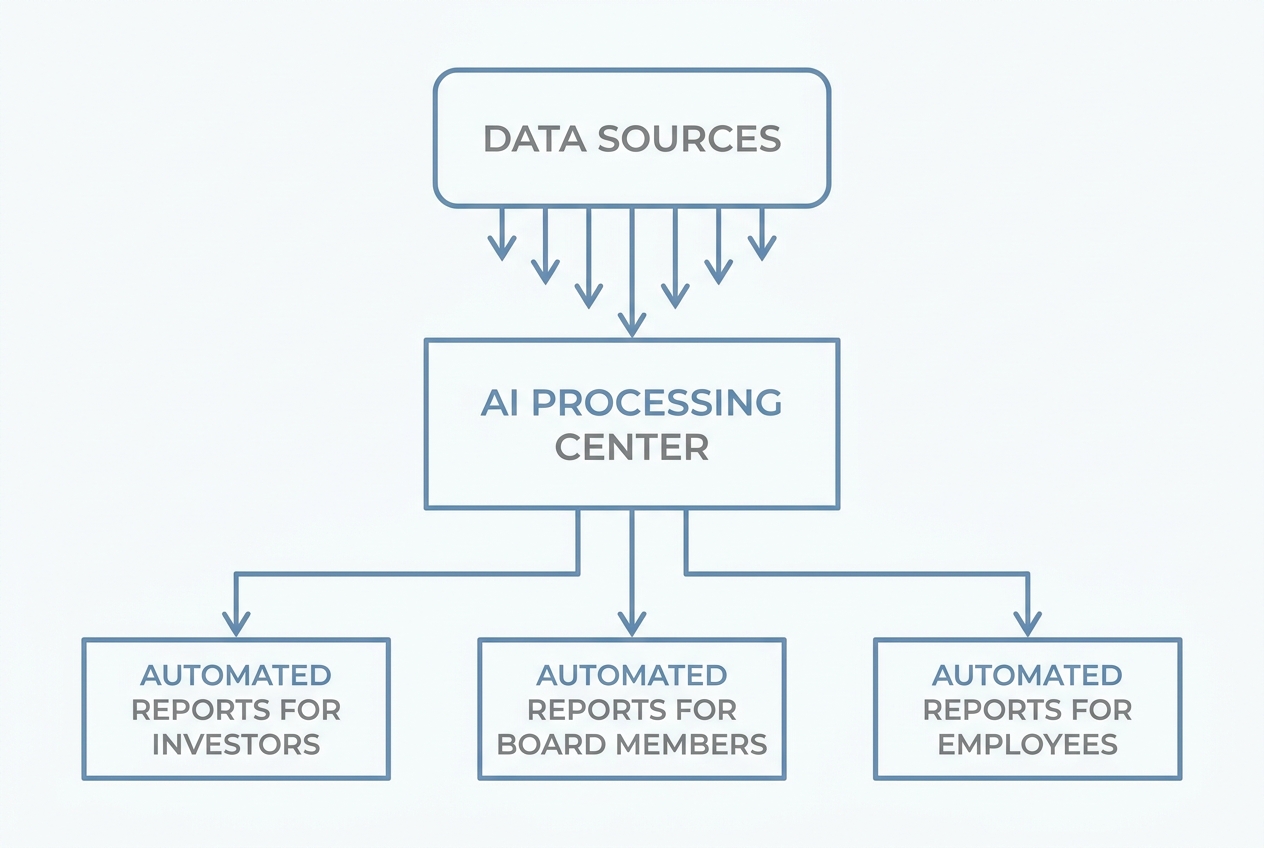
AI stakeholder communication platforms connect to all data sources via API and pull the required metrics automatically. The system knows that the board report needs quarterly P&L with prior year comparison, the investor update needs key performance indicators with industry benchmarks, and the employee newsletter needs operational highlights with forward-looking commentary.
Each report is generated from the same underlying data, with automatic reconciliation ensuring that the revenue number in the board report matches the one in the investor update. No more version control problems. No more last-minute corrections when someone spots an inconsistency.
Personalized Report Generation
Different stakeholders need different information presented differently. Investors want financial performance, competitive positioning, and forward guidance. Board members want risk management, governance, and strategic progress. Employees want operational wins, culture updates, and company direction. Regulators want compliance status, audit trails, and attestations.
AI platforms generate all of these simultaneously from the same data layer, applying audience-specific templates, tone guidelines, and materiality thresholds. A development in the supply chain that is material for the board risk committee might not belong in the employee newsletter. The AI applies judgment about what each audience needs.
!Stakeholder Communication Workflow: From Data to Delivery
Real-Time Dashboards and Self-Service
Beyond periodic reports, AI stakeholder communication platforms provide real-time dashboards that allow stakeholders to explore data on their own schedule. An investor can log in and see the latest metrics without waiting for the quarterly report. A board member can drill into a specific region's performance between meetings.
This self-service capability reduces ad hoc reporting requests by 70%. Instead of answering one-off questions from board members or analysts, the communications team configures the dashboard once and stakeholders access what they need directly.
The Numbers: Impact on Enterprise Reporting
Enterprises that have implemented AI stakeholder communication platforms report:
- 75% reduction in reporting cycle time (from 16 hours to 4 hours)
- 60% improvement in stakeholder satisfaction scores
- 70% reduction in ad hoc data requests
- 95% accuracy rate (up from 82% in manual processes due to automated reconciliation)
- 40% reduction in compliance reporting costs
A global technology company with 12,000 employees replaced its manual investor relations process with an AI platform. Quarterly earnings preparation dropped from 3 weeks to 5 days. Analyst satisfaction with information quality increased by 45%. The IR team reduced from 8 to 5 people while handling 30% more stakeholder inquiries.
Implementation Framework
Step 1: Map your stakeholder universe
Identify every stakeholder group and the information they need: frequency, format, data sources, and approval requirements. Most enterprises discover they have more stakeholder touchpoints than they realized, including regulators, vendors, and community stakeholders.
Step 2: Audit your data sources
Catalog every system that feeds stakeholder reports. Map the data elements required for each report to their source systems. Identify gaps where data exists but is not currently reported, and redundancies where the same data is pulled from multiple sources.
Step 3: Deploy the integration layer
Connect the AI platform to your data sources. Prioritize the highest-volume, highest-frequency reports first: typically investor relations, board reporting, and employee communications.
Step 4: Configure audience templates
Build templates for each stakeholder group, defining the metrics to include, the format (narrative vs. dashboard vs. chart-heavy), the tone (formal vs. conversational), and the approval workflow. This configuration phase typically takes 4 to 6 weeks.
Step 5: Pilot and calibrate
Run one full reporting cycle in parallel: generate reports both manually and through the AI platform. Compare outputs for accuracy, completeness, and stakeholder feedback. Adjust templates before fully transitioning.
Privacy and Compliance Considerations
AI stakeholder communication involves distributing sensitive financial and operational data. Ensure the platform provides role-based access controls (investors see investor-relevant data, not board materials), audit trails for all data access and distributions, and compliance with disclosure regulations (Regulation FD in the US, MAR in Europe). The AI should never distribute non-public material information outside the authorized stakeholder group.
This article was written with AI assistance.