AI Supply Chain Resilience: How Enterprises Predict Disruptions Before They Happen
By Delos Intelligence — 2026-08-01
Discover how AI-powered supply chain resilience helps enterprises predict disruptions, cut losses by 80%, and respond 7x faster than traditional methods.
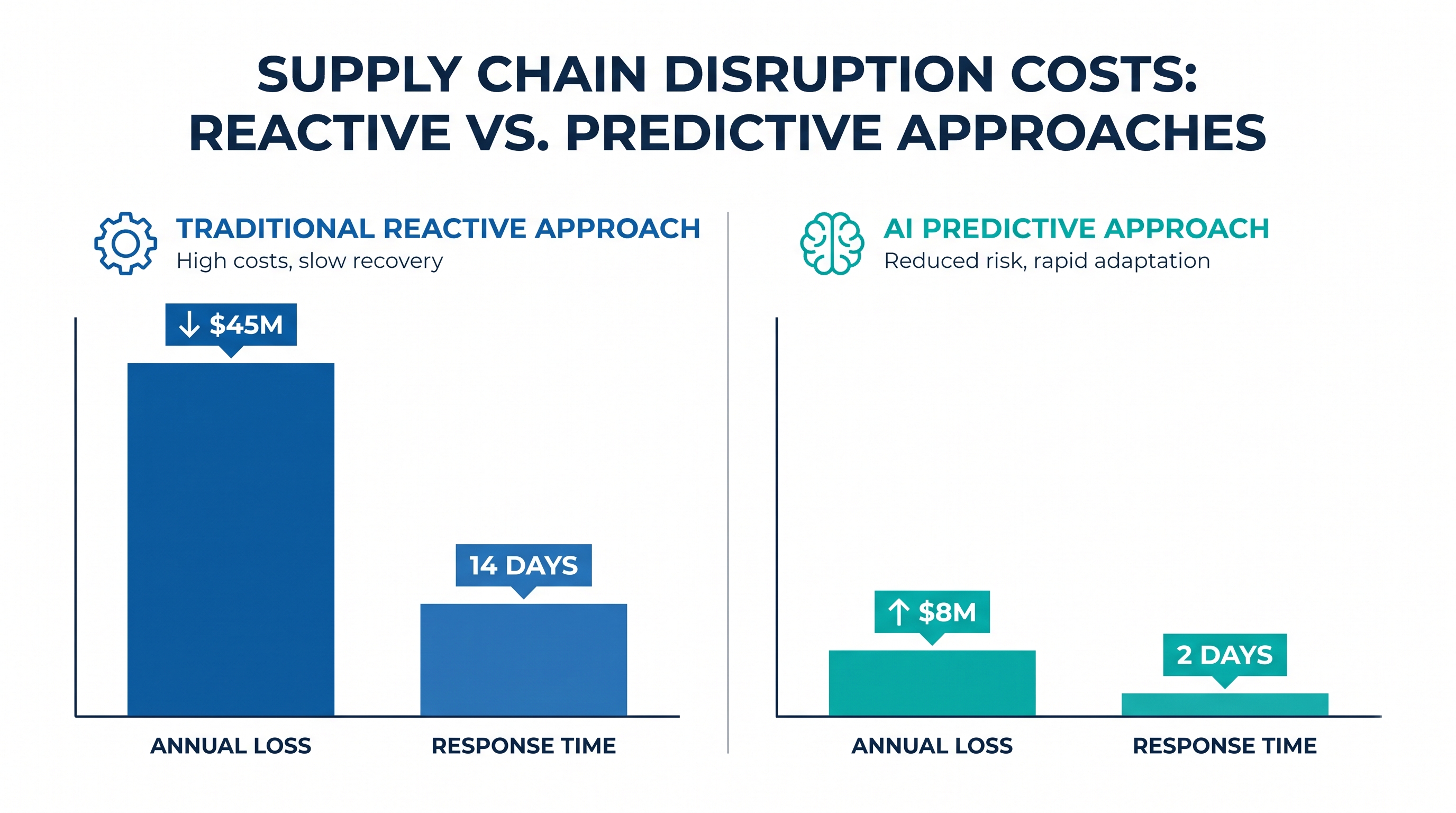
Supply chain disruptions cost enterprises an average of $45 million per year. The reactive model leaves companies vulnerable to cascading failures that can take weeks to resolve. AI-powered supply chain resilience is changing this.
The Cost of Reactive Supply Chain Management
Traditional supply chain management relies on historical data and human intuition. When a disruption occurs, the response is reactive: identify the problem, assess the impact, find alternative suppliers, and reroute logistics. This process typically takes 14 days.
The financial impact is severe. A single major disruption can cost an enterprise between $50 million and $200 million in direct losses, with cascading effects on revenue, customer trust, and market position.
!Supply Chain Disruption Costs: Traditional vs AI Predictive
How AI Predicts Supply Chain Disruptions
AI-powered supply chain resilience systems continuously monitor thousands of data sources:
- Supplier health signals: Financial stability indicators, payment delays, production capacity changes, and quality metrics from tier 1, 2, and 3 suppliers
- Geopolitical and economic data: Trade policy changes, tariff adjustments, sanctions, and regional instability
- Environmental and weather patterns: Hurricane forecasts, flood predictions, and climate events
- Market signals: Commodity price fluctuations, demand spikes, and inventory levels
- Logistics data: Port congestion, shipping route disruptions, carrier capacity
By correlating these signals with historical disruption patterns, AI models can predict disruptions with 85% accuracy, giving enterprises a 7-10 day head start.
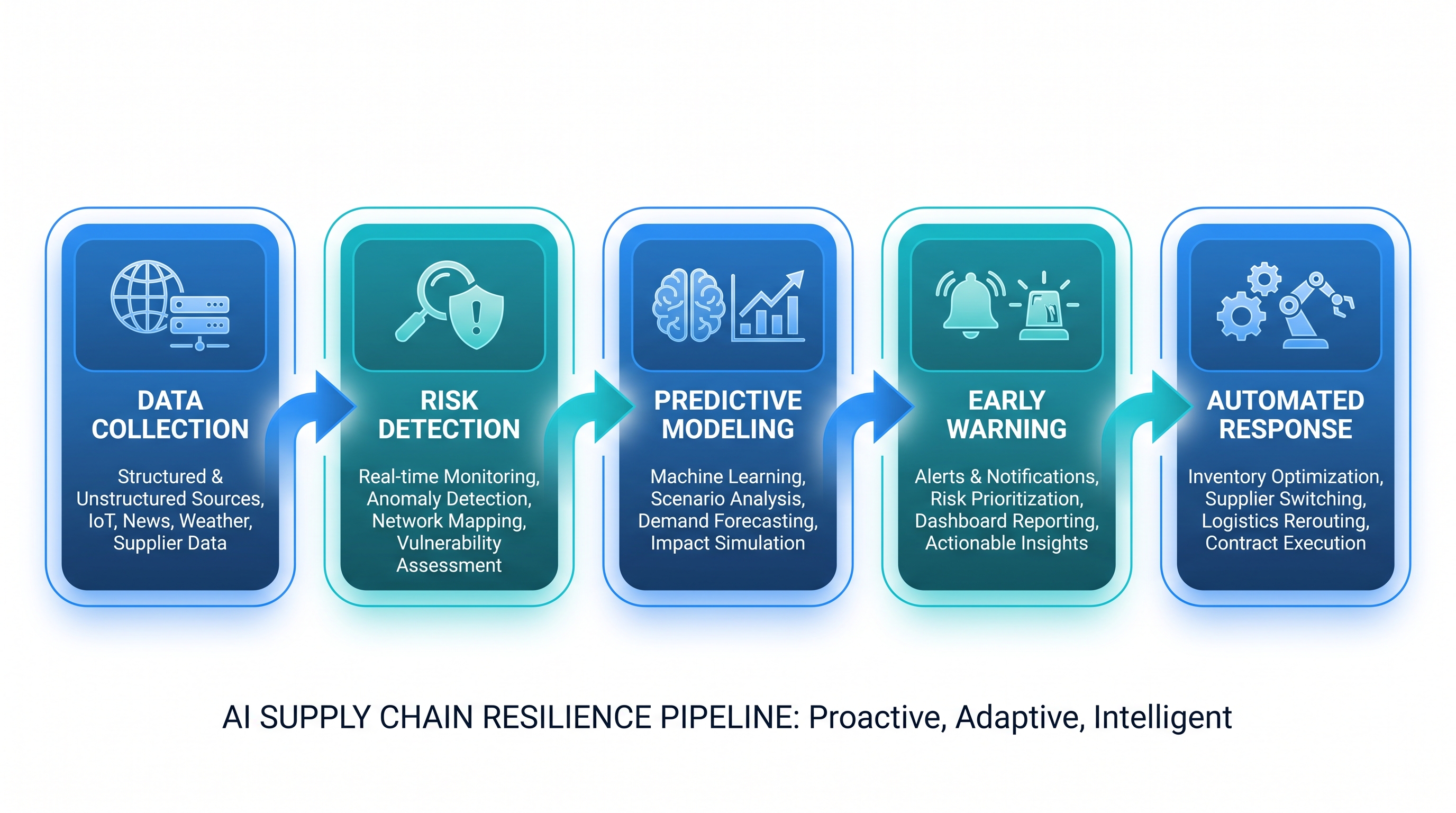
!AI Supply Chain Resilience Pipeline
The AI Resilience Pipeline in Action
The pipeline operates in five stages:
1. Data Collection: Ingests data from ERP systems, external market feeds, supplier portals, IoT sensors, and public data sources — creating a real-time digital twin of the entire supply chain.
2. Risk Detection: ML models analyze the data stream to identify anomalies and risk patterns.
3. Predictive Modeling: Scenario simulations predict potential disruptions, their probability, and cascading impact.
4. Early Warning: When disruption probability exceeds a threshold, the system generates alerts with specific recommendations.
5. Automated Response: For pre-approved scenarios, the system triggers responses automatically.
Real-World Impact
Enterprises implementing AI supply chain resilience report:
- 82% reduction in disruption response time: From 14 days to 2.5 days
- $37 million average annual savings through avoided disruptions
- 60% fewer stockouts due to predictive inventory management
- 45% improvement in supplier performance through early intervention
A global automotive manufacturer implemented AI supply chain resilience after losing $180 million to a single supplier disruption. Within the first year, the system predicted three major disruptions, saving an estimated $95 million.
Implementation Roadmap
Phase 1 (Months 1-3): Data integration and visibility — connect ERP, supplier portals, and logistics systems.
Phase 2 (Months 4-6): Predictive model development — train ML models on historical disruption data, implement risk scoring.
Phase 3 (Months 7-12): Automated response and optimization — deploy scenario simulation, automated alerting, and pre-approved response protocols.
Conclusion
As AI models become more sophisticated, supply chain resilience will evolve from prediction to prevention. For enterprises, the question is no longer whether to invest in AI-powered supply chain resilience, but how quickly they can deploy it before the next major disruption hits.