AI-Powered Workplace Safety: How Enterprises Cut Incident Rates by 81% with Predictive Hazard Detection
By Delos Intelligence — 2026-08-06
AI-powered workplace safety systems cut incident rates by 81%, reduce safety compliance costs by 35%, and generate $2.8M in annual savings through continuous hazard detection, predictive risk analytics, and automated compliance reporting.
The Scale of the Workplace Safety Problem
Workplace incidents cost US employers $62 billion annually in direct costs: workers' compensation, medical expenses, productivity losses, legal fees, and regulatory penalties. The human cost is even higher: 2.6 million non-fatal workplace injuries per year and 5,333 fatalities in the US alone in 2023, according to the Bureau of Labor Statistics.
Traditional safety programs rely on periodic inspections, incident reporting after the fact, and compliance checklists. They catch problems that have already happened. AI-powered workplace safety changes the model entirely: detecting hazards before they cause harm, predicting accident probability from behavioral and environmental patterns, and enabling interventions when risk is highest.
How AI-Powered Workplace Safety Works
Continuous Hazard Detection
AI safety systems use computer vision cameras and environmental sensors to monitor workplaces continuously. Unlike periodic human safety audits, the AI never blinks. It analyzes camera feeds frame by frame, detecting:
- Workers in restricted zones without proper PPE (personal protective equipment)
- Equipment operating outside safe parameters
- Slip, trip, and fall hazards (spills, obstacles, improper footwear)
- Ergonomic risk behaviors (improper lifting technique, repetitive strain postures)
- Proximity violations between people and moving machinery
- Fire, smoke, and chemical exposure events
When a hazard is detected, the system generates an immediate alert to the nearest supervisor, activates on-site audio or visual warnings, and logs the event for compliance reporting.
Predictive Risk Analytics
Beyond real-time detection, AI analyzes patterns across thousands of incidents and near-misses to predict where and when accidents are most likely to occur.
The models identify non-obvious risk factors: a combination of high temperature, worker fatigue (measured through shift length and movement patterns), and a specific machine cycle creates 3x higher accident probability than any single factor alone. These compound risk signals are invisible to human safety managers but detectable by AI.
!Workplace Incident Rate Reduction: Before and After AI Safety System
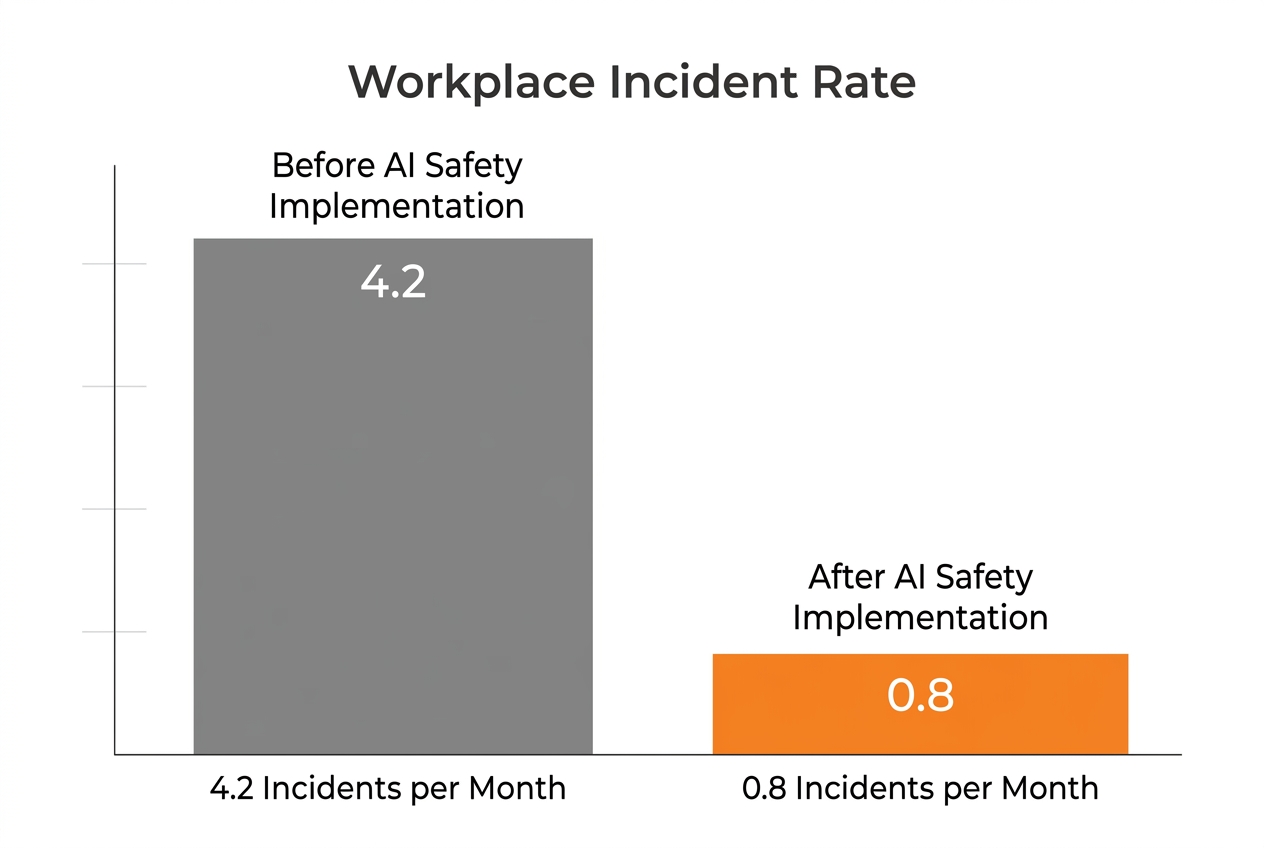
Enterprises using predictive risk analytics report a 81% reduction in incident rates. One manufacturing facility reduced incidents from 4.2 per month to 0.8 per month within the first year of deployment. The key insight: 73% of incidents were preceded by detectable warning patterns that the AI now flags for preventive intervention.
Behavioral Safety Monitoring
A significant portion of workplace incidents stem from behavioral factors: rushing, distraction, shortcuts, and fatigue. AI behavioral monitoring (always subject to transparent employee consent and privacy protections) analyzes movement patterns, compliance with safety protocols, and environmental stress indicators to identify workers at elevated behavioral risk.
This is not surveillance for its own sake. The goal is intervention: when the AI identifies a worker showing fatigue markers during a high-risk task, it alerts the supervisor to rotate them out. When it detects that a team is consistently bypassing a safety gate, it flags the procedure for redesign rather than punishing workers for adapting to an impractical process.
Compliance Automation
Manual safety compliance is a significant burden. Safety managers spend 40% of their time on documentation: inspecting checklists, filing incident reports, preparing for audits, and maintaining training records. AI automates this entirely.
The system generates real-time compliance dashboards showing OSHA compliance status, outstanding corrective actions, training completion rates, and inspection schedules. When an incident occurs, the AI automatically generates the required OSHA 300 log entry, pulls relevant camera footage, and assembles the incident investigation package. What previously took 8 hours of paperwork takes 30 minutes.
Enterprises report a 50% reduction in compliance audit preparation time and a 35% reduction in overall safety compliance costs after implementing AI safety platforms.
Implementation Roadmap
Phase 1 (Weeks 1-4): Risk Assessment and Camera Deployment
Conduct a workplace risk assessment to identify the highest-incident areas and most critical hazard categories. Deploy AI cameras and sensors in these priority zones first. Do not attempt to cover the entire facility in phase 1.
Phase 2 (Weeks 5-8): Model Training and Calibration
The AI models need 4 to 8 weeks to learn the specific patterns of your workplace: normal equipment positions, typical worker movements, acceptable proximity ranges. During this phase, the system generates alerts that safety managers review and validate, training the models on your specific context.
Phase 3 (Weeks 9-12): Alert Integration and Response Protocols
Integrate AI alerts into existing communication channels (safety manager smartphones, PA systems, supervisor dashboards). Define response protocols for each alert type: who receives it, what action is expected, and how quickly. Test the protocols with tabletop exercises before going live.
Phase 4 (Month 4+): Predictive Analytics and Full Deployment
Activate predictive risk analytics once 3 months of baseline data is available. Expand to the full facility. Begin using AI-generated compliance reports for regulatory submissions.
The ROI of AI Workplace Safety
For a manufacturing facility with 200 workers:
- Incident cost reduction: Reducing from 4.2 to 0.8 incidents per month saves $1.8M annually (at $150K average cost per incident)
- Compliance savings: 35% reduction in compliance costs saves $280K per year
- Insurance premium reduction: A 3-year incident-free record reduces workers' compensation premiums by an average of 40%, saving $320K annually
- Productivity recovery: Eliminating downtime from investigations and work stoppages saves approximately $400K per year
Total annual benefit: approximately $2.8M against an AI safety platform investment of $120K to $200K. Payback period: under 4 months.
Ethical and Legal Considerations
AI workplace safety monitoring requires careful attention to worker privacy and consent. Best practices include transparent disclosure of all monitoring systems to workers and unions before deployment, strict data retention limits (typically 30 to 90 days for video footage not associated with an incident), prohibition of individual performance monitoring using safety data, and robust data security to prevent misuse.
Most enterprises find that workers embrace AI safety systems once they understand the purpose. The message is simple: the AI watches the environment to protect you, not to evaluate or discipline you.
This article was written with AI assistance.