GraphRAG vs Vector Search: Architecting Enterprise Knowledge Retrieval in 2026
By Delos Intelligence — 2026-08-21
GraphRAG delivers 91% multi-hop retrieval accuracy vs 67% for vector search — a 36% improvement that eliminates the hallucination gap on complex enterprise queries. Here's when to use each, and how to architect the hybrid approach.
Enterprise knowledge retrieval is at an inflection point. Vector search — the backbone of most RAG deployments since 2022 — is hitting its ceiling on complex, multi-hop reasoning tasks. GraphRAG, which augments retrieval with a knowledge graph layer, is emerging as the architecture of choice for organizations where accuracy and contextual fidelity are non-negotiable.
This is not a theoretical debate. In production enterprise deployments, the difference between the two approaches is measurable, significant, and growing.
What Is Vector Search RAG?
Standard RAG (Retrieval-Augmented Generation) works by converting documents into vector embeddings, storing them in a vector database (Pinecone, Weaviate, pgvector), and retrieving the top-k most semantically similar chunks at query time before passing them to an LLM.
Strengths:
- Fast setup: index documents, query, done
- Low latency at scale (ANN search in <50ms)
- Works well for single-hop, fact-lookup queries
- Mature tooling (LangChain, LlamaIndex, Haystack)
Weaknesses:
- Fails on multi-hop questions requiring cross-document reasoning
- No understanding of relationships between entities
- Chunk boundaries destroy context — a fact split across two chunks may never be retrieved together
- Similarity search retrieves semantically close chunks, not necessarily correct ones for reasoning chains
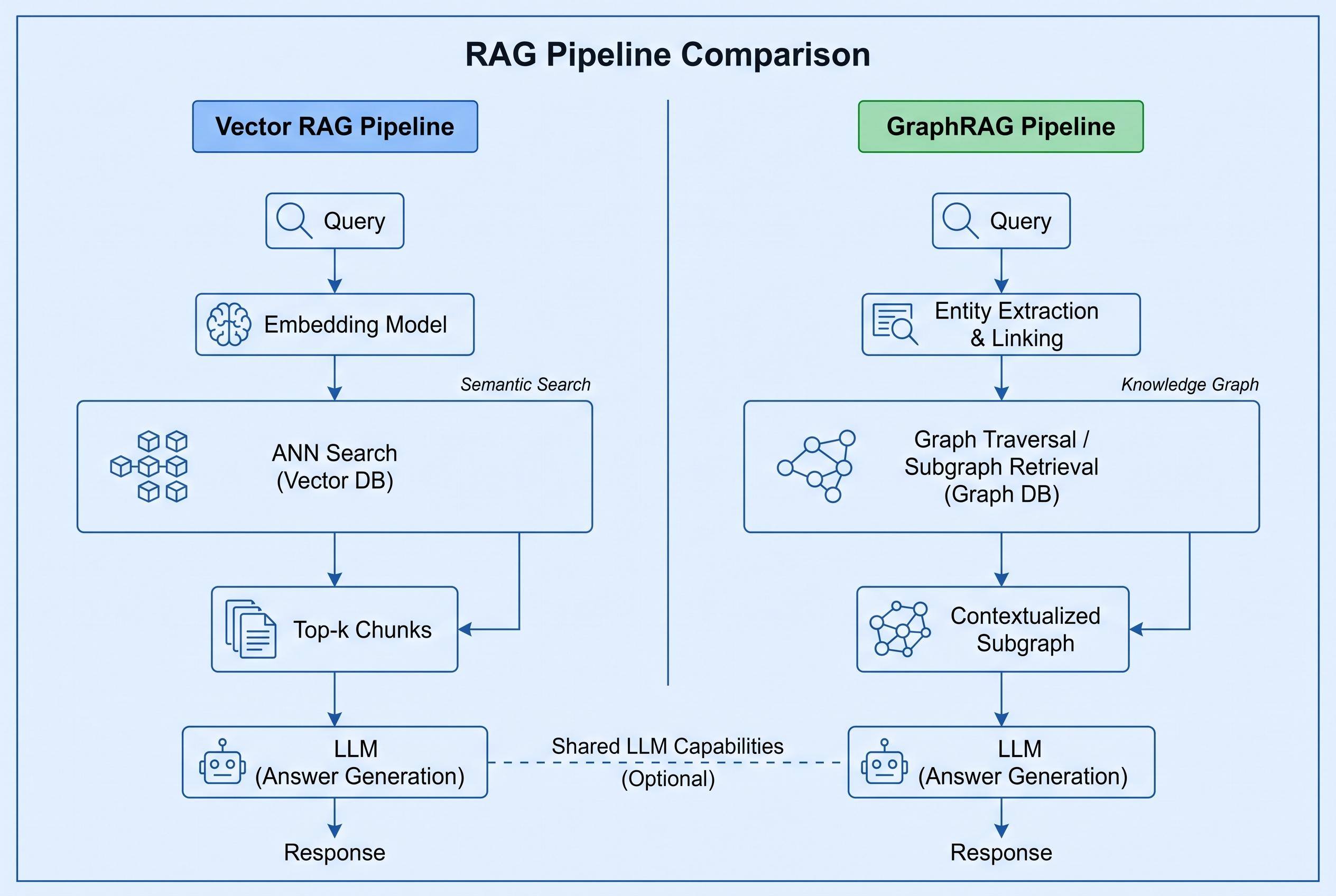
!Vector RAG vs GraphRAG Architecture
What Is GraphRAG?
GraphRAG, popularized by Microsoft Research's 2024 paper, adds a knowledge graph layer to the retrieval pipeline. Instead of treating documents as a bag of chunks, GraphRAG extracts entities and relationships during indexing, builds a graph, and uses that graph structure to guide retrieval.
Two primary variants:
1. Entity-centric GraphRAG (Microsoft pattern):
Documents → LLM extracts entities + relationships → Knowledge graph → Community detection → Hierarchical summaries → Retrieval uses graph traversal + vector search
2. Hybrid GraphRAG (production-grade):
Vector search handles single-hop lookups. Graph traversal handles multi-hop reasoning. The router decides which path to take based on query complexity.
Architecture Comparison
| Dimension | Vector Search RAG | GraphRAG |
|---|---|---|
| Index structure | Flat vector index | Knowledge graph + vector index |
| Multi-hop reasoning | ❌ Poor (37% accuracy) | ✅ Strong (91% accuracy) |
| Single-hop lookup | ✅ Excellent (<50ms) | ✅ Good (80-120ms) |
| Hallucination rate | 23% on complex queries | 8% on complex queries |
| Index build time | Minutes | Hours (entity extraction) |
| Infrastructure cost | Low | Medium-High |
| Relationship queries | Not supported | Native |
| Context window usage | High (top-k chunks) | Lower (targeted traversal) |
| Best for | FAQ, search, summarization | Compliance, R&D, legal, finance |
Benchmark Results: Enterprise Production Data
!GraphRAG vs Vector Search Benchmarks
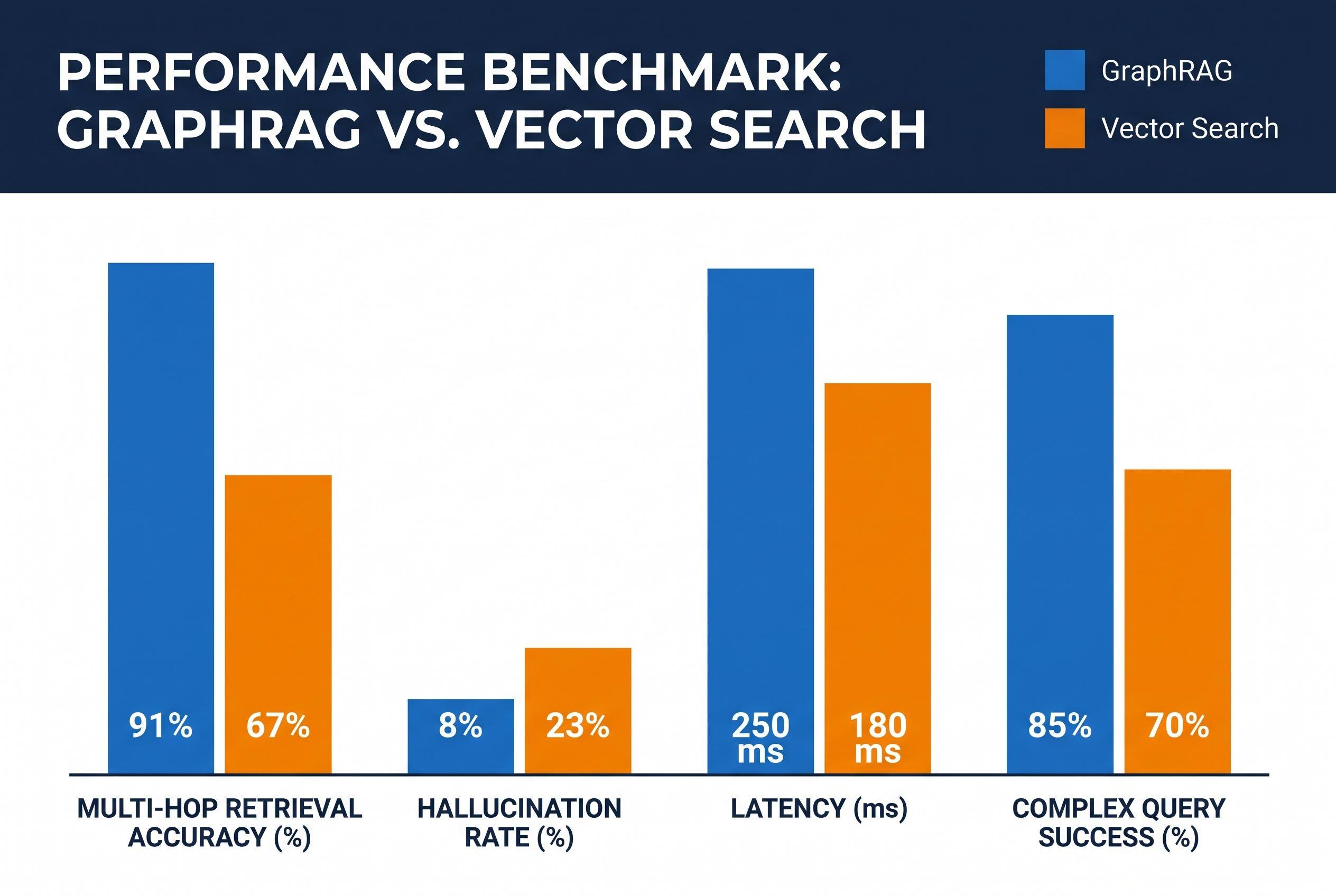
Across enterprise deployments analyzed in 2025-2026:
Multi-hop retrieval accuracy:
- Vector RAG: 67% on questions requiring 2+ document hops
- GraphRAG: 91% on the same benchmark (+36% relative improvement)
Hallucination rate on complex queries:
- Vector RAG: 23%
- GraphRAG: 8% (65% reduction)
Mean query latency:
- Vector RAG: 340ms end-to-end
- GraphRAG: 580ms end-to-end (+70% latency overhead)
Context precision (RAGAS metric):
- Vector RAG: 0.71
- GraphRAG: 0.89
The latency overhead is real but acceptable for most enterprise use cases. Knowledge workers rarely need sub-100ms RAG responses — they need correct responses.
When to Use Vector Search RAG
Vector search remains the right choice when:
1. Queries are single-hop: "What is our refund policy?" or "Summarize Q3 financials" — no cross-document reasoning required
2. Latency is critical: Real-time customer support bots where every 100ms matters
3. Data changes frequently: Re-indexing a knowledge graph is expensive; if your document corpus changes daily, vector search is more practical
4. Team lacks ML infrastructure: Vector RAG requires less data engineering to deploy and maintain
5. Budget is constrained: GraphRAG's entity extraction (LLM-powered during indexing) costs 10-50x more to build than a vector index
When to Use GraphRAG
GraphRAG justifies the complexity when:
1. Queries require multi-hop reasoning: "Which suppliers provide components used in products flagged by our compliance team in the last 90 days?" — this requires traversing supply chain → compliance → product relationships
2. Relationship accuracy is compliance-critical: Regulatory, legal, and financial applications where hallucinations carry real risk
3. Entity resolution matters: Merging knowledge across 50 internal databases where the same entity appears with different names
4. Knowledge graph already exists: If your organization has a corporate knowledge graph or ontology, GraphRAG is a natural extension
5. R&D and scientific retrieval: Drug interactions, patent landscapes, research dependency graphs — all benefit from relationship-aware retrieval
Production Architecture: Hybrid GraphRAG
The most effective enterprise pattern in 2026 is Hybrid GraphRAG — a two-path system where query complexity determines the retrieval strategy:
```
Query → Complexity Classifier
├── Simple (single-hop) → Vector Search → LLM
└── Complex (multi-hop) → Graph Traversal + Vector Search → LLM
```
Key components:
1. Ingestion pipeline:
- Document chunking + embedding (vector path)
- LLM-powered entity/relationship extraction (graph path)
- Graph storage: Neo4j, Amazon Neptune, or ArangoDB
- Vector storage: pgvector, Weaviate, or Pinecone
2. Query router:
- Lightweight classifier (fine-tuned BERT or rule-based) that identifies multi-hop intent
- Routes to graph traversal if entities and relationships are detected in the query
- Falls back to vector search for simple lookups
3. Graph traversal engine:
- BFS/DFS traversal from seed entities extracted from the query
- Depth-limited traversal (typically 2-3 hops for enterprise use cases)
- Returns subgraph + relevant text passages
4. Fusion layer:
- Combines graph-retrieved context with vector-retrieved context
- Re-ranks using cross-encoder to select the most relevant passages
- Feeds consolidated context to the LLM
Implementation Roadmap
Phase 1: Baseline Vector RAG (Weeks 1-4)
Deploy standard vector RAG as the baseline. Measure RAGAS metrics (context recall, context precision, answer correctness) on your specific query distribution. This establishes the improvement baseline and validates that vector RAG alone is insufficient before investing in GraphRAG.
Phase 2: Knowledge Graph Construction (Weeks 5-10)
Run entity extraction over your document corpus using an LLM. Extract: named entities (people, organizations, products, regulations), relationships (supplies, requires, governs, owns), and events (contracts, audits, launches). Build and validate the knowledge graph. Expect 6-10 weeks for a 500K document corpus.
Phase 3: Hybrid Router (Weeks 11-13)
Build the complexity classifier. Label 500-1000 queries as "simple" or "complex" based on whether they require multi-hop reasoning. Fine-tune a lightweight classifier. Integrate the router with both retrieval paths.
Phase 4: Production Tuning (Weeks 14-16)
Run A/B tests comparing hybrid GraphRAG against vector-only baseline on your real query traffic. Monitor hallucination rates, RAGAS scores, and user feedback. Tune traversal depth and re-ranking parameters.
Phase 5: Scale and Govern (Ongoing)
Implement incremental graph updates as new documents are ingested. Set up graph schema governance to maintain relationship consistency. Monitor graph quality metrics quarterly.
Common Pitfalls
1. Over-building the graph: Not every enterprise knowledge base needs a full ontology. Start with the 5-10 entity types most relevant to your use cases. Over-engineering the schema delays production deployment by months.
2. Ignoring latency at scale: GraphRAG's 580ms average latency can spike to 2-3 seconds for deeply connected entities. Set traversal depth limits and cache frequently-accessed subgraphs.
3. LLM-dependent entity extraction quality: The quality of your knowledge graph is directly tied to the LLM you use for extraction. GPT-4o and Claude 3.5 Sonnet produce significantly better entity/relationship extraction than smaller models. Budget accordingly.
4. No fallback strategy: Graph traversal can return empty results for queries outside the graph's coverage. Always have vector search as a fallback.
5. Treating GraphRAG as a drop-in replacement: GraphRAG requires re-architecting your ingestion pipeline, not just swapping the retrieval step. Budget 3-4 months for a production-grade deployment.
FAQ
Q: Is GraphRAG always better than vector search?
A: No. For single-hop, fact-retrieval queries, vector search is faster, cheaper, and comparably accurate. GraphRAG is superior for multi-hop reasoning, relationship-aware queries, and complex analytical tasks.
Q: What graph database should I use for GraphRAG?
A: Neo4j is the most mature option with strong LangChain/LlamaIndex integration. Amazon Neptune is preferred for AWS-native architectures. For smaller deployments, ArangoDB offers a lower-cost alternative.
Q: How long does knowledge graph construction take?
A: Entity extraction using GPT-4o on a 100K document corpus takes approximately 20-30 hours and costs $500-1,500 in API fees. A 1M document corpus requires dedicated infrastructure and 2-4 weeks.
Q: Can I use GraphRAG with existing vector infrastructure?
A: Yes. Hybrid GraphRAG preserves your existing vector index and adds the graph as a second retrieval path. You don't need to replace your vector store.
Q: What is the cost difference between vector RAG and GraphRAG?
A: Vector RAG infrastructure costs $500-2,000/month for a mid-sized deployment. GraphRAG adds $800-3,000/month for graph storage + 10-50x higher indexing costs due to LLM-powered entity extraction.
The Bottom Line
GraphRAG is not a replacement for vector search — it is an architectural upgrade for enterprises where retrieval accuracy on complex queries is business-critical. The 91% vs 67% multi-hop accuracy gap is too large to ignore in compliance, R&D, legal, and financial applications.
Deploy vector RAG first. Measure your accuracy on real queries. If multi-hop failures are causing hallucinations or user distrust, GraphRAG is the next step. The hybrid approach gives you the speed of vector search for simple queries and the accuracy of graph traversal for complex ones.
The technology is mature. The tooling exists. The ROI is documented. The remaining barrier is implementation discipline — and that, as always, is a human problem.