Multi-Agent Orchestration: How AI Agent Networks Are Reshaping Enterprise Workflows
By Delos Intelligence — 2026-07-07
Multi-agent orchestration is transforming how enterprises deploy AI — moving from single monolithic models to coordinated networks of specialist agents that collaborate, verify each other's work, and tackle complex workflows with unprecedented reliability.
What Is Multi-Agent Orchestration?
Multi-agent orchestration is the coordination of multiple specialized AI agents working together to accomplish complex tasks that no single model could handle reliably alone. Instead of asking one large language model to research, analyze, write, validate, and deliver — tasks that require competing cognitive modes — orchestration assigns each stage to a dedicated agent optimized for that specific function.
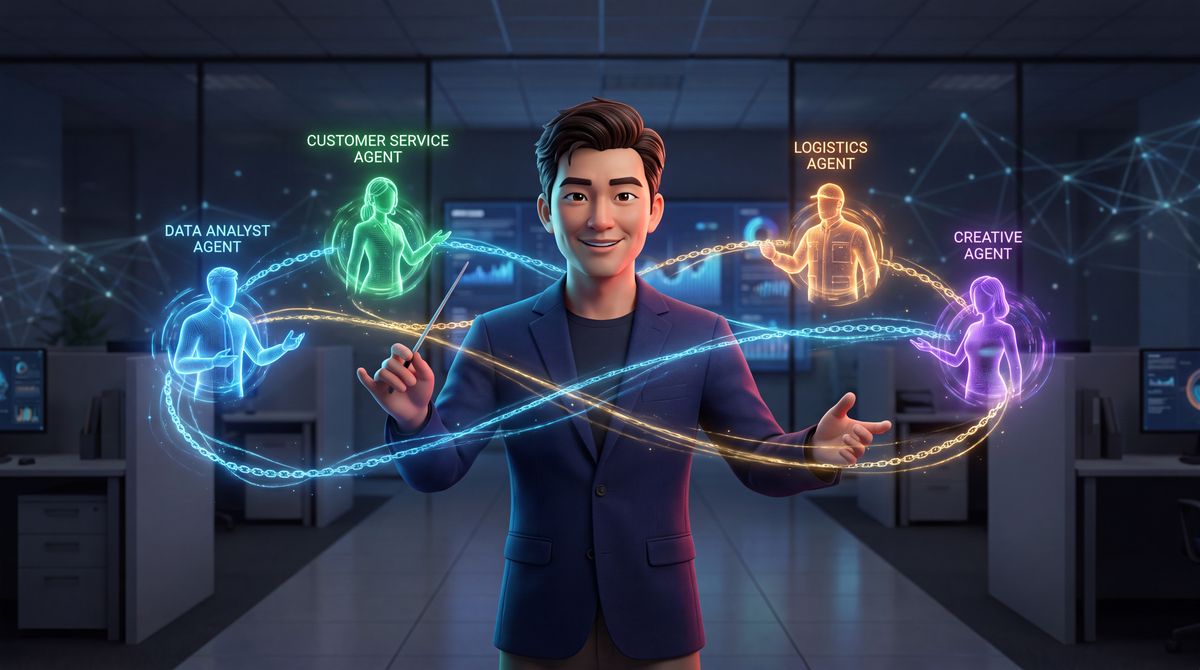
The orchestrator is the conductor: it receives the high-level goal, decomposes it into subtasks, delegates each subtask to the appropriate specialist agent, manages the flow of information between agents, and assembles the final output. Individual agents don't need to know about the broader task — they just need to execute their specialty exceptionally well.
This architecture mirrors how high-performing human teams work. A consulting firm doesn't ask one analyst to do everything. It assigns research to researchers, analysis to analysts, writing to writers, and review to senior partners. Multi-agent AI applies the same principle at machine speed.
The Architecture: How Multiple AI Agents Collaborate
The canonical multi-agent architecture has four layers:
The Orchestrator sits at the top. It receives user intent, maintains the task plan, and manages agent routing. It decides which agent handles which subtask, in what order, and how outputs are passed between agents. The orchestrator also handles error recovery — if an agent fails or returns low-quality output, the orchestrator can retry, reroute, or escalate.
Specialist Agents form the working layer. Each is a focused LLM instance with a specific system prompt, tool set, and evaluation criteria. A research agent has web search and database access. A reasoning agent has chain-of-thought prompting and structured output requirements. A writing agent has style guidelines and format constraints. A validation agent has adversarial prompting designed to find errors.
The Shared Knowledge Base provides persistent memory across the agent network. Individual agents are stateless between calls, but the knowledge base stores intermediate outputs, retrieved facts, and task context that agents can read and write. This enables true collaboration — the writing agent reads the research agent's findings without the orchestrator having to pass everything explicitly.
The Tool Layer gives agents access to external capabilities: web search, database queries, API calls, code execution, file I/O. Tools extend what agents can do beyond pure language processing.
Single Agent vs Multi-Agent Systems: Key Differences
The performance gap between single-agent and multi-agent approaches becomes dramatic as task complexity increases. For simple queries — summarization, translation, basic Q&A — a single agent is faster and cheaper. But for complex, multi-step enterprise workflows, the comparison is stark.
A single agent asked to produce a comprehensive competitive analysis must simultaneously maintain research breadth, analytical rigor, writing quality, and factual accuracy. These are competing pressures. The model optimizes for fluency at the expense of accuracy, or for comprehensiveness at the expense of coherence. The result is output that looks impressive but contains subtle errors.
A multi-agent system separates these pressures. The research agent focuses entirely on finding accurate information. The analysis agent focuses entirely on logical reasoning. The writing agent focuses entirely on clear communication. The validation agent focuses entirely on finding errors. Each agent can be fully optimized for its role without compromise.
Benchmarks across enterprise use cases consistently show 60-75% error reduction with multi-agent approaches versus single-agent on complex tasks, with the gap widening as task complexity increases.
!Comparison chart of single AI agent versus multi-agent system performance
Real-World Enterprise Use Cases
Financial Services: Fraud Detection Networks
Leading banks deploy multi-agent fraud detection systems where a transaction monitoring agent flags suspicious patterns, a context agent retrieves the customer's transaction history and risk profile, a reasoning agent evaluates the evidence, and a decision agent determines the response — all within milliseconds. This architecture reduces false positives by 40% compared to single-model approaches while improving detection rates for novel fraud patterns.
JPMorgan's AI-powered contract intelligence platform uses a similar multi-agent approach: extraction agents parse contract language, legal reasoning agents identify risk clauses, comparison agents benchmark against standard terms, and summary agents produce executive briefings. The system processes in minutes what previously took legal teams days.
Healthcare: Diagnostic Agent Swarms
Multi-agent systems are transforming clinical decision support. A patient case might be processed by a symptom analysis agent, a medical history agent, an imaging interpretation agent, a drug interaction agent, and a differential diagnosis agent — each contributing specialized analysis that a single generalist model would handle less reliably.
One hospital network reported a 28% improvement in diagnostic accuracy for complex cases when switching from a single-model assistant to a five-agent orchestrated system, with the biggest gains in rare disease identification where specialist depth matters most.
Supply Chain: End-to-End Optimization
Global manufacturers use multi-agent systems to optimize supply chains in real time. Demand forecasting agents analyze sales data and market signals. Inventory agents monitor stock levels across warehouses. Logistics agents optimize routing and carrier selection. Supplier agents manage vendor communications. A central orchestrator balances these inputs to minimize cost while maintaining service levels — a problem too complex for any single model to solve reliably.
Implementation Challenges and Best Practices
Latency compounds. Each agent adds processing time. A five-agent pipeline where each agent takes 3 seconds produces a 15-second response. For real-time applications, optimize by running independent agents in parallel and minimizing sequential dependencies.
Prompt engineering multiplies. Each agent needs a carefully crafted system prompt. The quality of the orchestrator's task decomposition determines the quality of the entire system. Invest in prompt engineering at the orchestrator level — it's the highest-leverage point in the architecture.
Failure modes are different. Single agents fail silently with plausible-sounding wrong answers. Multi-agent systems can fail at handoffs — when one agent's output format doesn't match the next agent's input expectations. Build explicit output schemas and validation at every handoff point.
Cost scales with agents. Each agent call costs tokens. A five-agent pipeline costs 5x the tokens of a single agent call. Design your routing logic to use lightweight agents for simple subtasks and expensive frontier models only where reasoning depth matters.
The Future of Multi-Agent Enterprise Systems
The trajectory is clear: multi-agent orchestration is becoming the default architecture for enterprise AI in complex domains. The next evolution is adaptive orchestration — systems that dynamically adjust their agent composition based on task characteristics, routing simple requests through fewer agents and complex requests through more specialized pipelines.
Persistent agent memory is another frontier. Current agents are largely stateless. Future systems will maintain long-term context across interactions, enabling agents that genuinely learn from experience within an enterprise context rather than starting fresh each time.
Cross-enterprise agent networks are emerging in regulated industries — where agents from different organizations collaborate on shared tasks while maintaining data sovereignty. In pharmaceutical research, agent networks spanning multiple companies are already accelerating drug discovery by enabling collaborative analysis without sharing proprietary data.
Conclusion
Multi-agent orchestration represents a fundamental shift in how enterprises deploy AI — from monolithic models that do everything adequately to coordinated networks that do specific things excellently. The performance gains are real, the use cases are proven, and the implementation path is increasingly well-defined.
The enterprises that build multi-agent expertise now will have a compounding advantage: each workflow they orchestrate generates data that improves future orchestration. The learning curve is real, but so is the moat it creates. For complex enterprise AI, the question is no longer whether to orchestrate — it's how quickly you can build the infrastructure to do it well.