RAG Explained: The Retrieval Architecture Powering Enterprise AI Search
By Delos Intelligence — 2026-07-04
RAG transforms how enterprises search and retrieve knowledge. Learn how retrieval-augmented generation works, why it outperforms keyword search, and how to implement it.
What Is RAG and Why Does It Matter?
Retrieval-Augmented Generation (RAG) is the architecture that makes generative AI useful inside enterprises. Without RAG, a language model answers questions from its training data — which may be outdated, incomplete, or irrelevant to your specific business. With RAG, the model first retrieves relevant documents from your knowledge base, then generates an answer grounded in those documents.
The result: accurate, citable, up-to-date answers instead of confident-sounding fabrications.
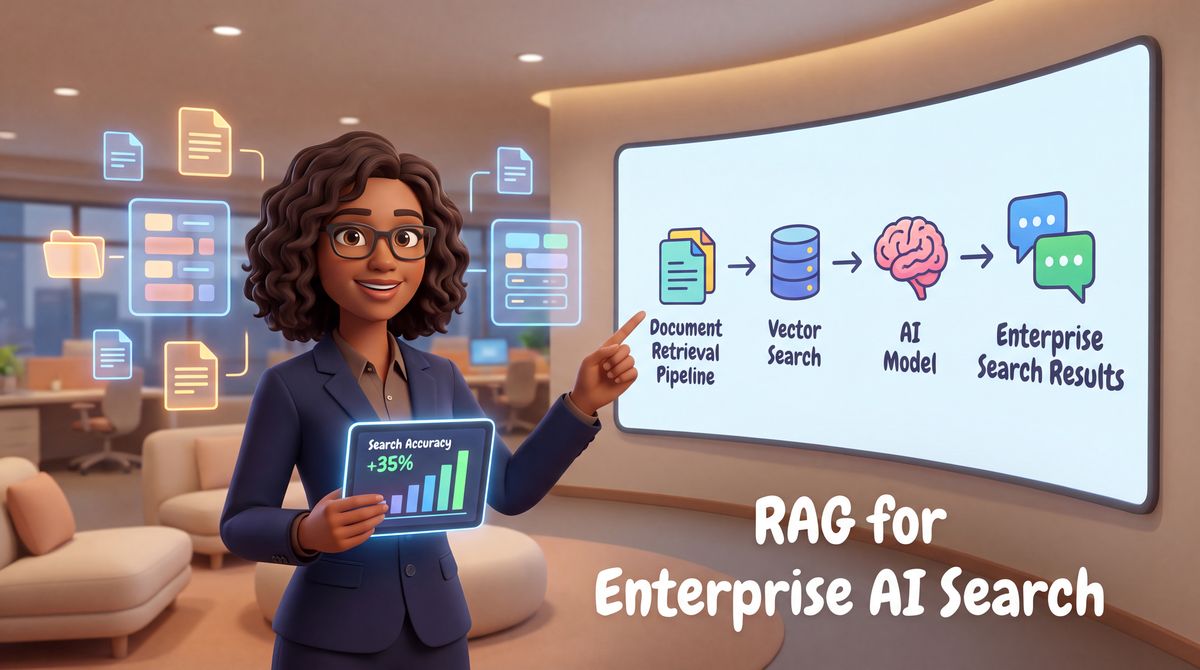
How RAG Works: The 4-Step Pipeline
Step 1: Document Processing
Your enterprise documents (PDFs, wikis, emails, databases) are split into chunks — typically 500-1000 tokens each. Each chunk is embedded into a high-dimensional vector using an embedding model (OpenAI text-embedding-3, Cohere embed-v3, or open-source alternatives like BGE). These vectors capture semantic meaning, enabling similarity-based retrieval.
Step 2: Vector Storage
Embeddings are stored in a vector database (Pinecone, Weaviate, Qdrant, pgvector). The database supports fast approximate nearest neighbor search, retrieving the most semantically similar chunks to any query in milliseconds.
Step 3: Retrieval
When a user asks a question, the query is embedded using the same model. The vector database retrieves the top-K most similar chunks. Advanced implementations add:
- Hybrid search: Combine semantic and keyword search for better recall
- Re-ranking: Use a cross-encoder to re-rank retrieved chunks by relevance
- Query expansion: Rewrite the user query to improve retrieval accuracy
Step 4: Generation
Retrieved chunks are inserted into the LLM prompt as context. The model generates an answer grounded in those chunks, with citations pointing back to source documents. This is where the magic happens — the model synthesizes information across multiple documents, answers complex questions, and produces coherent, accurate responses.
RAG vs Traditional Enterprise Search
Traditional enterprise search (Elasticsearch, SharePoint search, Google Workspace search) relies on keyword matching. It returns documents; the user reads them. RAG returns answers — synthesized, contextualized, and cited.
| Dimension | Keyword Search | RAG |
|-----------|----------------|-----|
| Output | Document list | Synthesized answer |
| Accuracy | Depends on user query skill | Semantic understanding |
| Speed to insight | User reads 5-10 documents | Instant answer with citations |
| Multi-document synthesis | Manual | Automatic |
| Follow-up questions | New search each time | Conversational context |
The productivity difference is dramatic. Knowledge workers spend 20-30% of their time searching for information. RAG-powered search reduces that by 40%, freeing up roughly one full day per week per employee.
!Infographic showing 40% faster search and 65% fewer errors with RAG-powered enterprise AI search
Implementation: Build vs Buy
Most enterprises shouldn't build RAG from scratch. The infrastructure (vector databases, embedding pipelines, re-ranking models) is commoditized. What matters is:
1. Data quality: RAG is only as good as your knowledge base. Clean, structured, up-to-date documents are essential.
2. Chunking strategy: How you split documents affects retrieval quality. Use semantic chunking (split by topic) rather than fixed-length chunks.
3. Embedding model choice: Match the model to your language and domain. Multilingual embeddings for international teams, domain-specific models for legal or medical content.
4. Retrieval tuning: Top-K value, re-ranking, and hybrid search ratios all need calibration against your specific document set.
Common RAG Pitfalls to Avoid
- Stale data: Vector databases need refresh pipelines. If your knowledge base updates but embeddings don't, RAG returns outdated answers.
- Poor chunking: Chunks that split mid-sentence or mid-table produce garbage retrieval. Invest in intelligent chunking.
- No fallback: When RAG retrieves nothing relevant, the model should say "I don't know" — not hallucinate. Build explicit empty-retrieval handling.
- Ignoring access control: RAG must respect document permissions. A user shouldn't retrieve chunks from documents they can't access.
The Future of Enterprise Knowledge
RAG is becoming the default interface for enterprise knowledge. Instead of navigating folder structures, employees ask questions and get grounded answers. Instead of reading 10-page reports, they get synthesized insights with citations. The shift is as fundamental as the move from physical filing cabinets to digital search — and it's happening now.
For enterprises, the question isn't whether to implement RAG, but how quickly they can do it well.