From RPA to AI Agents: The Next Evolution of Enterprise Automation
By Delos Intelligence — 2026-07-04
RPA is dying. AI agents are taking over. Learn why intelligent automation replaces rule-based bots, the ROI difference, and how enterprises are transitioning.
The End of Rule-Based Automation
Robotic Process Automation (RPA) transformed enterprise operations over the past decade. By 2023, the RPA market reached $2.9 billion, with companies like UiPath, Automation Anywhere, and Blue Prism promising to eliminate repetitive work through software bots.
But RPA has a fundamental limitation: it only works when processes are perfectly predictable. Every step must be explicitly programmed. Every exception requires human intervention. When a form changes, a system updates, or a process varies, RPA bots break — and maintenance costs skyrocket.
The average enterprise maintains 200-500 RPA bots, with 30-40% requiring fixes each month due to system changes. The maintenance burden has become unsustainable.
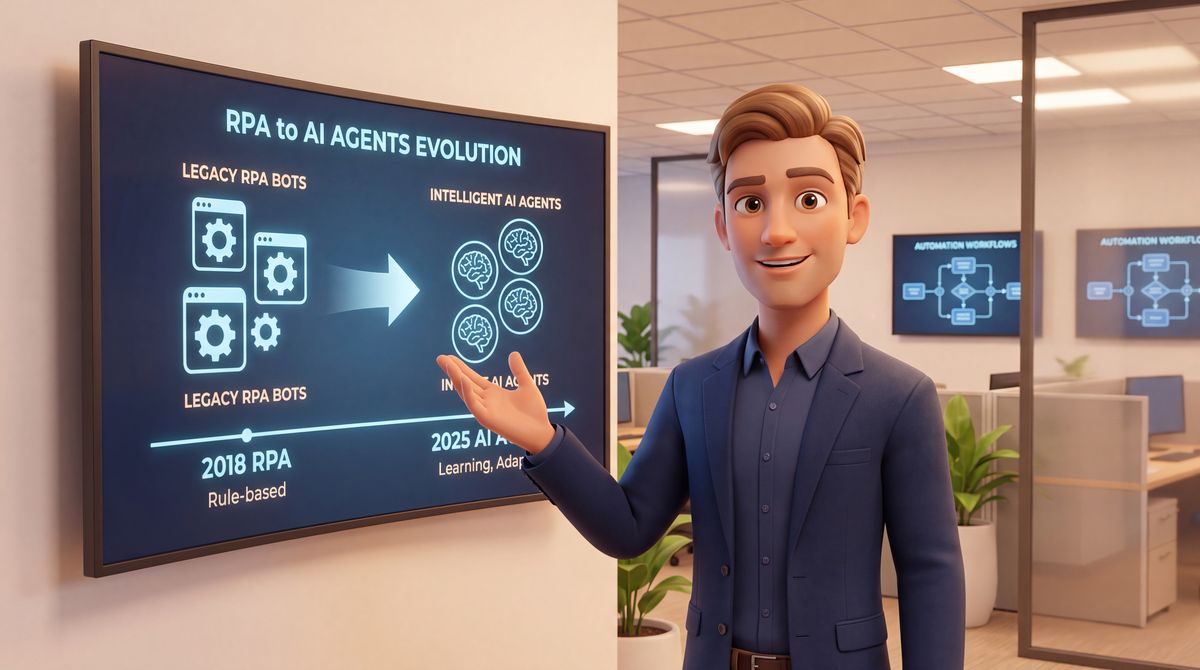
Why AI Agents Are Different
AI agents represent a paradigm shift in automation. Instead of following rigid rules, they understand goals, make decisions, and adapt to changing conditions. Here's what changes:
Understanding vs Rules
RPA bots follow if-then rules: "If email contains 'invoice', extract attachment, save to folder X." AI agents understand intent: "Process this invoice" — and they figure out the steps, even if the email format changes or the invoice arrives via a different channel.
Adaptability
When a UI element moves or a form adds a new field, RPA bots fail. AI agents adapt — they re-read the page, identify the new layout, and continue. This resilience reduces maintenance by 70-80% compared to RPA.
Unstructured Data
RPA requires structured inputs — forms, spreadsheets, databases. AI agents process unstructured data: emails, PDFs, images, conversations. This unlocks automation for the 80% of enterprise work that RPA can't touch.
Decision-Making
RPA bots execute; humans decide. AI agents can make intermediate decisions within defined guardrails — approving expenses under a threshold, routing documents based on content, escalating edge cases. This reduces human touchpoints by 60-70%.
The ROI Shift
The economics of AI agents vs RPA are fundamentally different:
| Metric | RPA | AI Agents |
|--------|-----|-----------|
| Implementation time | 8-12 weeks per bot | 1-2 weeks per agent |
| Monthly maintenance | 30-40% of bots need fixes | 5-10% need adjustments |
| Process coverage | Structured tasks only | Structured + unstructured |
| Average ROI | 200-300% | 500-800% |
| Time-to-value | 3-6 months | 2-4 weeks |
!Infographic showing AI agent automation ROI: 70% task reduction, 5x faster processes
The ROI difference stems from two factors: lower maintenance costs and broader process coverage. RPA automates 20-30% of enterprise processes. AI agents can automate 60-70%.
Migration Strategy: Don't Rip and Replace
Enterprises with heavy RPA investments shouldn't abandon their bots overnight. The winning strategy is hybrid:
1. Audit your RPA estate: Categorize bots by stability. Stable bots processing structured data can stay as RPA. Fragile bots that break frequently are prime candidates for AI agent replacement.
2. Start with high-maintenance bots: These cost the most to maintain and deliver the least value. Replacing them with AI agents delivers immediate ROI through reduced maintenance.
3. Expand to unstructured processes: Once your team is comfortable with AI agents, target processes RPA couldn't handle — document processing, email triage, customer inquiry routing.
4. Build a unified orchestration layer: Manage both RPA bots and AI agents from a single control plane. This gives you visibility across your entire automation estate and lets you migrate gradually.
Real-World Example: Invoice Processing
A mid-size manufacturing company processed 15,000 invoices per month with 12 RPA bots. The bots handled structured PDFs but failed on emailed invoices, scanned documents, and non-standard formats — 40% of total volume required manual processing.
After deploying AI agents:
- 95% of invoices processed automatically (up from 60%)
- Bot maintenance reduced from 20 hours/month to 3 hours/month
- Processing time dropped from 2 days to 4 hours
- Annual savings: €340,000 (including reduced maintenance and increased throughput)
The Future: Autonomous Enterprise Operations
The trajectory is clear. AI agents are moving from task automation to process orchestration — coordinating multiple systems, making decisions, and learning from outcomes. Within 3-5 years, most enterprise processes will be agent-managed, with humans setting policies and handling exceptions.
RPA won't disappear entirely. Highly stable, structured processes will remain automated with rules. But for everything else — the messy, variable, unstructured 80% of enterprise work — AI agents are the future.
The enterprises that start this transition now will have a 2-3 year operational advantage over those that wait. The question isn't if, but how fast you can move.