Shadow AI in the Enterprise: How to Detect and Manage Unauthorized AI Tools
By Delos Intelligence — 2026-08-10
78% of knowledge workers use AI tools at work, 70% unsanctioned. Learn how to detect Shadow AI, manage the risks, and provide secure alternatives.
The Problem Hiding in Plain Sight
Your marketing team is pasting customer data into ChatGPT to draft case studies. Your developers are using GitHub Copilot without IT approval. Your HR team is feeding résumés into an unvetted AI screening tool they found on Product Hunt.
This is Shadow AI — the use of AI tools and services by employees without the knowledge, approval, or oversight of IT, security, or compliance teams. And it is happening in your organization right now.
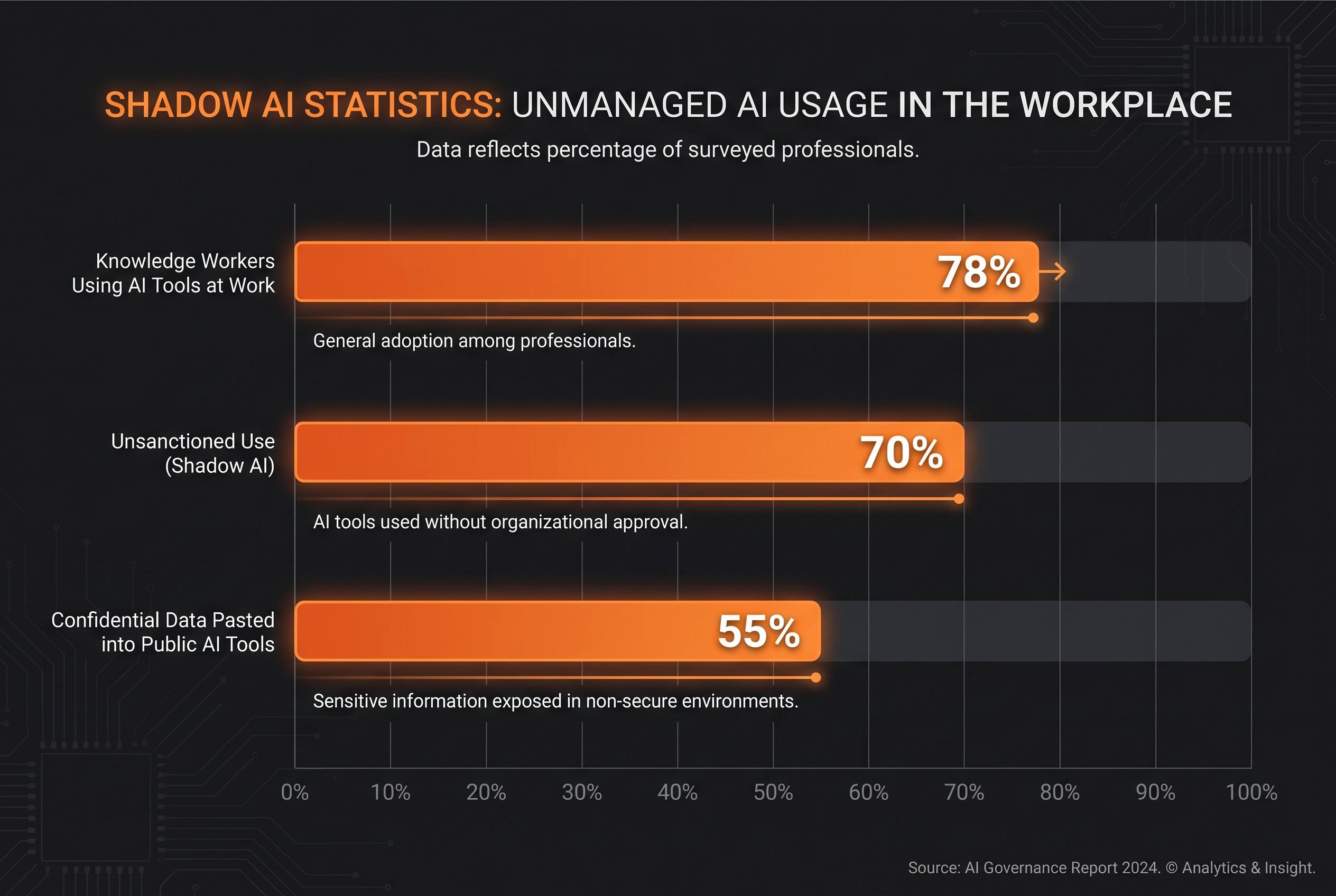
A 2026 Cisco study found that 78% of knowledge workers use AI tools at work. Of those, 70% use tools that their IT department has not approved. More alarmingly, 55% admit to pasting confidential company data into public AI tools — customer information, source code, financial data, and strategic plans.
The problem is not that employees are careless. The problem is that sanctioned AI tools are either unavailable, too slow to procure, or too restrictive. So employees find their own solutions. They are trying to do their jobs better and faster. But in doing so, they are exposing your organization to data leakage, compliance violations, and intellectual property risks.
The Real Risks of Shadow AI
Shadow AI is not a hypothetical concern. The risks are concrete, documented, and escalating.
Data leakage. When an employee pastes a customer list into ChatGPT, that data leaves your controlled environment. It may be stored, used for training, or exposed in a future model output to a different user. OpenAI, Anthropic, and Google have all faced questions about training data retention. You cannot guarantee that your data comes back.
Compliance violations. Under the GDPR, the EU AI Act, and CCPA, organizations are responsible for how personal data is processed — even when employees do it without authorization. A single employee pasting customer PII into an unsanctioned AI tool can trigger a data breach notification obligation. The fines: up to 4% of global annual revenue under GDPR.
Intellectual property exposure. When developers use unapproved AI coding tools, proprietary codebases may be uploaded to external servers. A 2025 Stack Overflow survey found that 42% of developers use AI coding assistants that are not sanctioned by their employer. The code they paste into these tools may resurface in suggestions to other users.
Security gaps. Unsanctioned AI tools do not go through your security review. They may have vulnerabilities, poor data handling practices, or inadequate access controls. They expand your attack surface without your knowledge.
No audit trail. When AI usage is invisible to IT, there is no log of what was asked, what data was shared, and what was generated. If a regulator asks "show us how AI is used in your organization," you cannot answer.
!Shadow AI statistics: usage and risk levels
How to Detect Shadow AI in Your Organization
You cannot manage what you cannot see. Detection is the first step.
Network traffic analysis. Monitor outbound traffic to known AI service endpoints (api.openai.com, anthropic.com, bard.google.com, copilot.github.com). Firewall logs and DNS queries reveal which AI services your employees are using, even if they access them through personal accounts. A 2026 study by Netskope found that 92% of organizations have employees accessing unsanctioned AI services through corporate networks.
API key scanning. Scan your code repositories and internal tools for hardcoded API keys to AI services. A single API key in a GitHub repo is evidence of unsanctioned AI usage — and a security vulnerability in itself.
Employee surveys. Ask your employees directly. An anonymous survey asking "Which AI tools do you use for work?" will surface 3-5x more tools than network monitoring alone. Employees are honest when they are not afraid of punishment. Frame the survey as discovery, not surveillance.
SaaS inventory audit. Review your expense reports for reimbursements to AI tool subscriptions. Check your SSO logs for applications that employees have connected their work accounts to. Shadow AI often leaves a financial trail.
Endpoint monitoring. Deploy agent-based monitoring that detects AI tool installations and browser-based AI usage. This catches tools that operate through personal accounts and don't touch your network.
The 5-Step Framework to Manage Shadow AI
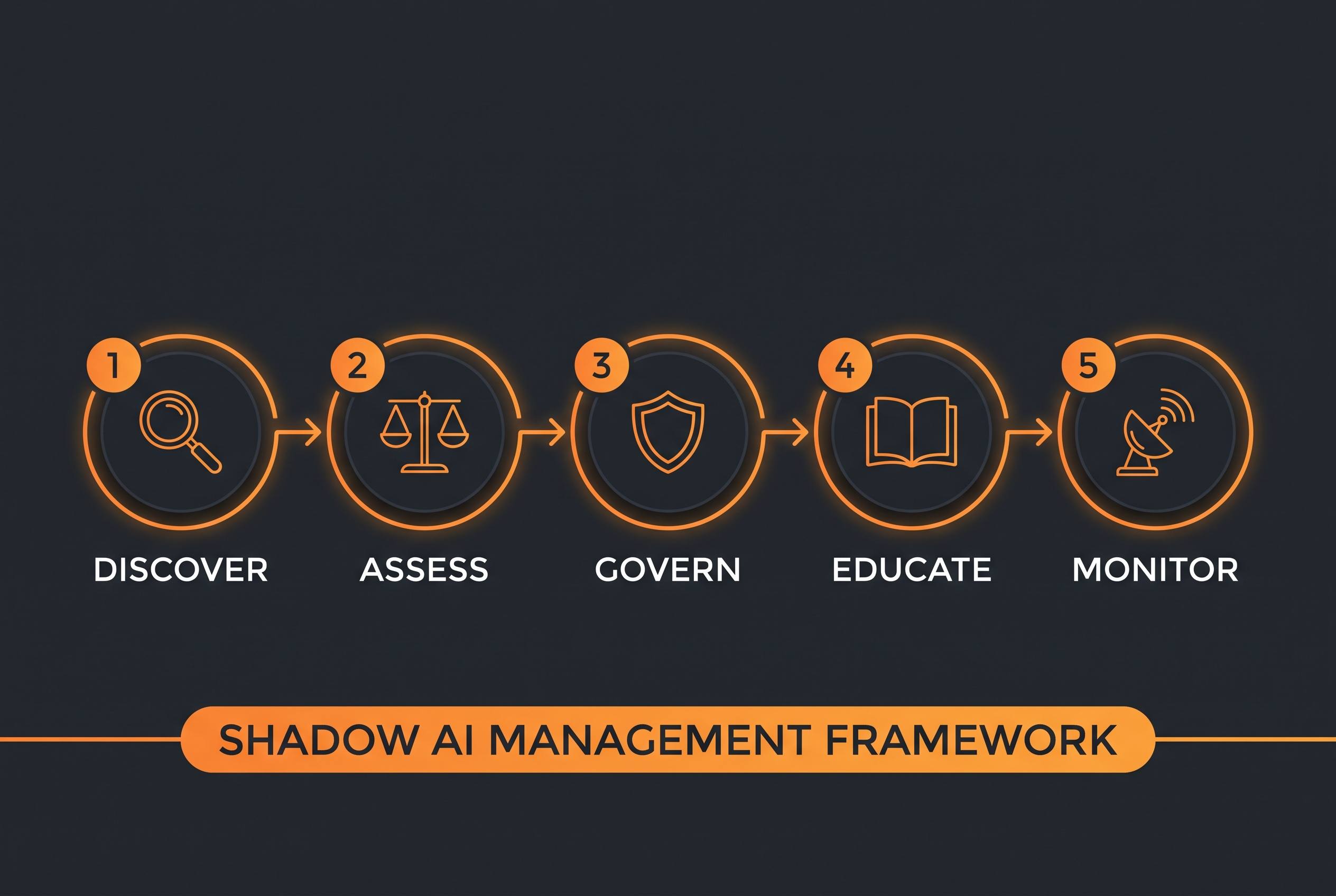
Detection is not enough. You need a framework that turns visibility into governance.
!5-step Shadow AI management framework
Step 1: Discover
Map every AI tool in use across the organization. Combine network monitoring, API key scanning, employee surveys, and SaaS audits. Build a living inventory: tool name, vendor, data types handled, number of users, business purpose. Update it quarterly.
Step 2: Assess
For each tool, assess the risk level. Key questions: What data does it handle? Where is data stored? Does the vendor train on customer data? Is it compliant with GDPR, CCPA, and your internal policies? Is there a data processing agreement (DPA) in place?
Classify tools into three tiers:
- Approved: Low risk, compliant, with DPA — deploy organization-wide
- Conditional: Medium risk — allow with restrictions (e.g., no PII, no source code)
- Prohibited: High risk, no DPA, trains on customer data — block and provide alternatives
Step 3: Govern
Create a clear AI usage policy. It should answer three questions: Which AI tools are approved? What data can be shared with them? What is the approval process for new tools? Make the policy short, accessible, and practical — not a 40-page legal document that nobody reads.
Establish an AI governance committee with representatives from IT, security, legal, and business units. New AI tool requests should be reviewed within 5 business days, not 5 months. Speed of approval is the best defense against Shadow AI.
Step 4: Educate
Most Shadow AI usage stems from ignorance, not malice. Employees use ChatGPT because it is useful, not because they want to violate policy. Train your teams on the risks, the approved tools, and the alternatives.
A 2026 Microsoft study found that organizations with AI training programs saw a 60% reduction in unsanctioned AI usage. Education works. But it must be ongoing — not a one-time slideshow during onboarding.
Step 5: Monitor
Continuously monitor AI usage. Set up alerts for new unsanctioned tools. Reassess approved tools quarterly — vendors change their terms, and a tool that was safe in January may not be safe in July.
Publish a quarterly "AI usage report" to leadership showing approved vs. unsanctioned usage trends. Transparency drives accountability.
The EU AI Act and Shadow AI
The EU AI Act, fully enforced from August 2026, creates new obligations that make Shadow AI management a legal requirement, not just a best practice.
Transparency obligations. Organizations must be able to disclose how AI is used in their operations. If you cannot account for the AI tools your employees use, you cannot meet this obligation.
Risk classification. AI systems are classified by risk level: unacceptable, high, limited, minimal. Employees using unsanctioned high-risk AI systems (e.g., AI for hiring decisions, credit scoring) without the required conformity assessments expose the organization to fines up to €35 million or 7% of global revenue.
Data governance. The Act requires that training, validation, and testing data meet quality and governance standards. If your data is being used to train unsanctioned tools without your knowledge, you have lost control of your data governance.
The message is clear: under the EU AI Act, ignorance of Shadow AI is not a defense. You are responsible for the AI tools used in your organization, whether you approved them or not.
How Enterprise AI Platforms Provide a Sanctioned Alternative
The most effective way to reduce Shadow AI is not to ban it — it is to provide a better, sanctioned alternative.
Enterprise AI platforms like Workers Delos offer AI workers that are:
- Governed: Every AI worker operates within an approved framework with clear permissions and audit logs
- Secure: Data is encrypted, isolated, and never used for model training
- Compliant: Built to meet GDPR, CCPA, SOC 2, and EU AI Act requirements
- Auditable: Every action, every data access, every output is logged
- Fast to deploy: A new AI worker can be deployed in minutes, not months
When employees have access to powerful, sanctioned AI tools that are easy to use and genuinely useful, the incentive to seek unsanctioned alternatives disappears. The best Shadow AI policy is a great sanctioned AI offering.
The Bottom Line
Shadow AI is not going away. The question is whether you will manage it proactively or reactively. The organizations that detect, assess, govern, educate, and monitor their AI usage will turn a risk into a competitive advantage. The ones that ignore it will face data breaches, compliance fines, and the slow erosion of data control.
Start with discovery. Find out what is already happening in your organization. Then build the framework, educate your teams, and provide sanctioned alternatives. The cost of action is small. The cost of inaction is a data breach you did not see coming.
---
Ready to replace Shadow AI with sanctioned, secure AI workers? Explore Workers Delos and deploy your first governed AI worker in minutes.