AI Claims Processing: How Insurers Cut Claims Handling Time by 70% with Automated Workflows
Par Delos Intelligence — 2026-07-30
Manual claims processing takes 32+ days. AI cuts it by 70%, detects $308B in fraud, and lifts customer satisfaction. Here's how insurers are transforming claims.
The Claims Processing Bottleneck: Why Insurers Are Turning to AI
The insurance industry is sitting on a paradox. Claims volumes are rising, customer expectations for speed have never been higher, yet the average property claim still takes 32.4 days from filing to resolution.
- Claims handlers spend roughly 30% of their time on low-value administrative tasks
- Only 7% of claims can be ingested via straight-through processing in traditional rules-based systems
- Claims costs have been rising at rates significantly above inflation (McKinsey: Aviva 6% above CPI in 2019, on track to 11% by 2023)
- The industry loses an estimated $308.6 billion annually to fraudulent claims
The Cost of Inaction
When claims take weeks instead of minutes, insurers pay in three ways: operational costs balloon, customer churn accelerates (J.D. Power: digital-first claims score 871/1000 satisfaction), and fraud leakage goes undetected.
How AI Automates the End-to-End Claims Lifecycle
!Claims processing time: Manual vs AI by stage
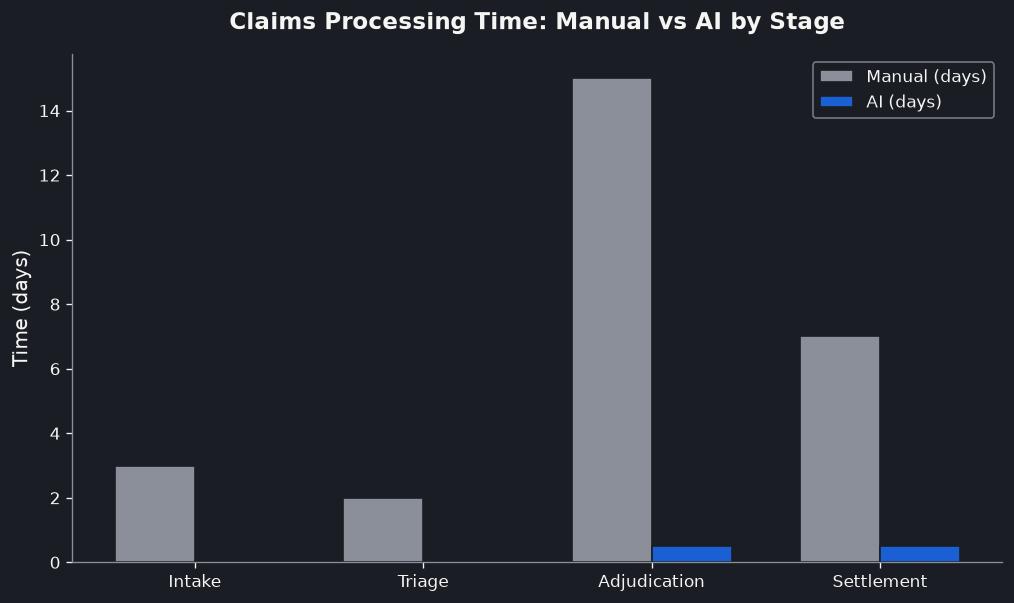
1. Intake: From Days to Minutes
AI-powered intake uses NLP and computer vision to extract relevant data instantly from photos, scanned documents, and emails. Shift Technology reports a large US travel insurer went from 0% to 57% automation, cutting processing time from three weeks to minutes.
2. Triage: Smart Routing Without Human Intervention
AI triage engines assess complexity, urgency, and risk. Low-complexity claims route to straight-through processing. High-complexity claims are flagged and assigned to the right adjuster with a pre-populated summary.
3. Adjudication: AI-Augmented Decision-Making
Machine learning models assess coverage, estimate damages, and recommend settlement amounts with 95%+ accuracy. Research published in 2025 found ML algorithms process routine claims with 99.4% accuracy while reducing adjudication time by 76%.
4. Settlement and Recovery
AI accelerates payment processing and identifies subrogation opportunities that manual review would miss. One top-5 P&C insurer used GenAI to detect a subrogation opportunity that would normally have been overlooked.
Key Benefits: Speed, Fraud Detection, and Customer Satisfaction
!Fraud detection performance: Manual vs AI
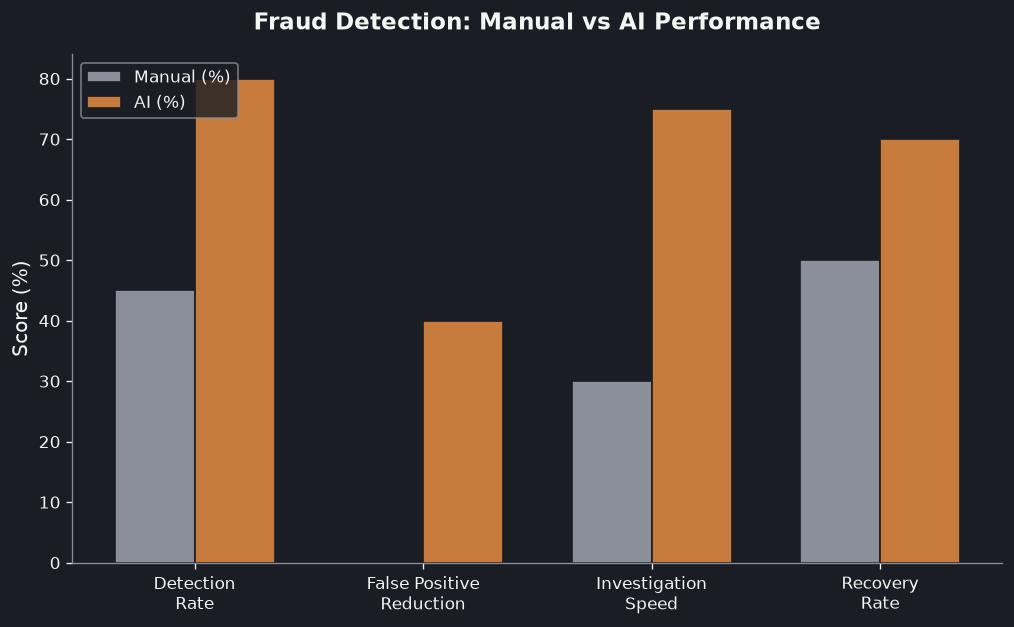
Processing Speed: The 70% Reduction
BCG analysis finds AI reduces claims processing time by 50% and enables real-time resolution in up to 70% of simple cases. McKinsey estimates more than 50% of claims activities could be automated by 2030.
Fraud Detection: $308 Billion at Stake
AI-powered fraud detection analyzes patterns invisible to human reviewers: photo similarity scoring, network analysis, and real-time anomaly scoring. Insurers report 35% better detection rates and 50% faster investigations.
Customer Satisfaction: The Digital Expectation
87% of Gen Z and Millennial customers prefer managing claims entirely online. Speed of settlement is the single biggest driver of claims satisfaction — cited by 60% of dissatisfied claimants as their primary frustration.
Adoption Statistics
- 76% of insurance companies have implemented generative AI (2025 data)
- 80% of insurers expected to adopt generative AI by end of 2025
- Insurance AI fraud detection market: $7.17B in 2025 → $22.78B by 2030 (26% CAGR)
- 96% of insurers now employ anti-fraud technologies
Swiss Re's ClaimsGenAI and Aviva's 80+ AI models across claims demonstrate that AI claims processing works at enterprise scale.
Implementation: A Practical Roadmap
Stage 1: Data Readiness
Audit your claims data — structured and unstructured. Clean, label, and centralize.
Stage 2: Start with Triage and Intake
Automate intake using NLP and computer vision. Target the 30% of adjuster time spent on document review.
Stage 3: Layer in Decision Support
Add AI-powered adjudication for low-complexity, high-volume claims. Keep human-in-the-loop for complex cases.
Stage 4: Expand to Fraud and Recovery
Deploy AI fraud detection and subrogation identification. Every dollar invested in fraud prevention returns an estimated $7 in savings.
The Bottom Line
AI claims processing has crossed from emerging technology to competitive necessity. The insurers winning today take a pragmatic, phased approach: starting with intake automation, layering in decision support, and expanding to fraud detection and recovery.
Sources: McKinsey — AI in Insurance · Swiss Re — ClaimsGenAI