Gestion de la Propriete Intellectuelle par IA : Comment les Entreprises Protegent leur Innovation 3x Plus Vite
Par Delos Intelligence — 2026-08-04
AI IP management cuts patent filing time by 61%, automates prior art searches, and protects enterprise innovation portfolios. Enterprises report 40% reduction in IP legal costs.
The IP Management Problem: Why 70% of Enterprise Innovation Goes Unprotected
In 2026, enterprises file over 3.5 million patent applications globally each year. The average patent takes 18 months to draft and file, costs $15,000 to $50,000 per application, and requires hundreds of hours of manual prior art searches. For companies managing portfolios of 500+ active patents, the operational burden is staggering.
AI intellectual property management is changing this equation. Enterprises using AI-powered IP tools report 61% faster patent filing, 40% reduction in IP legal costs, and 3x improvement in portfolio decision-making speed.
Most enterprises capture less than 30% of their internally generated innovations as formal IP. The reasons are structural: invention disclosure gaps (engineers rarely document innovations in IP-ready formats), prior art search limitations (manual searches miss 25% of relevant references), portfolio blind spots (no visibility into which patents generate value), and competitive intelligence lag (competitor patents discovered 18 months after filing).
The cost of inaction: enterprises lose an estimated $2.4 million annually in unrealized IP value per $100M of R&D spend.
How AI Transforms the IP Lifecycle
!AI Intellectual Property Management Pipeline
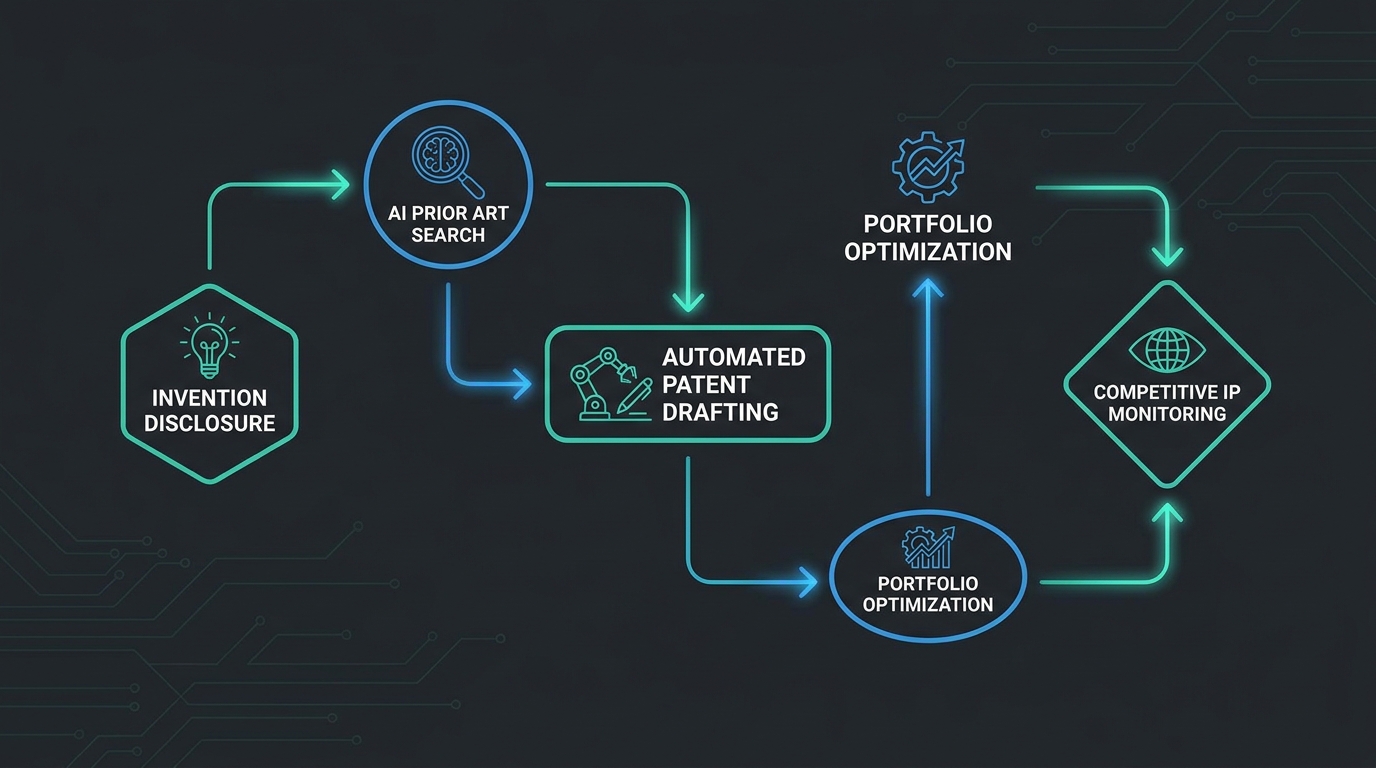
AI intellectual property management applies NLP, machine learning, and predictive analytics across five core stages:
1. Automated Invention Disclosure
AI-powered disclosure tools use NLP to scan engineering wikis, commit messages, technical documentation, and meeting notes to identify potentially patentable inventions automatically. Enterprises report a 47% increase in invention disclosures without additional burden on R&D teams.
2. AI Prior Art Search
Traditional prior art searches are manual, time-intensive, and limited by language capabilities. AI-powered search processes 140 million+ patent documents across 100+ languages in seconds using semantic search.
!Patent Filing Time Reduction: Before AI vs With AI
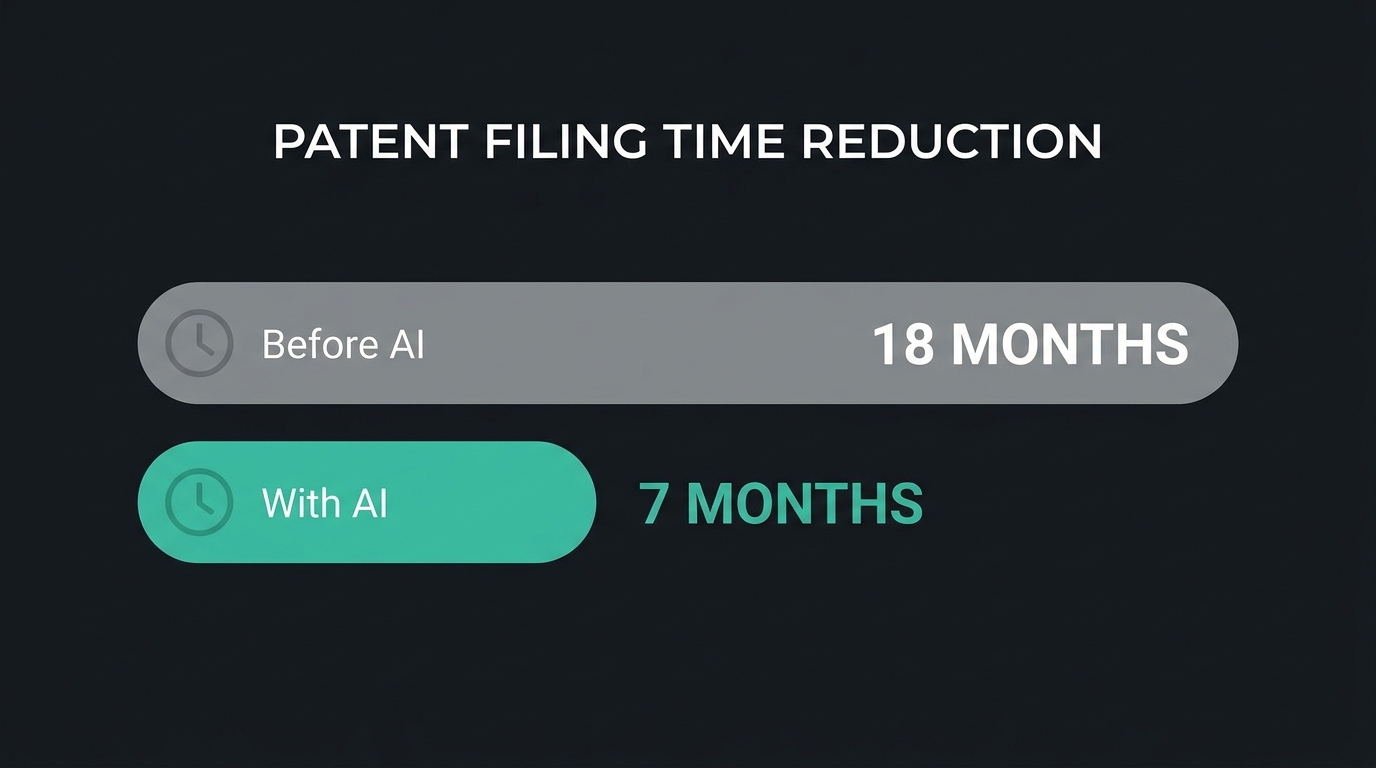
AI prior art searches reduce search time from 40-80 hours to 2-4 hours, with 94% recall rate vs 75% for manual searches. This means fewer office actions, fewer rejections, and faster grants.
3. Automated Patent Drafting
AI-assisted drafting generates initial patent application drafts from invention disclosures — claims, specifications, and drawing descriptions. The drafting phase drops from weeks to days. Key capabilities: claim generation, specification drafting, and drawing identification.
4. Portfolio Optimization
AI analyzes entire patent portfolios: which patents generate licensing revenue, which are dead weight, where white-space opportunities exist. Deliverables include valuation scoring, pruning recommendations (saving $4,000-$12,000 per abandoned patent in maintenance fees), and competitive gap analysis.
5. Competitive IP Intelligence
AI monitors competitor patent filings in real-time across all jurisdictions. Instead of discovering a competitor's patent 18 months after filing, enterprises receive alerts when related applications appear — enabling proactive counter-filing and design-around strategies.
Real-World Impact
Pharmaceutical Company: 73% Faster Drug Patent Filings
A top-20 pharma company with an 8,000-patent portfolio achieved: filing preparation time reduced from 14 weeks to 3.8 weeks, prior art search costs cut by $1.2M annually, 340 low-value patents identified for abandonment saving $2.8M in maintenance fees, and 23 white-space opportunities identified.
Technology Manufacturer: $18M in Avoided IP Loss
A global electronics manufacturer deployed AI competitive IP monitoring across 6 competitors. The system identified 47 patent applications overlapping with the product roadmap, enabling pre-grant opposition on 12 of them. Estimated value of IP conflicts avoided: $18M.
Automotive Supplier: 2.5x More Invention Disclosures
Invention disclosures increased from 180 to 450 per year without adding headcount, resulting in 89 additional patent filings and an estimated $12M in protected innovation value.
Implementation Roadmap
Phase 1 (Months 1-3): Start with AI-powered prior art search — fastest ROI, no workflow changes required.
Phase 2 (Months 3-6): Deploy automated invention disclosure scanning and AI-assisted drafting. Train R&D teams and establish patent attorney review workflows.
Phase 3 (Months 6-12): Implement portfolio optimization and competitive monitoring. Activate pruning recommendations and white-space analysis.
Phase 4 (Month 12+): Connect IP management with R&D planning, competitive strategy, and M&A due diligence.
Key Metrics to Track
- Disclosure capture rate: Target >60% of internal innovations formally disclosed
- Prior art search time: Target <8 hours per search
- Filing preparation time: Target <4 weeks from disclosure to filing
- Portfolio maintenance cost per patent: Target 15% YoY reduction
- Competitive patent detection lead time: Target <7 days from competitor filing to internal alert
The Bottom Line
AI intellectual property management is not about replacing patent attorneys — it is about giving them tools to work 3x faster, with better data, across larger portfolios. With global patent filings growing 5% annually and IP litigation averaging $3M per case, the question is not whether to adopt AI IP management, but how quickly you can deploy it before competitors do.
Enterprises that protect more innovation, spend less on low-value patents, and detect competitive threats months earlier have a compounding advantage: better IP positions mean stronger negotiating leverage, higher licensing revenue, and greater defensibility.