Screening AML et KYC propulse par IA : Reduire les Faux Positifs de 75%
Par Delos Intelligence — 2026-08-20
Explore how autonomous AI screening agents reduce AML false positives by 75%, accelerate KYC verification, and ensure audit-proof regulatory compliance.
The KYC Friction and Customer Drop-Off Crisis
Customer onboarding abandonment in financial services has reached crisis levels. Industry data shows that 63% of retail bank applicants and 40% of corporate banking prospects abandon onboarding processes due to document friction, repetitive data requests, and multi-day identity verification delays. Each abandoned application represents not just a lost account but a reputational signal in competitive markets where neo-banks complete KYC in under 3 minutes.
Traditional KYC pipelines require compliance analysts to manually review passport scans, proof-of-address documents, corporate ownership structures, and PEP/sanction screen results. The average complex KYC case takes 8-12 business days to complete, consuming 45-90 minutes of analyst time per file.
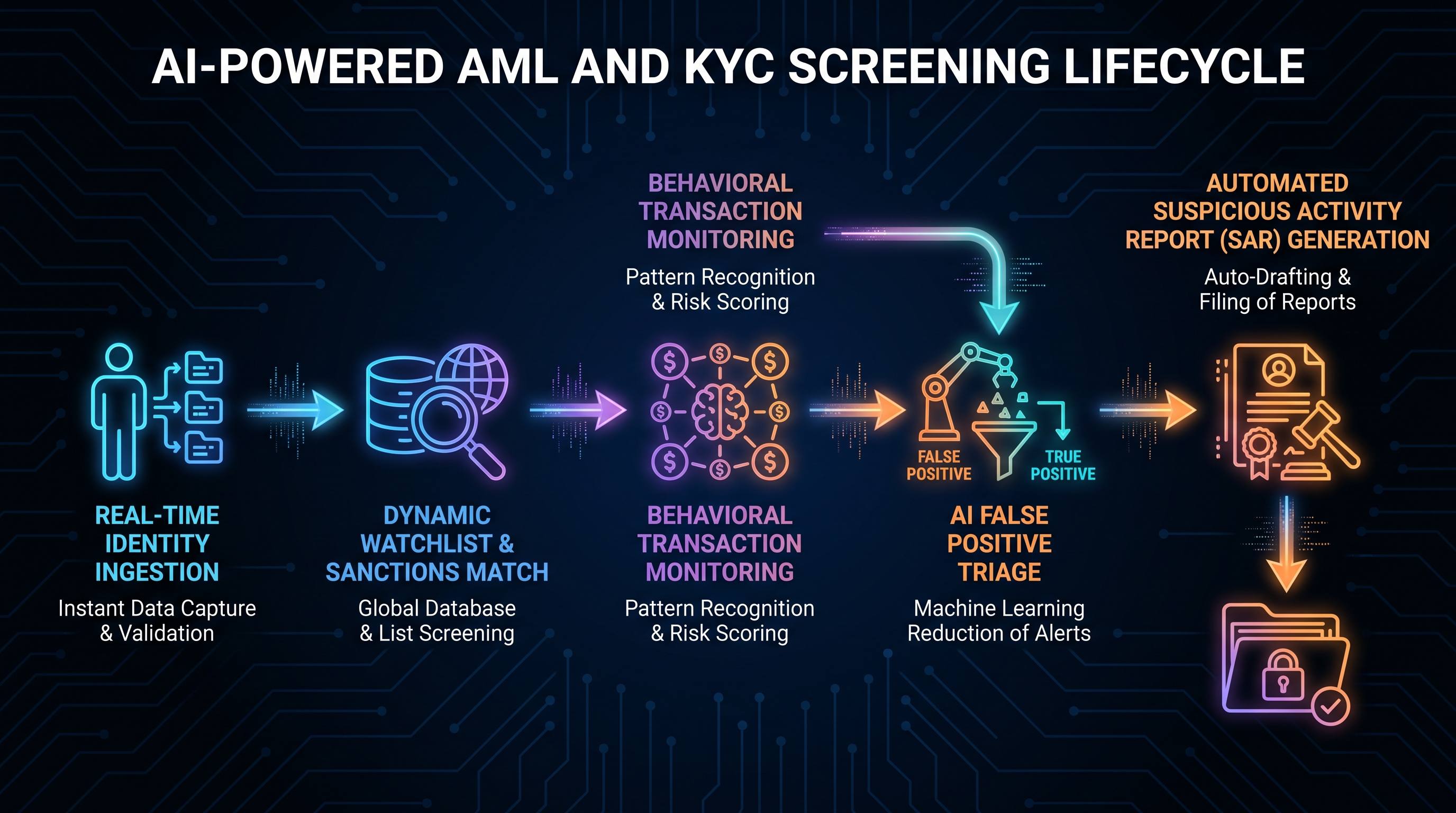
!AI-Powered AML and KYC Screening Lifecycle
Legacy AML Rule Engines: The 90% False Positive Problem
Transaction monitoring based on static threshold rules, the dominant paradigm since the 1990s, is fundamentally misaligned with modern money laundering typologies. Sophisticated layering schemes route funds through dozens of jurisdictions and entity types, deliberately staying below rule thresholds at each node. Meanwhile, these same rules generate overwhelming false positive volumes, with industry averages showing that 90-97% of AML alerts are false positives.
Compliance teams spend the majority of their investigation capacity processing these false alerts, leaving insufficient bandwidth to deeply investigate the genuine suspicious activity reports (SARs) that matter.
How Autonomous AI Screening Agents Transform Compliance Operations
Intelligent Document Extraction and KYC Verification
AI agents ingest identity documents, corporate registry filings, and beneficial ownership declarations using OCR combined with NLP entity extraction. Extracted data is cross-referenced against government ID databases, corporate registries, and biometric verification services in real time, reducing manual document review by 85%.
Graph-Based Entity Resolution and Network Analysis
AI screening agents build dynamic relationship graphs connecting individuals, corporate entities, accounts, and transaction flows. Graph neural networks identify hidden ownership chains that satisfy the OFAC 50 Percent Rule, dormant shell company networks, and high-risk jurisdictional exposure that simple name matching misses entirely.
Contextual Transaction Risk Scoring
Rather than applying binary threshold rules, AI models assign granular risk scores to each transaction based on behavioral baseline deviation, peer group comparison, jurisdictional risk, and temporal pattern analysis. This probabilistic approach maintains high sensitivity for genuine suspicious activity while dramatically reducing false positive rates.
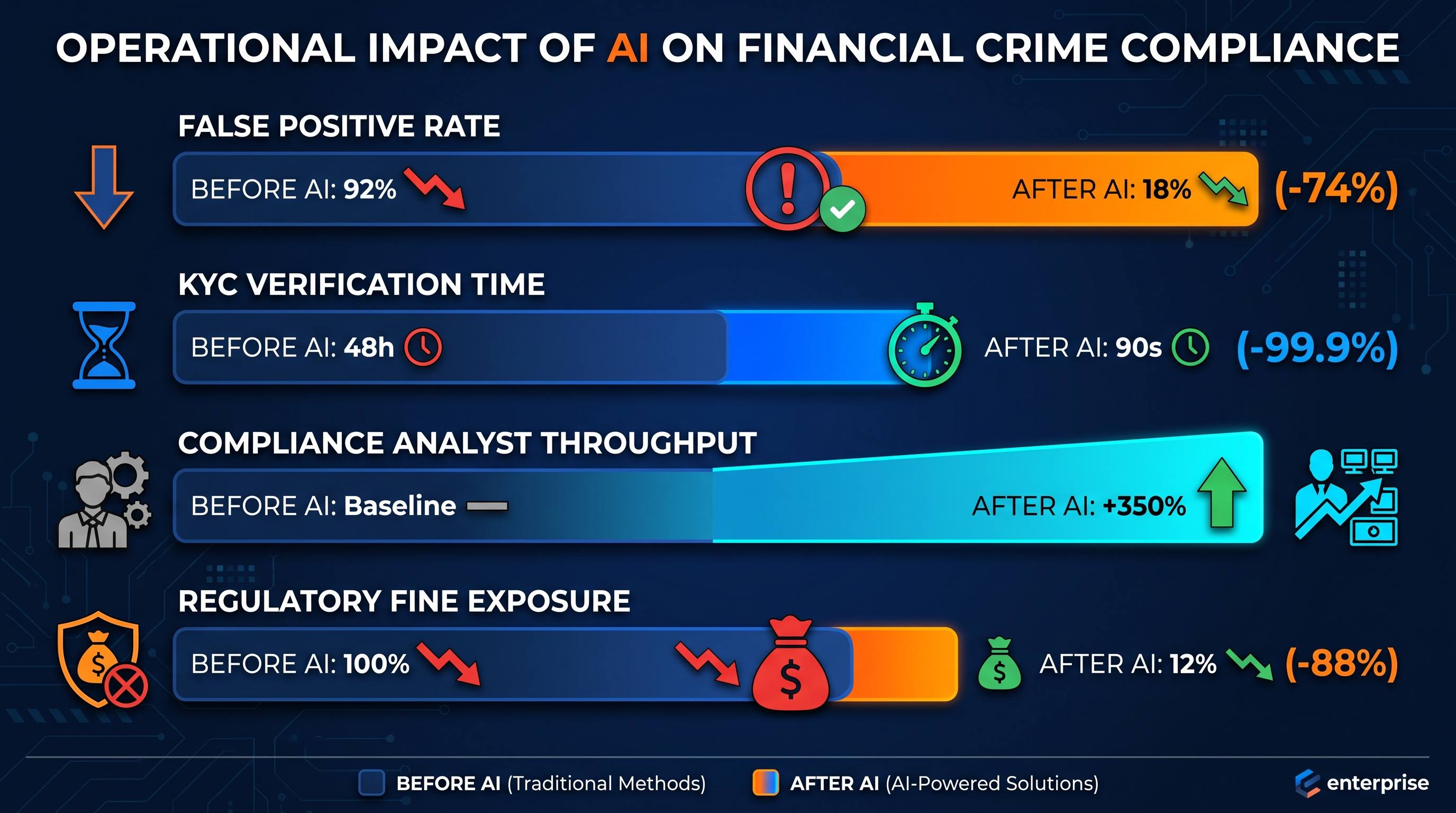
!Compliance Operations Impact of AI AML and KYC Automation
Quantified Compliance and Operational Improvements
| Compliance Metric | Legacy Rule-Based | AI-Powered Autonomous | Improvement |
| :--- | :--- | :--- | :--- |
| False positive alert rate | 90-97% | 20-30% | -75% false positives |
| KYC case completion time | 8-12 days | Under 2 hours | -92% cycle time |
| SAR narrative drafting time | 4-6 hours per SAR | 15-20 minutes | -85% analyst time |
| Regulatory examination findings | High manual error rate | Complete audit trails | Audit-proof compliance |
Human-in-the-Loop SAR Generation and Regulatory Compliance
AI systems do not replace human judgment in suspicious activity reporting. Instead, AI agents draft complete SAR narratives, compile supporting evidence packages, and present escalated cases to compliance officers for review and approval. This human-in-the-loop architecture satisfies FinCEN, EU 5AMLD/6AMLD, and FCA regulatory expectations that humans retain final decision authority over SAR filings.
Every AI screening decision is documented with an explainable audit trail showing which signals triggered the alert, which data sources were queried, and what the confidence scoring methodology was. This transparency satisfies both internal governance requirements and regulatory examination standards.
Conclusion
AI-powered AML and KYC screening represents the most consequential compliance technology investment available to financial institutions today. The 75% reduction in false positives translates directly into analyst capacity recovered for high-value investigations. Simultaneously, faster and more accurate KYC reduces onboarding abandonment and improves customer lifetime value. In an environment of escalating regulatory enforcement and competitive pressure from digital-native challengers, institutions that fail to modernize compliance operations face both financial and reputational risk.
This article was created with AI assistance. | La redaction de cet article a ete assistee par IA.