AI-Powered Claims Fraud Detection: How Insurers Catch 94% of Fraudulent Claims and Save $40M Annually
Par Delos Intelligence — 2026-08-12
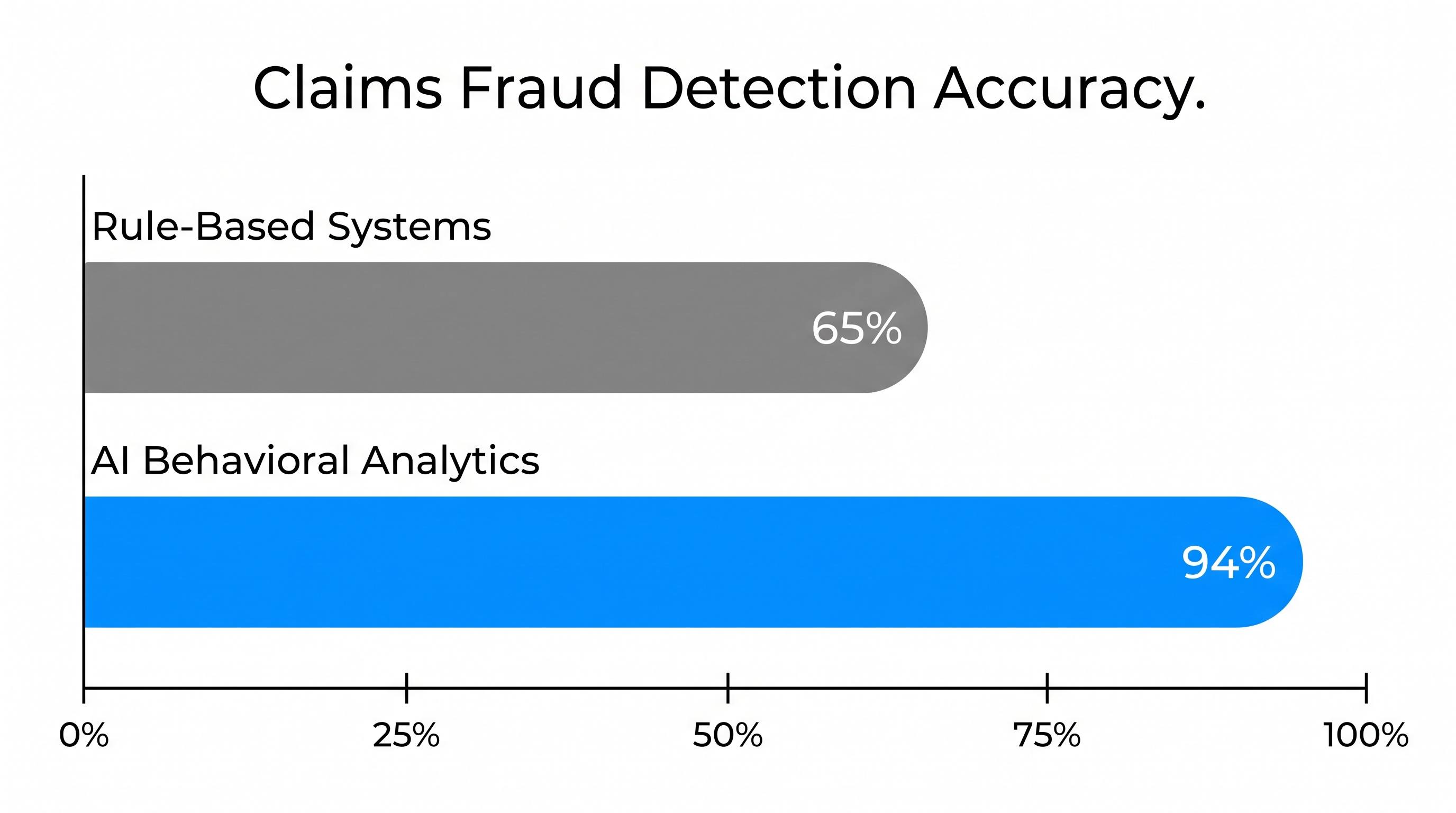
Insurance fraud costs $40B annually. Rule-based systems catch only 65% of it. AI behavioral analytics catches 94%, reduces false positives by 60%, and delivers ROI in under 6 months.
The Scale of Insurance Fraud
Insurance fraud costs the US economy $40 billion annually, according to the FBI. In Europe, the Association of British Insurers estimates fraud adds over 50 pounds per year to every household's insurance costs. Yet traditional rule-based detection systems, the fraud scoring models that most insurers still rely on, catch only 65% of fraudulent claims while generating false positive rates that waste investigator time and frustrate legitimate claimants.
The problem is architectural. Rules are static. Fraudsters adapt. A scheme that trips the system today is retired and replaced by a new variant tomorrow. The investigators who caught last year's fraud may be completely blind to this year's.
How AI Behavioral Analytics Changes the Equation
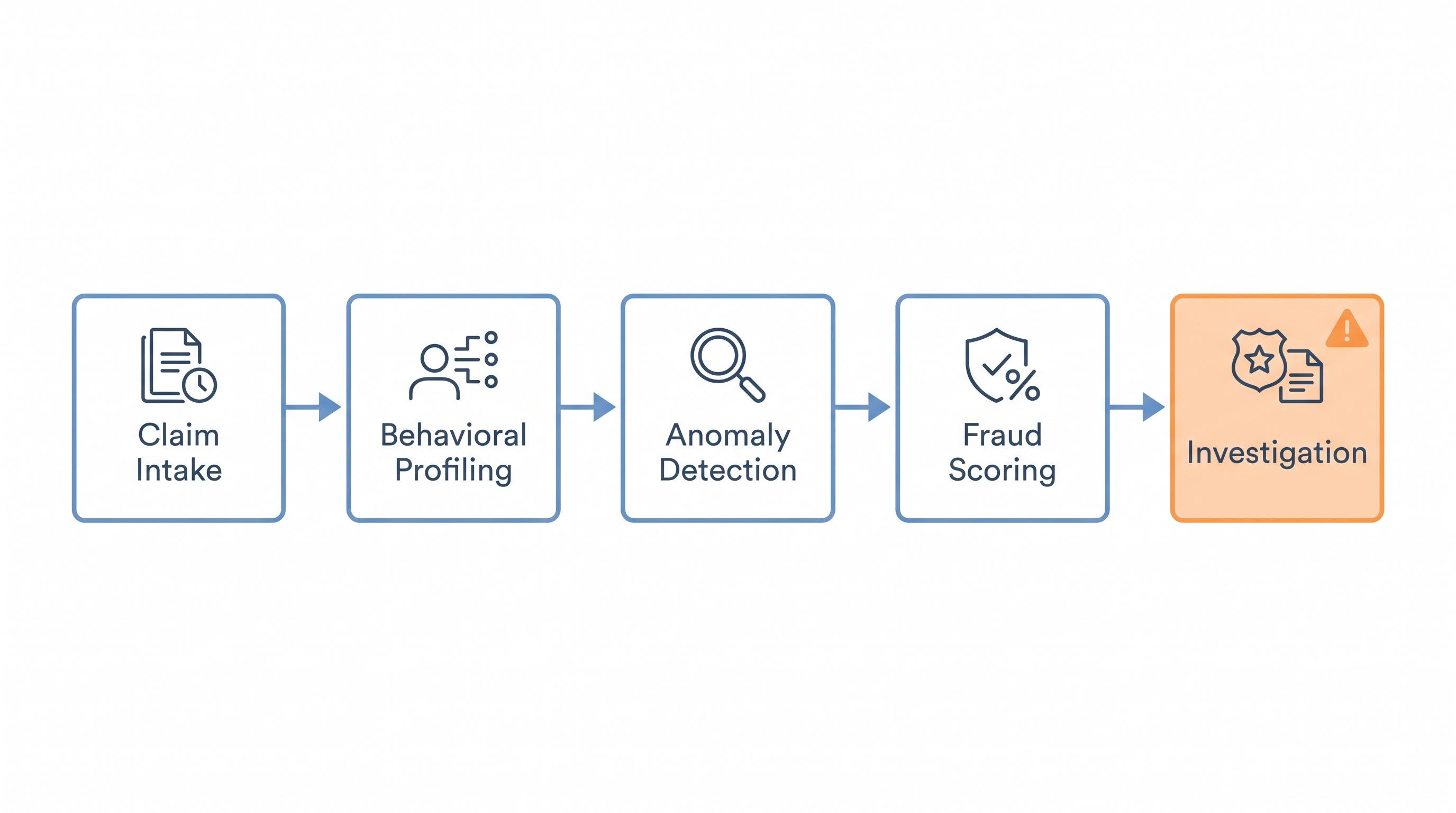
AI-powered claims fraud detection does not rely on rules. It builds a behavioral profile for every claimant, adjuster, body shop, medical provider, and attorney in the claims ecosystem, and it learns what normal looks like. Deviations from normal trigger investigation.
Pattern Recognition at Scale
AI models analyze hundreds of variables per claim simultaneously: claim timing relative to policy inception, historical claim frequency, geographic anomalies, the network of service providers involved, communication patterns, and dozens of other signals that no human investigator could monitor manually.
A claim filed 72 hours after policy purchase from a policyholder who also filed 3 claims in the prior 2 years, using a body shop that appears in 40% of flagged claims in that region, scores very differently from a claim filed by a 15-year customer after a documented accident.
!Claims Fraud Detection Rate: Rule-Based vs AI
Network Fraud Analysis
Some of the most expensive insurance fraud is organized: rings of staged accidents, corrupt medical providers, and attorney mills that systematically exploit claims processes. Individual claim analysis misses organized fraud because each claim appears legitimate in isolation.
AI network analysis maps the relationships between all parties in the claims process. When body shops, attorneys, medical providers, and claimants appear together repeatedly across claims, AI flags the cluster for investigation. This has proven critical for exposing personal injury protection fraud, which accounts for a disproportionate share of total fraud losses.
Behavioral Biometrics
AI systems now analyze the behavioral signals in how claimants interact with digital claims processes: typing patterns, mouse movements, session timing, and device fingerprinting. These signals are difficult to fake and provide early indicators of fraud even before the claim content is analyzed.
!AI Claims Fraud Detection Workflow
Continuous Model Retraining
Unlike static rules, AI models retrain continuously on new fraud case data. When investigators confirm a new fraud scheme, the model updates within days to catch similar schemes going forward. The system gets harder to fool over time, not easier.
The Numbers: What AI Delivers
Insurers deploying AI fraud detection report:
- 94% fraud detection accuracy, compared to 65% with rule-based systems
- 60% reduction in false positives, freeing investigators to focus on genuine fraud
- 40% reduction in average claim settlement cost through faster identification and denial of fraudulent claims
- $40M average annual savings for a mid-size commercial insurer
- Return on investment under 6 months for mature deployments
A major auto insurer deployed AI behavioral analytics across its personal lines claims. In the first year, the system flagged $52M in suspicious claims that were subsequently confirmed as fraudulent, against a platform cost of $2.1M. The program also reduced average investigation time per flagged claim from 9 days to 2 days.
Implementation Framework
Phase 1: Data Integration (Weeks 1-6)
Connect claims management system, policy data, historical fraud database, and third-party data (CLUE, ISO, public records). The AI requires historical claims data spanning at least 3 years to establish behavioral baselines.
Phase 2: Model Training and Validation (Weeks 7-12)
Train scoring models on historical confirmed fraud and legitimate claims. Validate performance on a held-out test set. Set alert thresholds calibrated to investigator capacity.
Phase 3: Production Deployment (Weeks 13-16)
Deploy AI scoring into the claims workflow at First Notice of Loss. Configure alert routing and investigator dashboards. Establish feedback loops for confirmed fraud and cleared claims.
Phase 4: Optimization (Ongoing)
Monthly model retraining on new fraud confirmations. Quarterly review of detection rates and false positive ratios. Expansion to new fraud vectors (cyber claims, emerging organized rings).
Regulatory and Ethical Considerations
AI fraud detection must comply with fair claims handling regulations. Insurers are required to investigate claims promptly and cannot use fraud scores as a sole basis for denial without supporting investigation. AI should be positioned as a triage tool that prioritizes investigator attention, not a decision engine that bypasses human review.
Explainability is also essential. Regulators increasingly require that adverse claim actions (requests for additional documentation, delays, referrals to SIU) be supported by specific, articulable reasons. AI platforms must be able to explain in plain language why a claim was flagged, not just produce a numeric score.
Conclusion
AI-powered claims fraud detection is the most effective weapon insurers have against the $40B annual fraud burden. With detection rates approaching 94% and ROI measured in weeks rather than years, the question for most insurers is not whether to adopt AI, but how quickly they can deploy it without disrupting legitimate claims handling.
Related: AI-Powered AML | AI Vendor Risk Management
External: FBI Insurance Fraud Statistics | IAIS Insurance Regulation