Gestion Litiges Sinistres par IA : Reduction Couts Juridiques 35%
Par Delos Intelligence — 2026-08-18
Decouvrez comment les assureurs IARD utilisent l IA predictive pour optimiser les reglements.
The Litigation Blindspot in Property and Casualty Claims
For property and casualty insurers, claims that enter formal litigation represent a disproportionate share of total loss costs. While litigated claims account for roughly 12 to 18 percent of total claim volume across most personal and commercial lines, they consume 55 to 70 percent of total claims expenditure. The traditional approach to litigation management relies on subjective reserve adjustments, reactive counsel engagement, and manual review of legal invoices that rarely catches billing irregularities until a claim has settled.
The consequence is systemic financial leakage. Legal defense costs for a single complex commercial liability claim regularly exceed dollar 300,000. Across a portfolio of 10,000 litigated matters annually, even a 10 percent improvement in resolution efficiency translates to tens of millions in preserved underwriting profit.
How AI Workers Transform Litigation Economics
Early Litigation Trigger Detection and Reserve Precision
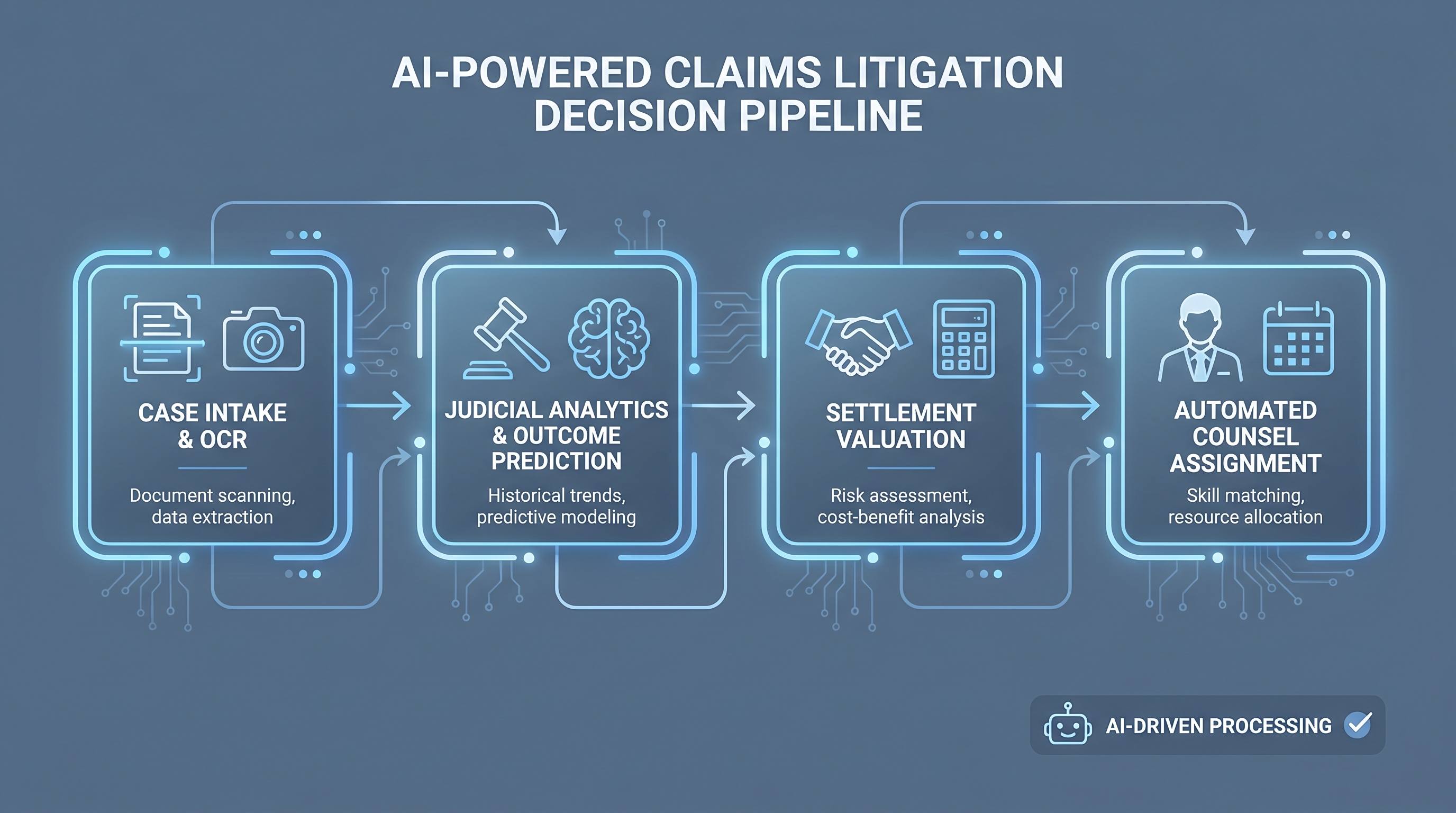
AI models analyze structured claim fields, adjuster notes, medical records, police reports, and plaintiff attorney filing patterns to identify litigation probability scores at first notice of loss. Claims matching high-litigation-propensity profiles trigger automatic reserve strengthening, early counsel assignment, and proactive investigation workflows before legal costs compound.
Judicial trend models analyze verdict histories, venue-specific jury award patterns, and assigned judge characteristics to calibrate expected litigation costs by jurisdiction. A commercial auto claim filed in a plaintiff-favorable jurisdiction receives a materially different reserve and settlement authority than an identical claim filed in a defense-favorable forum.
!AI-Powered Claims Litigation Management Workflow
Predictive Settlement Timing Optimization
AI settlement timing models integrate claim maturity indicators, opposing counsel filing velocity, and macroeconomic signals to recommend optimal settlement windows. Settling a claim six months before trial in a venue with historically rising jury awards produces materially better outcomes than waiting for pre-trial mediation. AI workers continuously update settlement recommendations as case facts evolve, rather than relying on static periodic reserve reviews.
Automated Legal Bill Auditing and Fraud Detection
Legal bill review is a high-volume, low-complexity task that consumes significant claims management resources. AI workers audit every invoice line against agreed billing guidelines, flag duplicate time entries, identify block billing violations, and surface partner rate substitution for paralegal-level work. Automated auditing recovers an average of 12 to 18 percent of gross legal spend without requiring manual review of compliant invoices.
Intelligent Counsel Matching and Panel Optimization
Not all defense counsel perform equally across claim types, jurisdictions, and opposing counsel combinations. AI models analyze historical case outcomes, average defense costs, and time-to-resolution across hundreds of counsel-matter combinations to recommend optimal panel assignments. Counsel with demonstrated competency in specific claim categories and venues are prioritized for matching, while underperformers are flagged for panel review.
Quantified Enterprise Impact
!Claims Litigation Management Metrics
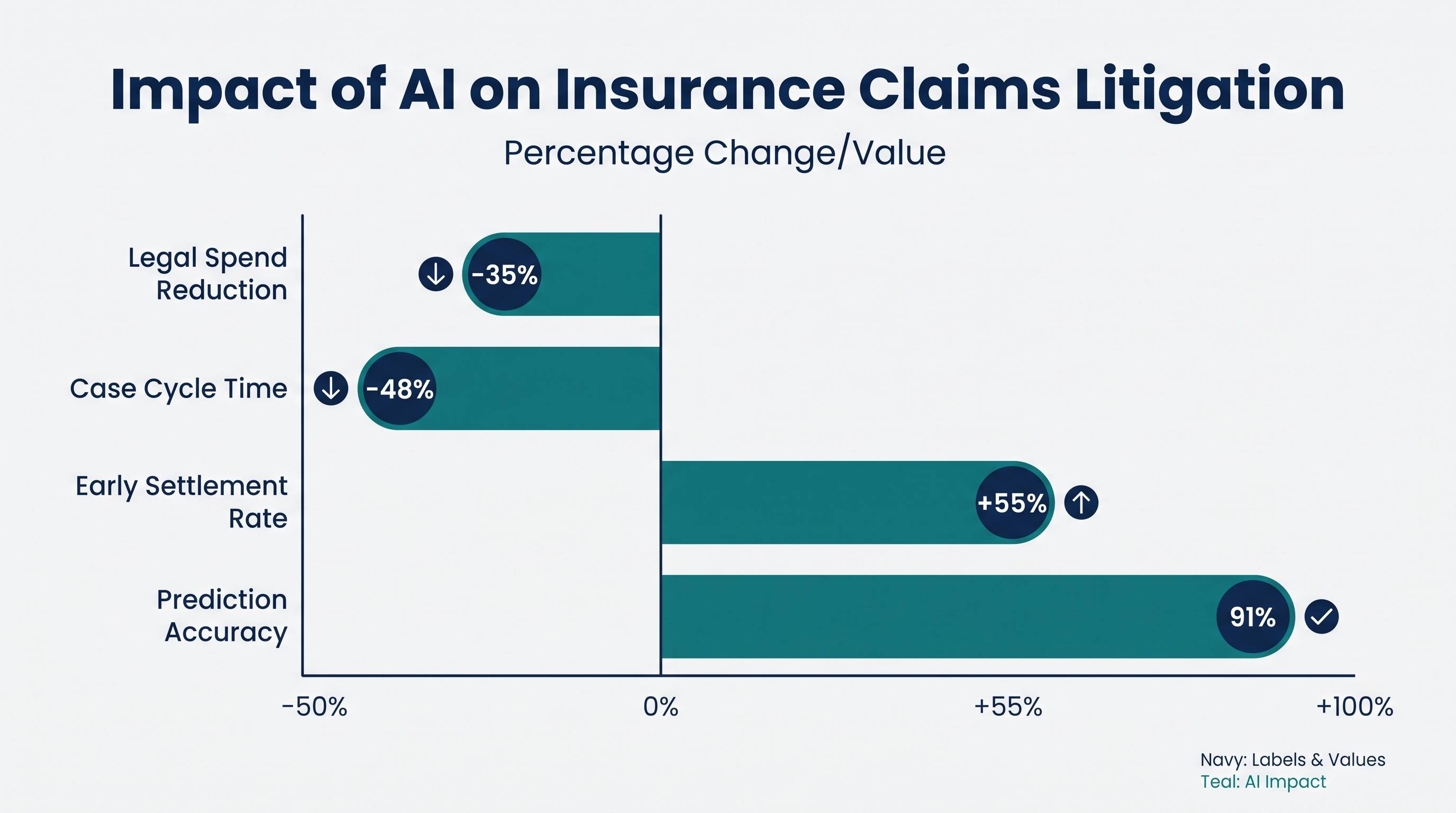
P&C insurers deploying AI-powered litigation management platforms report:
- 35 percent reduction in defense legal spend through automated billing audits and counsel optimization.
- 28 percent improvement in reserve accuracy from litigation trigger models and judicial trend analysis.
- 40 percent faster claim resolution for litigated matters through optimized settlement timing.
- .8M average annual savings per 10,000 litigated matters.
Implementation Roadmap
Phase 1 (Weeks 1-6): Integrate claims management system data. Deploy litigation propensity scoring models trained on 3 to 5 years of historical claim outcomes.
Phase 2 (Weeks 7-12): Activate automated legal bill auditing across all panel firms. Build judicial trend database for top 50 venues by claim volume.
Phase 3 (Weeks 13-20): Enable counsel matching optimization. Deploy settlement timing recommendation engine with adjuster workflow integration.
This article was written with AI assistance. | La rédaction de cet article a été assistée par IA.